AstraZeneca's Proprietary ADC Pipeline Emerges from Daiichi Sankyo's Shadow with Promising Clinical Data

AstraZeneca
Biopharmaceutical Manufacturer
AstraZeneca, the British pharmaceutical giant, holds a leading position in the highly sought-after ADC field. However, its achievements to date have primarily come from its collaboration with Japanese company Daiichi Sankyo, rather than from research and development within its own laboratories.
However, this situation is expected to change in the future.
Recently, AstraZeneca announced the early clinical data of its two self-developed ADC drugs at the ESMO conference: B7-H4-targeted ADC drug AZD8205 and FRα-targeted ADC drug AZD5335.
Two Self-Developed ADCs Debut at ESMO
AZD8205 is a B7-H4-targeted ADC developed by AstraZeneca based on its proprietary TOP1i platform. It connects the B7-H4 monoclonal antibody INT016 with the novel topoisomerase 1 inhibitor (TOP1i) AZ'0132 via a cleavable linker, with a DAR value of 8.
B7-H4 is highly expressed in a variety of solid tumors (endometrial cancer, ovarian cancer, breast cancer, cholangiocarcinoma, etc.), while its expression is limited in normal tissues. This characteristic makes B7-H4 a promising ADC target.
Currently, the B7-H4 ADCs under research include AstraZeneca's AZD8205, Hansoh Pharma/GCK’s HS-20089, BeiGene/DualityBio’s BG-C9074, and Pfizer's Felmetatug vedotin acquired from Seagen. Among them, AstraZeneca's AZD8205 is in the first tier of development.
Table 1 B7-H4 ADC Drugs Under Research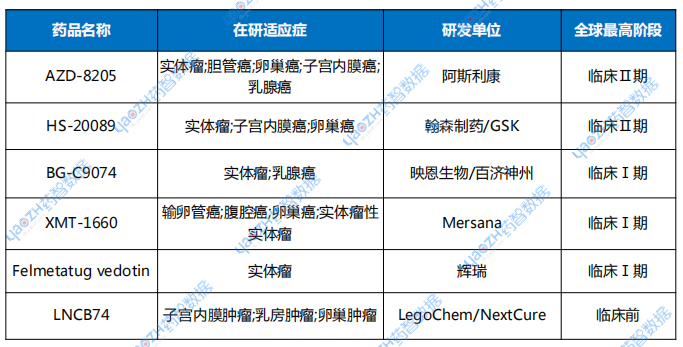
Data Source: Pharmcube Data
At the 2024 ESMO Congress, AstraZeneca presented the dose-escalation results from the BLUESTAR I/IIa trial of AZD8205 in patients with advanced/metastatic solid tumors.
As of February 23, 2024, 46 patients had received AZD8205 treatment, and the results showed:
97.8% of patients experienced treatment-emergent adverse events (TEAEs) of any grade, with the most common being nausea (58.7%), neutropenia (56.5%), and anemia (50.0%). Two patients (4.3%) discontinued treatment due to TEAEs. Two patients experienced dose-limiting toxicity at the 3.2 mg/kg dose.
Among 43 patients treated with ≥1.6 mg/kg doses, partial responses were confirmed in 9 patients with ovarian, breast, or endometrial cancer (20.9%), but no responses were observed in patients with cholangiocarcinoma.
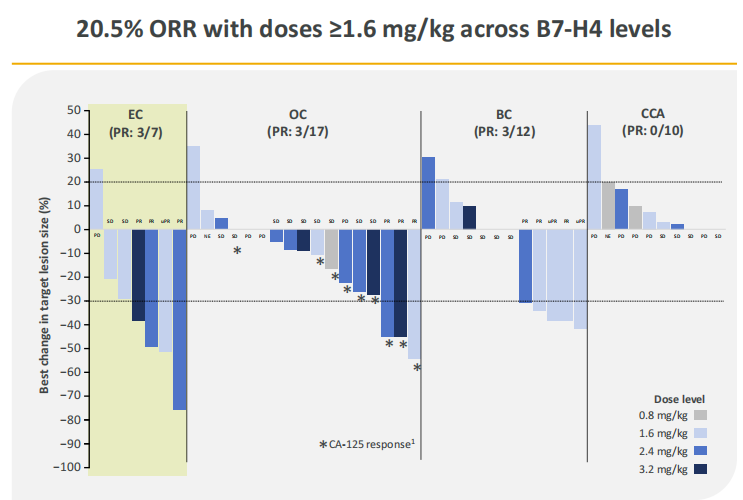
Image Source: AstraZeneca
Researchers believe that AZD8205 has manageable safety and demonstrates treatment potential in patients with advanced or metastatic solid tumors.
AstraZeneca is currently conducting a Phase 2 dose-expansion cohort study of AZD8205 monotherapy in patients with endometrial cancer, ovarian cancer, breast cancer, and biliary tract cancer, as well as a dose-escalation study of AZD8205 in combination with the PD-1xTIGIT bispecific drug rilvegostomig.
In addition, AstraZeneca also announced the preliminary clinical research results of another self-developed ADC drug, AZD5335, in ovarian cancer patients.
AZD5335 is a folate receptor α (FRα)-targeted ADC drug carrying a TOP1i payload.
Elahere (mirvetuximab soravtansine), which targets the same site as AZD5335, was granted accelerated approval by the FDA in November 2022 for the treatment of patients with advanced ovarian cancer who have been treated and exhibit high FRα expression and resistance to platinum-based therapies. This is also the first ADC drug approved by the FDA for platinum-resistant ovarian cancer. In 2023, AbbVie acquired ImmunoGen for $10.1 billion, gaining ownership of Elahere. This year, Elahere received full approval from the U.S. FDA in the field of ovarian cancer. However, AstraZeneca believes that AZD5335 may be more effective than Elahere in patients with low FRα expression.
According to the data published by AstraZeneca, responses were observed at all dose levels of AZD5335, with an overall ORR of 34.2%. In patients with high FRα expression, the ORR was 46.2%, while in patients with low FRα expression, the ORR was 35.7%. After excluding the lowest dose, the ORRs increased to 55.6% and 41.7%, respectively.
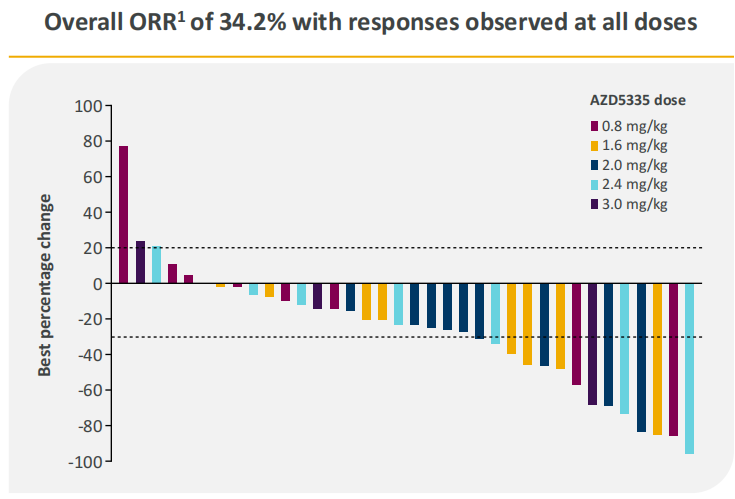
Image Source: AstraZeneca
In contrast to Elahere, the ORR was 31.7% in the SORAYA trial, which supported its approval, for ovarian cancer patients with high FRα expression. Thus, the preliminary data of AZD5335 suggests it may be competitive, but the current number of patients included in the analysis is limited, and further clinical data are awaited.
The pharmacokinetics of the two investigational drugs, AZD8205 and AZD5335, both support once every three weeks dosing, which is the same as the dosing regimen of the approved ADCs (including Elahere and Enhertu from AstraZeneca and Daiichi Sankyo), indicating that AstraZeneca's linker-payload platform has acceptable stability.
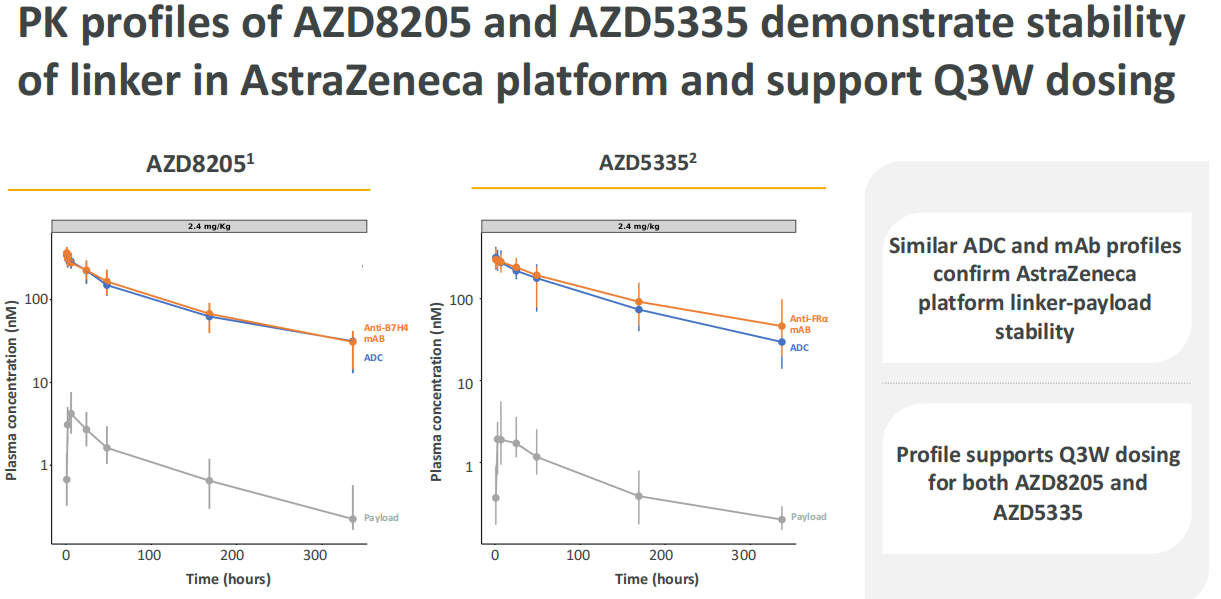
Image Source: AstraZeneca
Betting on Multiple Platforms: AstraZeneca's Anxiety and Ambition
Oncology is a key focus area for AstraZeneca, and AstraZeneca regards ADC as the key development direction in the oncology field for the next stage.
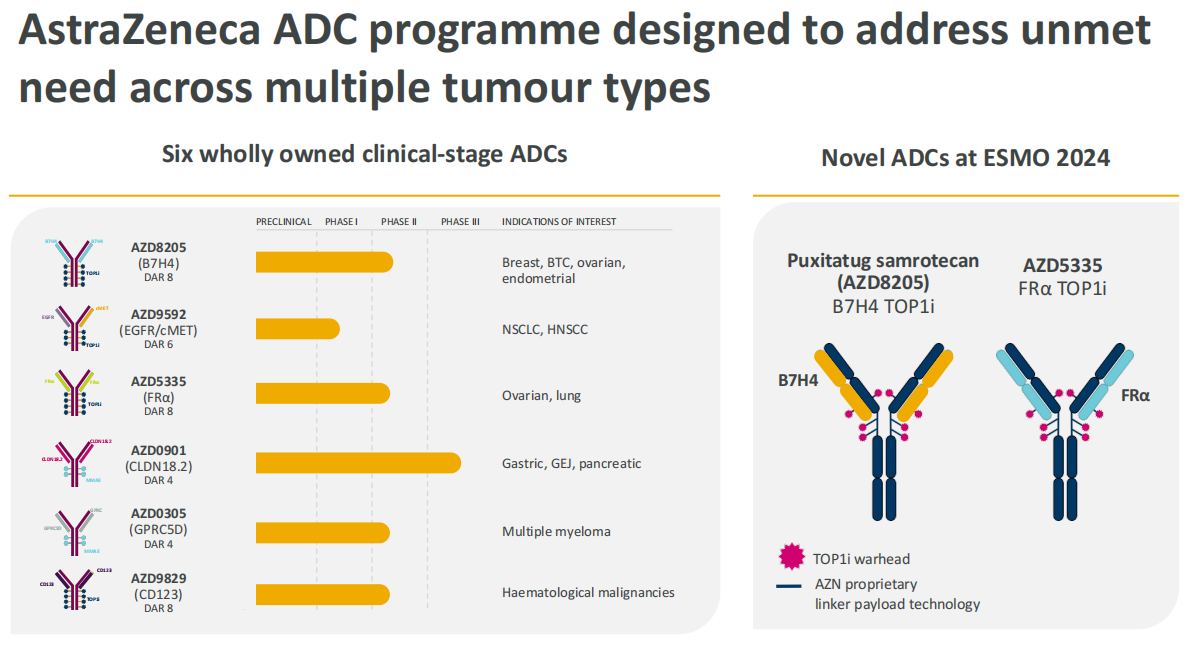
Image Source: AstraZeneca
Among them, Enhertu (T-DXd, trastuzumab deruxtecan), developed in collaboration with Daiichi Sankyo, has become the highest-selling ADC drug globally, with sales reaching $2.566 billion in 2023 and $1.772 billion in the first half of this year, representing a 52% year-over-year increase.
However, another Trop-2 ADC candidate drug from AstraZeneca and Daiichi Sankyo's collaboration, Dato-DXd (DS-1062a), has not been as fortunate, encountering setbacks in both non-small cell lung cancer and breast cancer fields.
Recently, AstraZeneca announced the phase III TROPION-Lung01 study data of Dato-DXd as a second-line treatment for NSCLC at the 2024 WCLC conference. The results showed that in the overall patient analysis, the median OS was 12.9 months vs 11.8 months in the Dato-DXd group and docetaxel group, respectively, with an HR of 0.94, which did not reach statistical significance.
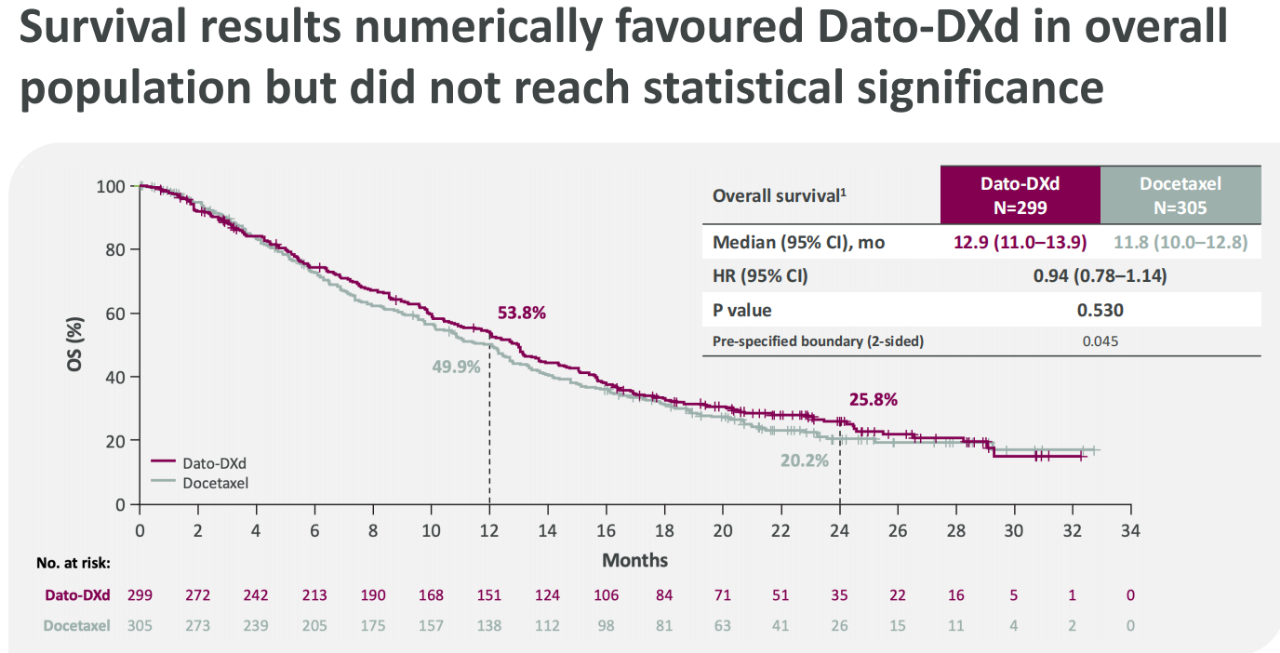
Image Source: AstraZeneca
In the squamous NSCLC subgroup, consistent with previous analyses, no improvement in OS was observed.
In the highly anticipated non-squamous subgroup, although the OS in the Dato-DXd group improved by 2.3 months compared to the docetaxel group (14.6 months vs. 12.3 months), the HR=0.84 (0.68, 1.05) was lower than the interim OS HR of 0.77 (0.59, 1.01) reported at ESMO 2023 and the HR of 0.79 (0.60, 1.02) at ELCC 2024. Moreover, the KM curves almost overlapped again in the last few months, adding uncertainty to whether regulatory approval can ultimately be obtained.
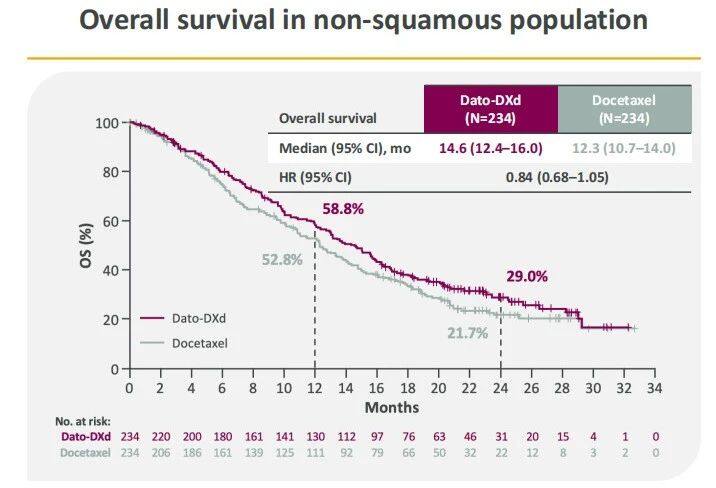
Image Source: AstraZeneca
In terms of safety, Dato-DXd also does not have an advantage, as the TROPION-Lung01 study reported seven patient deaths due to interstitial lung disease (ILD).
On September 23, 2024, AstraZeneca announced that the phase 3 clinical trial TROPION-Breast01 of Dato-DXd for the treatment of HR+/HER2-low or negative breast cancer did not meet the primary endpoint of OS.
The failure of these two clinical trials has undoubtedly cast a shadow over the future of Dato-DXd.
However, AstraZeneca's layout in ADC is by no means reliant solely on Daiichi Sankyo.
In addition to the collaboration with Daiichi Sankyo, AstraZeneca introduced two clinical-stage ADC projects from Chinese biotech companies in 2023: CMG901 (AZD0901), a CLDN18.2-targeted ADC drug developed by Connaught/LePu Biotech, and LM-305 (AZD0305), a GPRC5D-targeted ADC drug developed by Limei Pharmaceuticals.
Moreover, as mentioned earlier, AstraZeneca's self-developed ADC technology platform has entered the harvest period, with four products—AZD8205, AZD5335, AZD9829, and AZD9592—now in the clinical stage.
Table 2 AstraZeneca's ADC Pipeline Under Development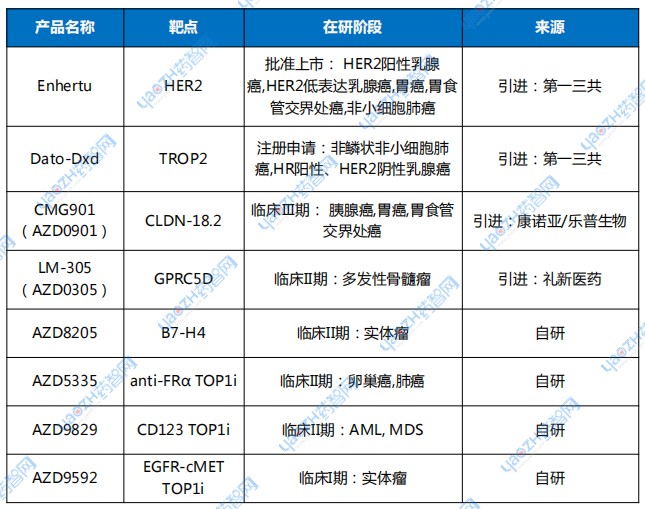
Data Source: Compiled from public information
DCMG901(AZD0901)
This drug is an ADC targeting Claudin 18.2, conjugated with the payload monomethyl auristatin E (MMAE) through a linker. In February 2023, AstraZeneca obtained global rights to this product through an exclusive global licensing agreement worth over $1.1 billion with Keymed Biosciences and Lepu Biopharma.
The drug is currently undergoing international, multi-center Phase III trials (CTR20240730, NCT06346392) to evaluate its efficacy and safety in patients with CLDN18.2-expressing advanced gastric cancer.
LM-305(AZD0305)
This drug is a novel GPRC5D-targeted antibody-drug conjugate with first-in-class molecular potential, consisting of an anti-GPRC5D monoclonal antibody, a protease-cleavable linker, and a cytotoxic payload monomethyl auristatin E (MMAE). AZD0305 is also an ADC product introduced by AstraZeneca in 2023, originally developed by Limin Pharmaceuticals, with an agreement amount of $600 million.
AZD9829
This is a CD123 TOP1i ADC drug independently developed by AstraZeneca, currently in Phase II clinical trials.
AZD9592
This is a self-developed EGFR/c-Met bispecific antibody-drug conjugate (ADC) by AstraZeneca, also utilizing the TOP1i payload.
Osimertinib is the leading third-generation EGFR inhibitor and also AstraZeneca's best-selling oncology drug. Addressing EGFR-TKI resistance is a key focus in the development of next-generation lung cancer drugs, where Johnson & Johnson's EGFR/c-MET bispecific antibody Amivantamab has shown strong performance, with the potential to succeed osimertinib.
AstraZeneca has chosen the EGFR/c-Met bispecific antibody-drug conjugate (ADC) to address the issue of osimertinib resistance. The drug is currently in Phase I clinical trials.
Expand Self-Production Capacity
In recent years, AstraZeneca has created the star ADC drug—Trastuzumab Deruxtecan (Enhertu, DS-8201) through its collaboration with Daiichi Sankyo. Another ADC drug from their partnership, DS-1062 (Dato-DXd), has also gained significant attention. However, AstraZeneca's ambitions in the ADC field do not stop there.
The latest data released by AstraZeneca shows that its self-developed ADC also has good potential.
In terms of R&D, AstraZeneca has become an undisputed leader in the ADC field through both acquisition and self-research. On the production side, AstraZeneca is also expanding its territory.
In May this year, AstraZeneca announced that it would spend 1.5 billion US dollars to build an ADC production base in Singapore. AstraZeneca stated in the announcement that the Singapore production base would become the company's first facility capable of completing end-to-end ADC drug production, from clinical to commercial scale.
ADC drugs are mainly composed of three parts, including specific monoclonal antibodies, small-molecule cytotoxins, and the linkers that connect them. Their production requires capabilities in all three fields, and due to the diversity in composition, it leads to diverse and complex process development with high production difficulty. Currently, there are only a few companies globally with ADC production capabilities. AstraZeneca's establishment of its own ADC production base will ensure a robust supply of its ADC products.
References:
1. "AstraZeneca's ADC Portfolio: Star Drug Leading a New Chapter in the Industry," Boyao
2. "Earthquake in the CXO Industry: AstraZeneca Decides to Build Its Own ADC Production Line," Jian Shi Ju
3.https://www.fiercebiotech.com/biotech/astrazeneca-steps-out-daiichis-shadow-posting-data-house-rivals-abbvie-and-pfizer-adcs

Editor: Liuli
Disclaimer: The views expressed in this article are solely those of the author and do not represent the position of Pharma Intelligence. We welcome discussions and additional insights in the comment section; for reprints, please be sure to credit the author and source. If there are any issues regarding the content, copyright, or other aspects of the work, please leave a message on this platform, and we will address it promptly.