

Janssen Submits BLA for Subcutaneous Amivantamab, a First-in-Class EGFR/c-MET Bispecific Antibody with 5-Minute Administration Time

Johnson & Johnson
Healthcare Product Manufacturers, Health Service Providers

Source: PharmaCube Info
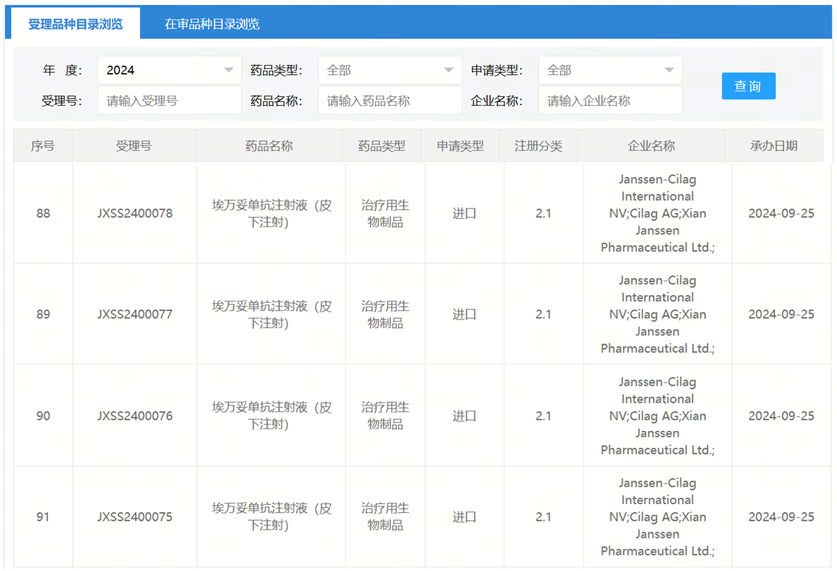
On September 25, the official website of the Center for Drug Evaluation (CDE) under the National Medical Products Administration (NMPA) showed that Johnson & Johnson's Amivantamab Injection (Subcutaneous Injection) marketing application has been accepted. This marks the first time that the subcutaneous injection formulation of Amivantamab has been submitted for marketing in China.
Data from the Phase III PALOMA-3 study (NCT05388669) showed that, in patients with non-small cell lung cancer (NSCLC) harboring epidermal growth factor receptor (EGFR) exon 19 deletions or L858R mutations, the objective response rate (ORR 30.1% vs 32.5%) of subcutaneous (SC) administration of amivantamab was comparable to intravenous (IV) infusion. SC amivantamab also significantly reduced administration time (completed within approximately 5 minutes), decreased infusion-related reactions by 5-fold, while extending overall survival, progression-free survival (mPFS of 6.1 months vs 4.3 months), and duration of response.
On June 17 this year, Johnson & Johnson announced the submission of a Biologics License Application (BLA) to the FDA for the subcutaneous injection formulation of amivantamab, covering all indications previously approved or submitted for the intravenous formulation of amivantamab.
Amivantamab is a fully human bispecific antibody targeting EGFR and MET, with immune cell-directed activity.FDA has approved intravenous RYBREVANT (amivantamab) in combination with chemotherapy (carboplatin + pemetrexed) for the first-line treatment of locally advanced or metastatic NSCLC with EGFR exon 20 insertion mutations, in combination with the third-generation EGFR inhibitor Lazcluze (lazertinib) for the first-line treatment of locally advanced or metastatic NSCLC with EGFR exon 19 deletions or exon 21 L858R substitution mutations, and in combination with chemotherapy (carboplatin + pemetrexed) for the second-line treatment of locally advanced or metastatic NSCLC with epidermal growth factor receptor (EGFR) exon 19 deletions (ex19del) or L858R substitution mutations, among other indications.
Disclaimer:
The content of the article is for reference only and does not constitute investment advice. Investors who take action based on this information bear their own risks. The article maintains a neutral stance on the statements and viewpoints expressed, and does not provide any explicit or implicit guarantees regarding the accuracy, reliability, or completeness of the content. Readers are advised to use it solely as a reference and assume full responsibility for their actions. The various articles published by this public account aim to share information; if there is any infringement, please contact us, and we will delete the content.


Booths for the Class of 2024 are now available for booking!
(Sponsorship forms include but are not limited toSpeaking slots, exhibition booths, color pages in conference proceedings, dinner sponsorship, promotional conference materials, etc.)
Scan to consult immediately!

Phone: 13816031174