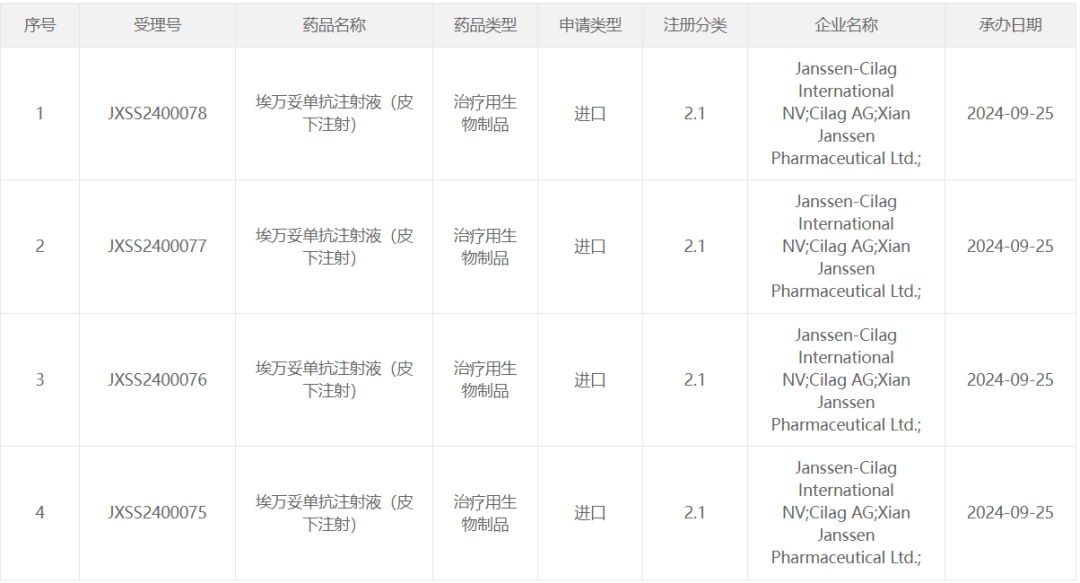
On September 25, the CDE website showed that Johnson & Johnson's EGFR×c-Met bispecific antibodyAmivantamab Injection (Subcutaneous Injection)Has been submitted for marketing approval in China and has been accepted. In June this year, the subcutaneous injection formulation of Amivantamab was submitted to the US FDA for marketing approval, intended for the treatment ofEGFR-Mutant Non-Small Cell Lung Cancer。 Clinical trial data show that subcutaneous injection of AmivantamabMedian dosing time reduced to 4.8 minutes, while the intravenous versionAmivantamabThe median administration time is 5 hours. Moreover, compared with intravenous infusion,Subcutaneous injection of Amivantamab group appearedAdverse Reaction Rate (ARR) andPatients with venous thromboembolism (VTE) are also fewer. Screenshot source: CDE official websiteAmivantamab is the world's first approved EGFR×c-Met bispecific antibody. Its intravenous injection formulation has been approved for marketing in the United States and the European Union for multiple indications, including:
Monotherapy for the treatment of EGFR ex20ins mutant NSCLC (second-line);
In combination with carboplatin and pemetrexed for EGFR ex20ins mutation NSCLC (first-line);
In combination with standard chemotherapy for the treatment of locally advanced or metastatic NSCLC (second-line) with EGFR exon 19 deletion (ex19del) or L858R substitution mutation;
In combination with Lazertinib for the first-line treatment of locally advanced or metastatic NSCLC with EGFR exon 19 deletion or exon 21 L858R substitution mutation (This indication is only approved in the United States.)。
In China, multiple marketing applications for the intravenous version of Amivantamab have been submitted.Its first application was accepted by the CDE in October 2023, and the Insight database predicts that the application is expected to be approved in the first quarter of next year.。 The subcutaneous injection formulation of Amivantamab is the subject of this marketing application. In June this year, Johnson & Johnson submitted the BLA for the subcutaneous injection formulation of Amivantamab to the FDA.Applications for the treatment of intravenous versions of Amivantamab that have been approved or submitted in their entirety NSCLC Indications。 At the 2024 ASCO Annual Meeting, researchers announcedPhase ⅢPALOMA-3 Study (NCT05388669)Data. The PALOMA-3 study aims to evaluateSubcutaneous Injection of Amivantamab + LazertinibAndIntravenous injection of Amivantamab + Lazertinib, Progression after Osimertinib and chemotherapy treatmentIn patients with EGFR-mutated advanced or metastatic NSCLCThe pharmacokinetics (PK), efficacy, and safety. Among them, Lazertinib is a third-generation EGFR-TKI developed by Johnson & Johnson. Phase III PALOMA-3 study data show,Subcutaneous injection of Amivantamab shows an overall response rate comparable to intravenous administration, while significantly shortening administration time, reducing infusion-related reactions by fivefold, and demonstrating longer overall survival, progression-free survival, and duration of response.Specifically:
The ORR of the subcutaneous injection group was 30%, and the ORR of the intravenous injection group was 33%. In terms of median PFS, the subcutaneous injection group had 6.1 months, significantly longer than the 4.3 months in the intravenous injection group.
Compared with the intravenous injection group, fewer patients in the subcutaneous injection group experienced infusion-related reactions and venous thromboembolism.
Subcutaneous Injection of AmivantamabMedian infusion time for the first infusion reduced to 4.8 minutes(Range 0-18), intravenous injection of AmivantamabMedian infusion time for the first infusion reduced to 5 hours(Range: 0.2-9.9).
On Day 1 of Cycle 1, 85% and 52% of patients in the subcutaneous injection group and intravenous injection group, respectively, found the treatment convenient; the treatment rates at the end of the treatment were 85% and 35%, respectively.

Overall, the study concluded that subcutaneous administration of amivantamab + lazertinib is non-inferior to intravenous administration of amivantamab + lazertinib, with consistent safety, reduced infusion-related reactions (IRR), and increased convenience as well as prolonged survival. In addition, researchers also evaluated in the Phase Ⅱ study PALOMA-2 (NCT05498428),Subcutaneous Injection of Amivantamab in Combination with Lazertinib and/or Chemotherapy as First-Line Treatment for Patients with EGFR-Mutated Advanced or Metastatic NSCLCEfficacy, safety, and PK. Data presented at the 2024 ASCO meeting showed,Subcutaneous injection of Amivantamab + Lazertinib shows a response rate similar to historical intravenous Amivantamab + Lazertinib in the first-line treatment of EGFR-mutant NSCLC, with improved safety., including a significantly reduced rate of drug-related reactions (ARR). Additionally, prophylactic anticoagulation can be safely implemented and reduce the incidence of venous thromboembolism (VTE). Insight database shows,Globally, more than ten drugs targeting both EGFR and c-MET have entered the clinical application stage or above., Drug types includeBispecific antibodies, trispecific antibodies, antibody-drug conjugates (ADC),But so far, only Amivantamab has been approved for marketing. To learn more about the research and development progress of EGFR and c-MET targeted drugs, please click on the video below.
Cover Source:Company LogoDisclaimer:This article is for information sharing only, and does not represent the position or viewpoint of Insight. It does not recommend or introduce any treatment plans. If you have any needs, please consult and contact正规医疗机构. Editor:XinyaoPR Article Coordination: WeChat insightxbSubmissionWeChat: insightxb; Email: insight@dxy.cn Diversified functions, traceable data……Insight Database Web Version Awaits Your Experience Click to read the original text,ImmediatelyUnlock!