Johnson & Johnson Exits Cardiovascular and Metabolism Therapeutic Areas Amid Strategic Restructuring

Johnson & Johnson
Medical Device R&D and Manufacturer
The adjustment of MNC's global market strategy often brings changes to the Chinese market, followed by changes in its China business structure and senior management.
Johnson & Johnson Business Adjustment
Closure of Two Major Departments
On September 25, according to foreign media Endpoints, Johnson & Johnson is closing its cardiovascular and metabolic drug division within its pharmaceutical sector.
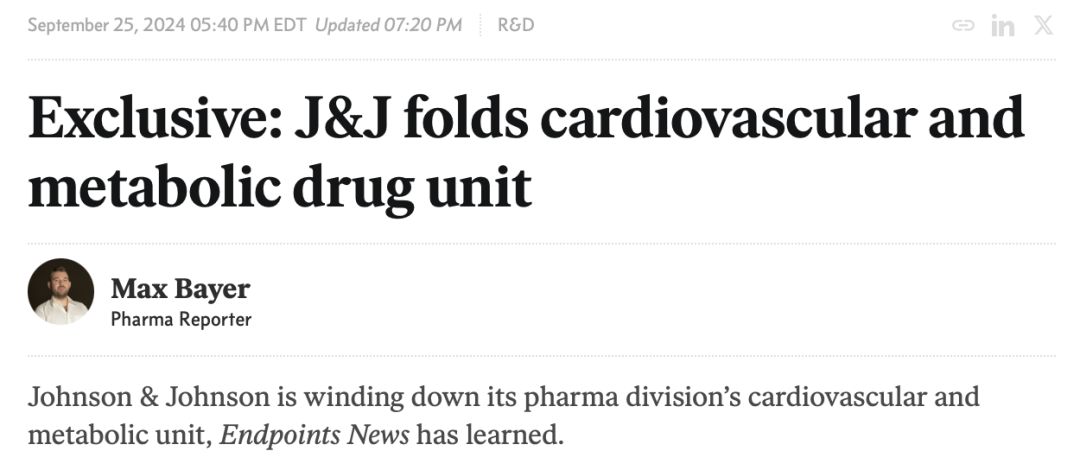
This is the second major restructuring since Johnson & Johnson closed its infectious diseases and vaccines division. Starting last year, Johnson & Johnson gradually de-emphasized cardiopulmonary and metabolic work. Under these changes, Johnson & Johnson has narrowed its R&D focus to three therapeutic areas: oncology, immunology, and neuroscience.
This restructuring primarily impacts the commercial operations (sales, marketing, and medical affairs teams) of the cardiovascular division, rather than R&D. Currently, it appears that the cardiovascular division of Johnson & Johnson's medical device sector has not been affected, as its acquisition activities continue unabated.
The core product of Johnson & Johnson's cardiovascular and metabolic drug division is Xarelto (Rivaroxaban), which was once one of the world's best-selling anticoagulant drugs, jointly developed by Johnson & Johnson and Bayer.
In August this year, according to the U.S. Inflation Reduction Act (IRA), Xarelto was included in the list of the first 10 drugs that need to undergo Medicare price negotiations. The U.S. government negotiated a 62% reduction in the price of the drug, but this does not include the cost after rebates or discounts.
The financial report for the first half of 2024 showed that the global sales of Johnson & Johnson's Xarelto were $1.105 billion, a year-on-year decrease of 9.1%; the global sales of Bayer's Xarelto were $1.83 billion, a year-on-year decrease of 4.8%.
Taking the field of metabolic diseases as an example, which is currently a hot area of competition among pharmaceutical companies worldwide, it seems that everyone is positioning themselves in "GLP-1." Johnson & Johnson's exit may indicate its determination to change.
This year, Johnson & Johnson has not stopped adjusting its pace. In February, Johnson & Johnson announced the closure of a nearly 200,000-square-foot R&D base (San Francisco Bay Area Campus) located in Brisbane, California. This base had been in operation for less than 18 months since its official opening in September 2022.
Johnson & Johnson is striving to adjust its business structure and strategic direction. However, while making these changes, how to balance business adjustments with employee interests may be a question that Johnson & Johnson needs to consider carefully.
Global Market
MNC's Transformation in China
Facing changes in the global and Chinese markets, large pharmaceutical companies have never paused their business or structural adjustments; Bayer, AstraZeneca, Novartis, and Pfizer are all undergoing changes.
Taking AstraZeneca as an example, this year, AstraZeneca China's structure has been adjusted at least three times. On October 1, AstraZeneca China’s biopharmaceuticals business and the full-channel division will officially merge to form the new AstraZeneca China Biopharmaceuticals Business (BBU).
Namely, merging the Respiratory Inhalation Business Unit, Respiratory Nebulization Business Unit, and Digestive Business Unit to establish the Respiratory and Digestive Business Division; merging the Biologics Business Unit, Vaccines and Immunotherapies, and Autoimmune Business Unit; merging the Biologics Business Unit, Vaccines and Immunotherapies, and Autoimmune Business Division to form the Respiratory and Autoimmune Biopharmaceuticals, Vaccines, and Immunotherapies Business Division. Through continuous adjustments, AstraZeneca believes that the new structure will add momentum to the long-term development of its business.
Pfizer adjusted its business lines in China on July 26 this year, merging the hematology oncology and rare disease teams into Pfizer China's Hospital Emergency Business Unit (HBU).
Changes in multinational pharmaceutical companies in China are closely related to their global strategies. In 2019, Pfizer announced the merger of its off-patent brands and generics business unit, Upjohn, with Mylan. Since then, Pfizer has divested several of its generic drugs to focus on innovative medicines. Returning to the China region, in March 2021, Pfizer announced the cessation of biosimilar production in China and sold its biologics manufacturing base in Hangzhou to Wuxi Biologics.
Johnson & Johnson, which has undergone business adjustments this time, faced considerable challenges in the past few years. The centralized procurement nearly affected multiple business departments of Johnson & Johnson, including orthopedics, surgery, ophthalmology, and cardiovascular. Amid changes in the global market, Johnson & Johnson's operations in China have also been continuously adjusting.
Since March this year, there have been frequent changes in the senior management of Johnson & Johnson's China region. In March, Johnson & Johnson announced the new appointment for the General Manager of its Surgical Division in China; in April, Song Weiqun, Chairman of Johnson & Johnson's China region and President of Johnson & Johnson Medical Technology China, resigned.
Johnson & Johnson's 2024 semi-annual report shows that its revenue was approximately US$43.83 billion, a year-on-year increase of 3.3%. Of this, the revenue from innovative drugs was US$28.052 billion, a year-on-year increase of 3.3%; medical technology revenue was US$15.778 billion, a year-on-year increase of 3.3%. Innovative drugs account for the main performance of Johnson & Johnson. However, from Johnson & Johnson’s mergers and acquisitions, its layout in the medical device business is gradually increasing.
Architectural changes are often accompanied by personnel realignment. Under the changes in global market strategy, will Johnson & Johnson China have corresponding adjustments in the future?
- END -