

AstraZeneca's Tagrisso Receives FDA Approval for Unresectable Stage III EGFR-Mutated NSCLC with 84% Reduction in Disease Progression or Death Risk

AstraZeneca
Biopharmaceutical Manufacturer
▎WuXiEdited by Kant Content Team
Recently, AstraZeneca announced that its epidermal growth factor receptor (EGFR) tyrosine kinase inhibitor (TKI) Tagrisso (osimertinib) has been approved by the U.S. FDA.For the treatment of adult patients with unresectable Stage III epidermal growth factor receptor-mutated (EGFRm) non-small cell lung cancer (NSCLC) who have received chemoradiotherapy (CRT).Tagrisso is indicated for EGFRm patients whose tumors have exon 19 deletions or exon 21 (L858R) mutations.
This FDA approval is mainly based onResults of the LAURA Phase 3 Clinical Trial.This is a randomized, double-blind, placebo-controlled, global multicenter Phase III trial, with participants being patients with unresectable Stage III EGFRm NSCLC whose disease has not progressed after receiving platinum-based CRT.Patients receive once-daily oral Tagrisso 80 mg until disease progression, unacceptable toxicity, or other discontinuation criteria are met.
The results assessed by the Blind Independent Central Review (BICR) showed,Compared with placebo, Tagrisso reduced the risk of disease progression or death by 84% (HR=0.16; 95% CI: 0.10-0.24; p<0.001). The median PFS for patients treated with Tagrisso was 39.1 months, compared to 5.6 months in the placebo group.The proportion of patients in the Tagrisso group and placebo group who were alive and disease-free at 12 months was 74% (95% CI: 65-80) and 22% (95% CI: 13-32), respectively. Notably,A clinically meaningful PFS benefit was observed across all predefined subgroups, including gender, race, EGFR mutation type, age, smoking history, and prior CRT.
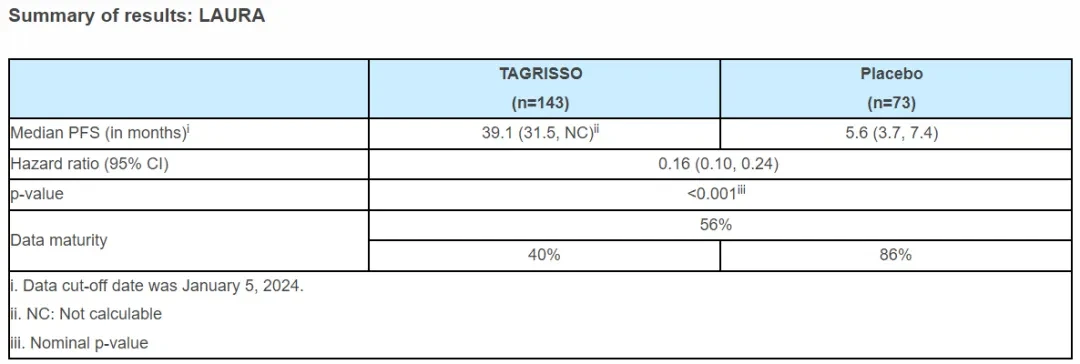
▲Summary of Efficacy Results from the LAURA Trial (Image Source: Reference [2])
When the data was released this June, the Tagrisso group also showed a favorable trend in overall survival.At 36 months, the overall survival rates for the Tagrisso group and the placebo group were 84% (95% CI: 75-89) and 74% (95% CI: 57-85), respectively. The difference was not statistically significant (HR=0.81, 95% CI: 0.42-1.56; p=0.53). However, the data were not yet mature at the time of analysis (data maturity 20%), and the trial will continue to evaluate changes in the secondary endpoint OS.
Safety results and discontinuation rates due to adverse events were as expected, with no new safety issues identified. Grade 3 or higher adverse events of any cause occurred in 35% of patients in the Tagrisso group versus 12% in the placebo group.
Tagrisso is a third-generation, irreversible EGFR-TKI that has been clinically proven to be effective in NSCLC.Tagrisso Approved Indications Include Treatment for Locally Advanced or Metastatic EGFRm NSCLC, and Adjuvant Therapy for Early-Stage (IB, II, and IIIA) EGFRm NSCLC. In August 2023, Tagrisso in combination with chemotherapy received Breakthrough Therapy Designation from the U.S. FDA as a first-line treatment for adult patients with locally advanced or metastatic EGFRm NSCLC. In February this year, Tagrisso in combination with chemotherapyFDA Approved, for the treatment of adult patients with locally advanced or metastatic EGFR-mutated non-small cell lung cancer.

▲To learn more about the application of cutting-edge technologies in the biopharmaceuticals industry, please long-press and scan the QR code above to access "WuXi Live Studio" and watch live discussions and exciting replays on related topics.


Share,PointLike,In View, Focusing on Global Biomedical Health Innovation