FDA Approves Lazertinib in Combination with Amivantamab, Extending Median PFS to Nearly Two Years in EGFR-Mutant NSCLC

Johnson & Johnson
Healthcare Product Manufacturers, Health Service Providers
 ▲October 26-27, Chengdu
Note:This article does not constitute any investment opinions or suggestions., subject to official/company announcements;This article only introduces drugs related to medical health, not a recommendation of treatment options (if involved), and does not represent the platform's position.Any article reprinted needs to be authorized.
In August, the FDA approved LAZCLUZE, developed by Johnson & Johnson, for use in combination with amivantamab as a first-line treatment for non-small cell lung cancer (NSCLC) with EGFR exon 19 deletions and exon 21 L858R mutations. The generic name of LAZCLUZE is LAZERTINIB, and it is a tablet taken orally once daily.
LAZERTINIB is a third-generation kinase inhibitor targeting EGFR exon 19 deletions and exon 21 L858R base substitution mutations, exerting anti-tumor activity at very low concentrations. Amivantamab is also an EGFR inhibitor, approved by the U.S. FDA in May 2021 for the treatment of NSCLC with EGFR exon 20 insertion mutations. When used in combination with Amivantamab, it can significantly enhance the effectiveness of LAZERTINIB against EGFR L858R mutations.
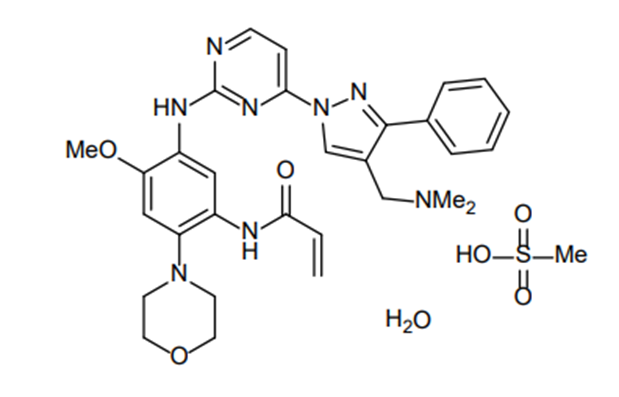
Molecular Structure of LAZERTINIB
The FDA approval of this product was based on a clinical trial named "MARIPOSA" (NCT04487080). This trial was an active-controlled study where 429 patients received LAZERTINIB + Amivantamab treatment, while another 429 patients were treated with the current best therapy, osimertinib, as the active control. Among the enrolled patients, 58% were Asian, and 38% were Caucasian. Thirty-four percent of the patients had an Eastern Cooperative Oncology Group (ECOG) performance status of 0, while 66% had a status of 1. Forty-one percent of the patients had brain metastases, and 89% were initially diagnosed at stage IV.
After treatment with LAZERTINIB + Amivantamab, 78% of patients achieved relief, of which 5% had complete relief and 73% had partial relief. The median progression-free survival (mPFS) was 23.7 months, and the median duration of response (mDoR) was 25.8 months. In the active control group (first-line treatment with Osimertinib), 73% of patients achieved relief, of which 3.5% had complete relief and 70% had partial relief. The median progression-free survival was 16.6 months, and the median duration of response was 16.7 months. Details are shown in the table below:
MARIPOSA Trial Results (FDA Label)
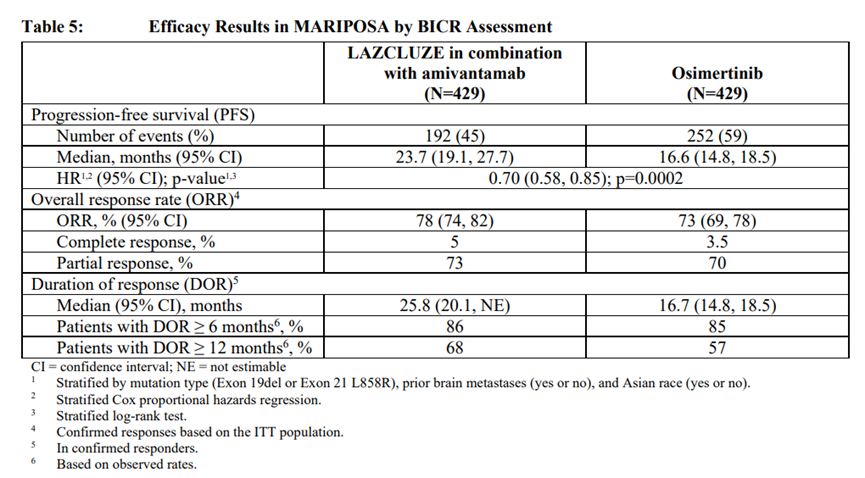
Compared to Osimertinib, the combination therapy of LAZERTINIB and Amivantamab extended progression-free survival by a full 7 months and reduced the risk of death by 30%. For patients with EGFR-positive non-small cell lung cancer, this is absolutely a godsend.Moreover, for patients with intracranial metastases, the efficacy of combination therapy appears to be superior, as detailed in the table below:
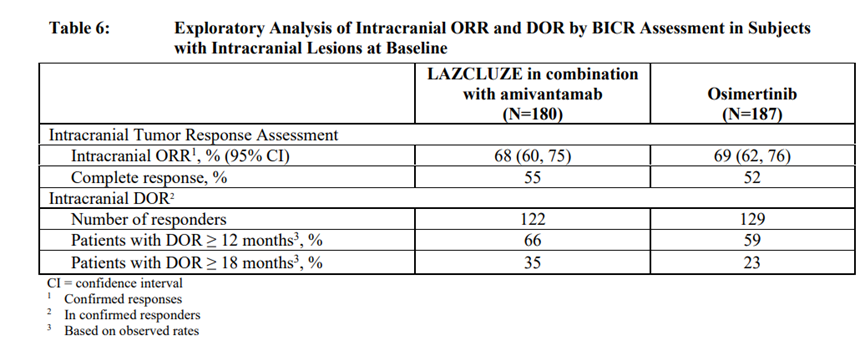
Since the endpoint of the clinical trial has not yet been reached (overall survival)Data not yet available), the final extent to which this product can extend life expectancy still requires further confirmation.
References
FDA Label:
https://www.accessdata.fda.gov/drugsatfda_docs/label/2024/219008s000lbledt.pdf
Nakajima A, Seki M, Taniguchi S, Ohta A, Gillberg PG, Mattsson JP, Camilleri M. Safety and efficacy of elobixibat for chronic constipation: results from a randomised, double-blind, placebo-controlled, phase 3 trial and an open-label, single-arm, phase 3 trial. Lancet Gastroenterol Hepatol. 2018 Aug;3(8):537-547.https://www.ncbi.nlm.nih.gov/pmc/articles/PMC8217052/
Copyright Statement: This article is reproduced fromPharmaceutical Affairs纵横,Media or individuals who do not wish to be reprinted can contact us, and we will delete it immediately.

[About PharmaCircle]
PharmaPRHub aims to assist biopharmaceutical technology enterprises in brand promotion and business development services. It provides systematic solutions based on clients' real needs, using "translation-simplification-contextualization" to communicate the brand information in a straightforward manner to the public. With access to over 1 million vertical users through various channels, it achieves cooperation objectives while helping partners complete a closed-loop marketing service from branding to business. We have successfully organized dozens of offline biopharmaceutical R&D conferences with 1,000 attendees, covering fields such as small-molecule drugs, large-molecule drugs, improved new drugs, and cross-border BD transactions, serving more than a hundred listed/unicorn/biotech/pharmaceutical companies.