BioAge Labs Raises $198M in IPO to Advance Obesity Drug Azelaprag, Doubling Initial Target

BioAge
Drug Discovery Platform Developer


On September 26, AI pharmaceutical companyBioAge LabsSuccessfully went public and landed on NASDAQ, with the ticker symbol BIOA.
On the first day of listing, BioAge Labs opened at $22.5, a 25% increase from the issue price of $18; the closing price was $18.31.
According to the previous prospectus, BioAge Labs initially planned to raise $100 million. However, BioAge Labs directly increased the scale of the offering, issuing approximately 11 million shares at $18 per share.
In other words, BioAge is expected to raise198 millionFunds in dollars, the proceeds of which will be specifically used for clinical trials of its obesity drug.
As the only AI pharmaceutical company to go public in the US stock market this year, BioAge is already tapping into the billion-dollar weight-loss drug blue ocean, sparking market anticipation.
 Backed by several well-known VCs
BioAge Labs, Inc. was founded in 2015 and is headquartered in California, USA. It was established by two PhDs from the University of Toronto, dedicated to providing solutions for human aging issues.
BioAge has built a systems biology and AI platform that leverages human datasets to identify molecular drivers of age-related pathologies, developing innovative drugs to extend human healthspan.
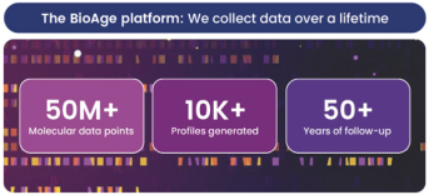
Through collaboration with Age Labs and other methods, BioAge has collected a platform containing over 50 million molecular data points, spanning 10,000 individual participant profiles and more than 50 years of follow-up data.
They use molecular analysis techniques to analyze these samples, measuring thousands of biologically relevant molecules, and then apply computational tools to the resulting data to extract potential drivers of longevity and healthy lifespan.
The core asset of BioAge Labs is an oralApelin ReceptorAzelaprag, a small molecule agonist of APJ. This is also one of the few drugs that enhances the weight loss effects of GLP-1RA without causing muscle loss.
Apelin is a substance released by the body after exercise, which helps regulate metabolism and promote muscle regeneration. BioAge discovered through big data that Apelin levels decrease with age.
Studies have found that 25% to 40% of the weight lost with semaglutide is muscle, and it also causes some harm to bones.Early clinical data for Azelaprag suggest it may help prevent muscle loss.
According to the Phase 1b clinical trial data of Azelaprag, 21 healthy subjects aged 65 and above showed statistically significant prevention of muscle atrophy after receiving Azelaprag or a placebo during 10 days of strict bed rest, with no serious side effects observed, demonstrating good safety and tolerability.
In addition,BioAge Still in the process of developing an oralBrain-Penetrant NLRP3 Inhibitor, for the treatment of diseases driven by neuroinflammation.
BioAge An IND application is expected to be submitted in the second half of 2025, with a Phase I clinical trial scheduled to begin in the first half of 2026 following approval.
Before its IPO, BioAge had completed five rounds of financing, raising a total of over 300 million US dollars.
BioAge's latest round of financing was in February this year, led by Sofinnova Investments.$170 Million Series D Financing, other investors include Eli Lilly, Amgen, RA Capital, OrbiMed, etc.
Shareholders holding more than 5% or above include a16z Bio + Health, Khosla Ventures, Sofinnova Investments, Longitude Capital, RA Capital, Cormorant Asset Management, Kaiser Permanente, and Horsley Bridge.
 U.S. Stock Market IPOs Rebound
Just days before BioAge's IPO, the Federal Reserve announced a significant 50 basis point rate cut, which directly caused the XBI (S&P Biotech Index) to rebound immediately.
The start of an interest rate cut cycle is good news for biotechnology companies.The reduction in financing costs has also made it easier for listed companies to raise funds. This may also be one of the reasons that contributed to BioAge Labs' oversubscription in financing.
Since the beginning of this year, the U.S. IPO market has shaken off last year's downturn,In the first half of 2024, a total of 10 biotech companies successfully went public, nearly equaling the total number for all of 2023, and are expected to return to the level seen in 2022.
Although the number of IPOs cannot compare with the peak years of 2020 and 2021, there is no doubt that the number of IPOs this year will continue to recover and rebound.
But AI pharmaceutical companies that have already gone public haven't been so lucky, with Schrödinger, Relay, AbCellera, and others losing most of their market value.Some have even fallen 90% from their peak.
Previously, after the two U.S.-listed AI pharmaceutical companies Recursion and Exscientia announced their merger, the boost to Recursion's stock price was very limited.
Subsequently, Recursion announced the Phase 2 data for REC-994, a small molecule drug for rare diseases. Although the drug demonstrated good tolerability and safety, its efficacy was limited. Following the release of this information,Caused Recursion's stock price to drop by more than 16%.
This also means that if no convincing drugs are presented, even with the support of an AI platform, the valuations of AI pharmaceutical companies can only fall back to the valuation level of traditional biotech companies.
A Closer Look at the Valuation Sources of BioAge LabsRather than seeing BioAge Labs as an AI + aging research company,It would be more accurate to say that it is a weight-loss drug company,After all, the market is looking forward to it.Azelaprag's success has been consistently backed by its existing shareholders.
Goldman Sachs predicts that by 2030, the size of the global obesity market may grow to$100 billionBy 2033, the market is expected to reach $150 billion.
Similarly, according to Frost & Sullivan, the global GLP-1 drug market size is expected to increase to $28.2 billion by 2025 and reach $40.7 billion by 2030.
The company has not generated any revenue to date, with a loss of $26.57 million in the first half of this year, compared to a loss of $28.27 million in the same period in 2023.
As of June 30, 2024, BioAge hasUSD 1.591 billion in cash and cash equivalents。Based on the company's current operational status, the funds after the IPO will be sufficient to support operations at least until 2027.