

Sanofi's CD38 Monoclonal Antibody Sarclisa Gains FDA Approval for First-Line Multiple Myeloma Therapy, Challenging J&J's Darzalex Dominance
Sanofi
Pharmaceutical Manufacturer
Johnson & Johnson
Medical Device R&D and Manufacturer
In the treatment field of multiple myeloma (MM), Johnson & Johnson's CD38 monoclonal antibody Darzalex (daratumumab, trade name "Jiaoke") has long occupied a dominant position in the market. However, Sanofi's Sarclisa (isatuximab) is gradually becoming a strong competitor.
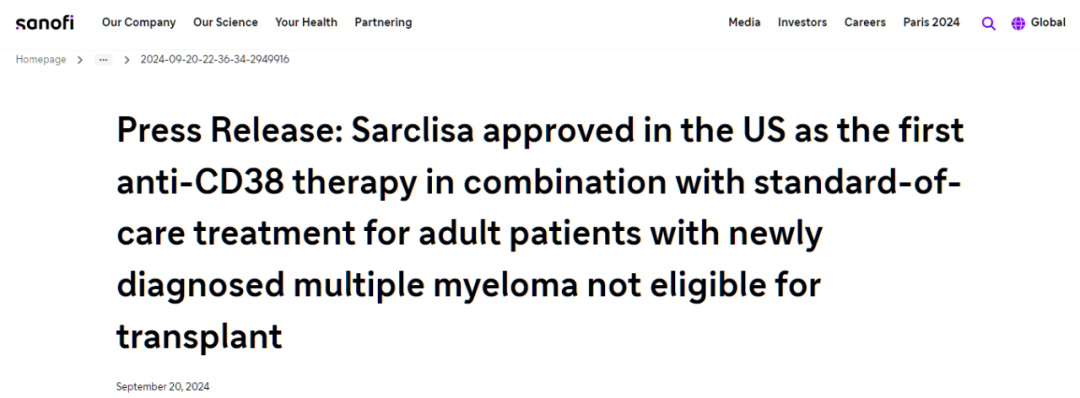
Sanofi previously announced that the supplemental Biologics License Application (sBLA) for its anti-CD38 monoclonal antibody Isatuximab has been approved by the U.S. FDA. The new therapy is: in combination with the standard treatment regimen VRd (bortezomib + lenalidomide + dexamethasone) for the treatment of adult patients with newly diagnosed multiple myeloma (NDMM) who are not eligible for transplant.
In December 2023, Sanofi submitted the marketing application for Isatuximab to the China CDE for the first time and it was accepted.As the indications further expand, the market impact of Isatuximab on Daratumumab will intensify.
Market observers believe that the CD38 monoclonal antibody market is growing rapidly. As new drugs are continuously being developed and launched, market competition is expected to become even fiercer. Sanofi's Isatuximab has the potential to reshape the current market landscape, offering patients more treatment options and posing a challenge to Johnson & Johnson’s Daratumumab’s market position.
First-line Therapy Finally Approved
Has Sanofi Successfully Overtaken?
Multiple Myeloma (MM) is a malignant disease characterized by the abnormal proliferation of clonal plasma cells. Globally, more than 130,000 new cases are diagnosed annually, ranking it second among hematologic malignancies in many countries. Despite the availability of various treatment options, MM remains an incurable and highly heterogeneous disease, with a 5-year overall survival rate of approximately 55%.
Due to the high expression of CD38 on MM cells, it has become a preferred target for antibody therapy. Isatuximab, a CD38 monoclonal antibody introduced by Sanofi from ImmunoGen (now part of AbbVie), is specifically designed to bind to a specific epitope of the CD38 receptor on the surface of MM cells, thereby triggering significant anti-tumor effects.
Isatuximab was first approved for marketing in March 2020, when the FDA approved its use in combination with pomalidomide and dexamethasone for the treatment of adult patients with relapsed or refractory MM who have undergone at least two prior lines of therapy, including lenalidomide and a proteasome inhibitor. Subsequently, in March 2021, the indications for isatuximab were further expanded when the FDA approved its use in combination with carfilzomib and dexamethasone for the treatment of adult patients with relapsed or refractory MM after one to three prior lines of therapy. Currently, isatuximab has been approved in more than 50 countries/regions worldwide, and the most recent approval marks its third indication in the United States.
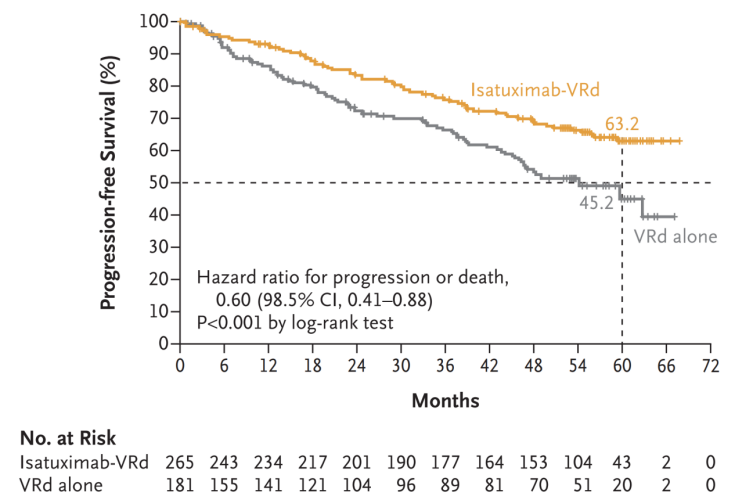
The FDA's approval this time is mainly based on the positive results of the Phase III IMROZ study. The study enrolled 446 adult patients with NDMM who were not eligible for transplantation, and the primary endpoint assessed was progression-free survival (PFS).
In the IMROZ study, compared with the treatment regimen of VRd (bortezomib, lenalidomide, and dexamethasone) followed by Rd (lenalidomide and dexamethasone) maintenance therapy, the combination of isatuximab with VRd followed by isatuximab plus Rd maintenance therapy successfully achieved the primary endpoint of progression-free survival (PFS). Compared with the control group, the combination therapy using isatuximab significantly reduced the risk of disease relapse or death by 40% (HR=0.60; 95% CI: 0.44-0.81, p=0.0009). At a median follow-up time of 59.7 months, the median PFS in the isatuximab combination therapy group had not yet been reached, while the median PFS in the active control group was 54.3 months. Additionally, at 60 months, the estimated progression-free survival rate in the isatuximab combination therapy group was 63.2%, compared to 45.2% in the control group.
In addition, 74.7% of patients treated with the isatuximab combination therapy achieved a complete response (CR) or better, compared to 64.1% in the VRd group.55.5% of patients treated with the isatuximab combination therapy achieved minimal residual disease (MRD)-negative CR, compared to 40.9% in the VRd group.
Another IsaFiRsT study targeting patients with relapsed or refractory multiple myeloma (RRMM) was recently published. This is the first real-world study assessing the therapeutic efficacy of the combination therapy of isatuximab with pomalidomide and dexamethasone (Isa-Pd) in Chinese patients, and serves as an innovative drug registration study. The study met its primary endpoint, achieving an objective response rate (ORR) of 82.6%.
Industry experts believe that, with Sanofi's Isatuximab receiving FDA approval for first-line treatment of MM, it will challenge Johnson & Johnson's Daratumumab leading position in the global market.
CD38: A Battle Between Two Powerhouses
Has Johnson & Johnson Lost the Initiative?
In the MM treatment field, Johnson & Johnson's daratumumab is undoubtedly the main competitor of Sanofi's isatuximab.
Since daratumumab was approved by the U.S. FDA as the world's first CD38 antibody in 2015, it has been used to treat patients with relapsed and refractory multiple myeloma and quickly became a market leader. Daratumumab has demonstrated outstanding market performance and has been approved for use in multiple treatment phases, including first-line, second-line, and multi-line therapies. Its indications have even expanded to include the treatment of light chain amyloidosis. To enhance treatment convenience, the subcutaneous injection formulation of daratumumab was approved in the U.S. in May 2020.
Since its launch, the sales of Daratumumab have been increasing year by year, becoming an important growth engine for Johnson & Johnson's oncology business. In its fifth year on the market, sales reached $4.19 billion in 2020, a year-on-year increase of 39.8%; in 2023, Daratumumab's sales reached $9.744 billion, a year-on-year increase of 22.2%; in 2024...In the first half of the year, its global sales reached 5.57 billion U.S. dollars, increasing by 18.6% year-on-year. At this growth rate, daratumumab is expected to break through 10 billion U.S. dollars in sales this year.
Johnson & Johnson Chairman and CEO Joaquin Duato said that Johnson & Johnson expects its multiple myeloma franchise to generate a total of $25 billion in revenue, with one-half of patients eventually receiving treatment from Johnson & Johnson's multiple myeloma drugs.
On the other hand, Sanofi's Isatuximab has experienced relatively slow growth since its launch in 2020, with global sales of 176 million euros, 294 million euros, and 381 million euros from 2020 to 2023 respectively. In the first half of 2024, Isatuximab sales reached 227 million euros (approximately 253 million US dollars), a year-on-year increase of 32%, accounting for 1.07% of Sanofi’s total sales of 21.209 billion euros in the first half of the year, indicating substantial room for improvement in market share and sales.
In addition to gaining new indications approval in the United States, Sanofi is also actively promoting the marketing process of Isatuximab in China. Notably, thanks to the convenience of the "Hong Kong-Macau Drug and Medical Device Access" policy, Isatuximab has been successfully implemented in the Guangdong-Hong Kong-Macao Greater Bay Area of China since February 2023.
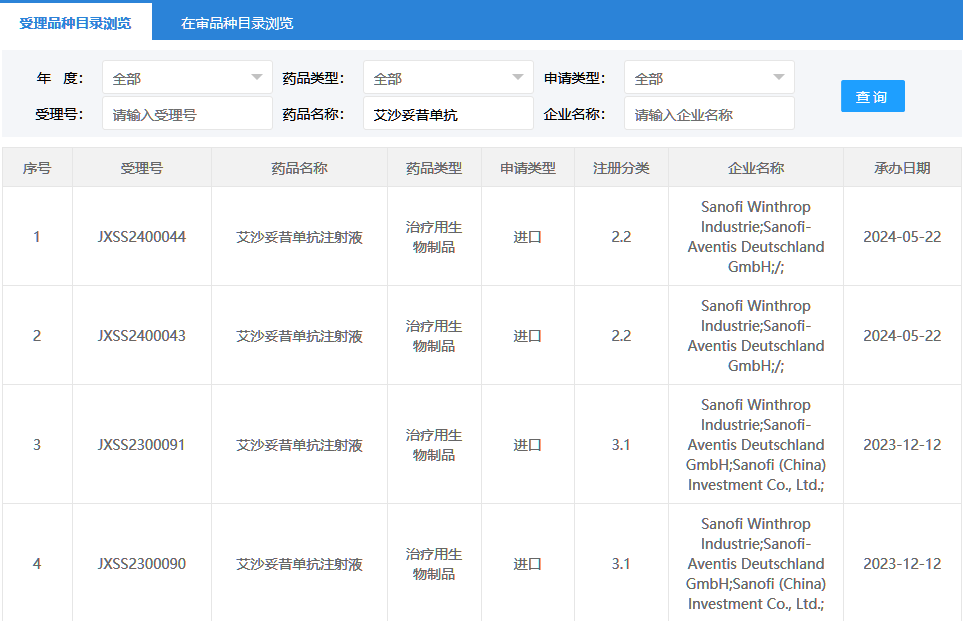
Public data shows that, in China, the overall incidence rate of MM is 1.6/100,000.Compared with the situation in Western countries, a higher proportion of Chinese patients are already at an advanced stage at the time of diagnosis, and there are more high-risk patients.
Currently, the only CD38 monoclonal antibody approved in the Chinese market is Johnson & Johnson's daratumumab, which was launched in China in September 2019 and is mainly used for the treatment of MM. However, its high treatment cost makes it unaffordable for many patients. It was not until the 2021 National Reimbursement Drug List negotiation that daratumumab was included in the medical insurance directory with a price reduction of over 70%, allowing more patients to access the treatment.
Industry experts generally believe that daratumumab, as a mature product in the market, has established strong brand influence and a broad patient base. Isatuximab will need to put more effort and innovation into clinical efficacy, pricing strategy, and marketing promotion in order to achieve significant market share growth.
With the approval of new indications for Isatuximab and Sanofi's continuous optimization of market strategies, the drug is expected to offer more treatment options for MM patients, and its market performance is likely to improve gradually. This progress may pose a certain challenge to the market share of Daratumumab.
Editor: Wu Yun




www.yyjjb.com.cn
Insight into Industry Trends

"Pharmaceutical Economy Newspaper"
Academic Official Account
Focusing on the Frontier of Oncology Academia

Terminal Official Account