Source |Artery Network
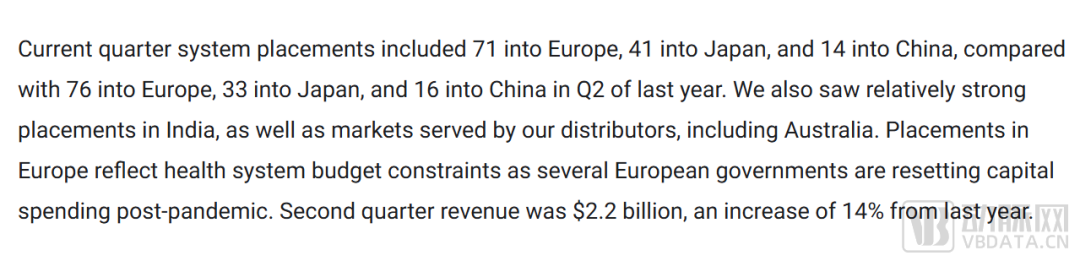
After the localization of Da Vinci in China, the price has significantly dropped, and a new landscape has emerged in the surgical robot market.On September 19, 2024, Gary Guthart, Global CEO of Intuitive Medical, attended the 36th Shanghai Mayor's International Business Leaders Advisory Conference. According to publicly available information, this CEO's last appearance in China was in October 2023 at the official unveiling of the domestically produced da Vinci surgical robot. The global CEO has been making frequent appearances in China recently.Frequent appearances not only demonstrate the company's emphasis on the Chinese market but also reflect that the competitive pressure in the Chinese market is gradually increasing, requiring more effort.According to the earnings call data from Intuitive Surgical for the first and second quarters of 2024, the installation volume of da Vinci surgical robots in China has decreased year-on-year. In the first half of 2024, the number of installations in China was 24 units, compared to 34 units during the same period in 2023, representing a nearly 30% year-on-year decline. Although the reduction in installations was partly influenced by delays in equipment tendering and procurement, the rise of domestic competitors is also a factor that cannot be ignored. Intuitive Medical 2024 Q1&Q2 Earnings Conference Data AnnouncementTo cope with competitive pressures, the domestically produced version of the da Vinci system has frequently been sold at ultra-low prices. The price range for the da Vinci IS4000CN version has dropped from 19 million yuan to 13 million yuan, with the lowest winning bid price being "halved" compared to the imported version.
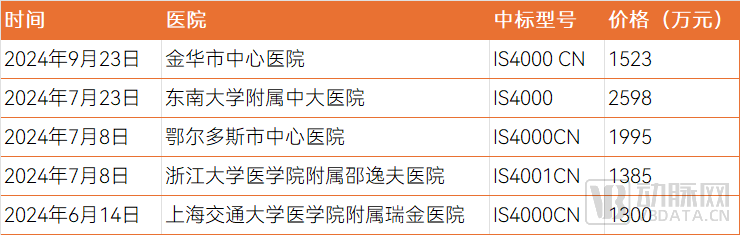 Data Source: China Government Bidding and Procurement NetworkChinese-brand endoscopic surgical robots have begun to compete with the da Vinci Surgical Robot in the new installation market since their launch two years ago.
Three Chinese Surgical Robot Companies
Significant Increase in Installation VolumeThe main domestic brand companies that have put pressure on Intuitive Surgical's business in the Chinese market are three: MicroPort Robotics (Toumai Laparoscopic Surgical Robot), Jingfeng Medical (MP1000), and Sizhe Rui Medical (Kangduo Robot). Among domestic brands, these three companies are leading in the number of中标s in the laparoscopic surgical robot field.According to the half-year report data from MicroPort Robotics, the TuMi laparoscopic surgical robot achieved commercial installations of 7 units in the first half of the year, with a cumulative total of 20 units installed commercially in China. Additionally, overseas market orders have exceeded 10 units.The other two companies have not yet disclosed specific installation data. According to incomplete statistics from China Government Procurement Network's public bidding data and publicly available information, as of September 2024, the cumulative number of中标 (awarded bids) for Kangduo's endoscopic robot is 14 units; Jingfeng Medical's MP1000 has a cumulative number of awarded bids of 11 units. (Only public data is included in the statistics, which does not represent the total installations.)A highlight of the business model for endoscopic surgical robots lies in the subsequent sales of surgical arms and consumables, with the volume of surgeries after installation directly impacting ongoing consumables revenue. According to Frost & Sullivan data, in 2021, the equipment market size for China's endoscopic surgical robot market was 1.61 billion yuan, the consumables market size was 1.41 billion yuan, and the service market size was 190 million yuan. Consumables and services account for half of the market, underscoring the importance of the volume of surgeries conducted post-installation.How are the performance of domestically produced brands of endoscopic surgical robots in terms of utilization rate? According to publicly available information, as of March 2024, the TuMi surgical robot has completed 2,000 surgeries, with domestic consumables generating revenue of 3 million yuan in the first half of the year, and the number of surgeries is rapidly increasing. In August 2024, Jingfeng Medical announced that the clinical surgery volume of its multi-port surgical robot had officially exceeded 4,000 cases. This indicates that domestically produced brands of endoscopic surgical robots have been market-validated in terms of product stability and reliability.However, the average number of surgeries performed by a single da Vinci surgical robot in hospitals is as high as around a thousand, while the number of surgeries performed by domestically produced endoscopic surgical robots still has room for improvement.Currently, Intuitive Medical mainly sells the fourth-generation product in China — the imported and domestically produced versions of the da Vinci Xi. In terms of product functionality and performance, Chinese-brand endoscopic surgical robots still have a certain gap compared to the da Vinci Surgical System. However, Chinese-brand products are in a phase of rapid iteration and development, striving to catch up.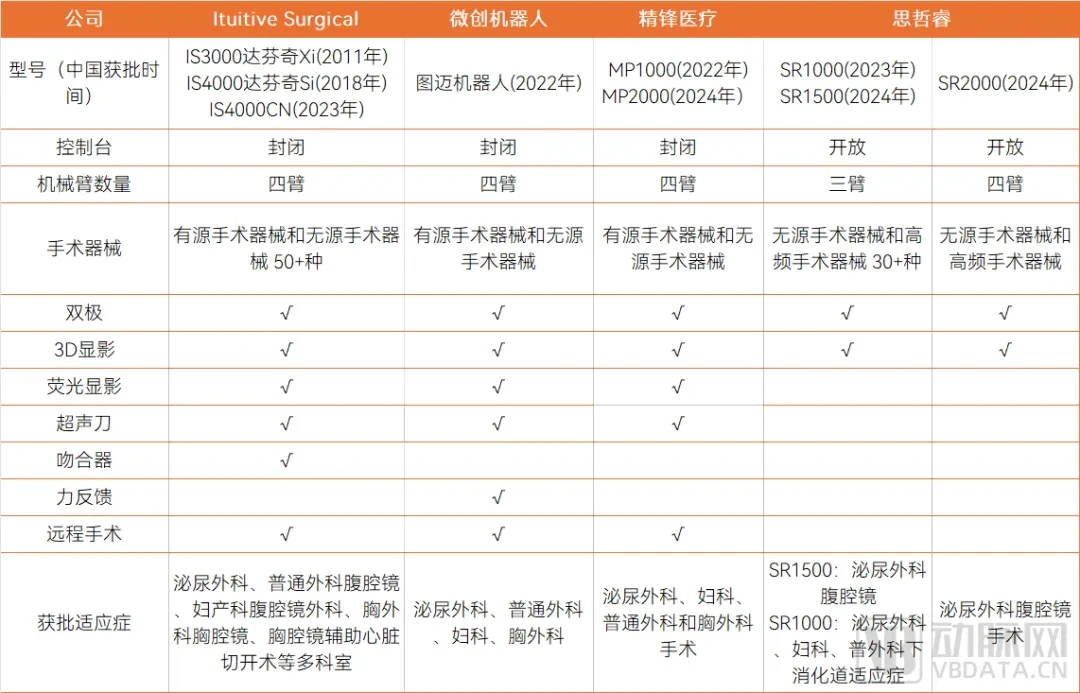 Comparison of Main Functions of Domestic Endoscopic Surgical RobotsThis gap is mainly reflected in the following four aspects:In terms of supporting surgical instruments, the types supported by domestically produced robotic-assisted laparoscopic surgery systems are fewer than those supported by the da Vinci system.Surgical robots are equipped with both active and passive instruments. The Da Vinci surgical robot is compatible with up to 50 different instruments and supports advanced minimally invasive surgical tools such as ultrasonic scalpels and staplers. Taking the stapler as an example, the Da Vinci surgical robot is equipped with the SureForm Da Vinci linear cutting stapler, which allows the chief surgeon to operate fully independently. This device automatically monitors the thickness of the tissue within the jaws and adjusts the pressure accordingly, eliminating the need for an assistant to operate the stapler through an auxiliary port. In contrast, the robotic arms of most domestically produced surgical robots can only manipulate basic tools such as knives, scissors, forceps, and tweezers to perform simple actions. To achieve high-precision stapler operation, further technological breakthroughs are required in precision design, drive technology, multi-degree-of-freedom control, and intelligent feedback systems.In terms of imaging functions, domestically produced products still need to improve their performance.Apart from the 3D fluorescence endoscope of Intuitive Surgical's da Vinci robot, dedicated 3D fluorescence endoscopes from other surgical robot manufacturers still lag behind mature mainstream brands in terms of reusable sterilization capability, image quality, and service life. The da Vinci Xi has been equipped with 3D imaging and fluorescence imaging functions since 2014, providing more stereoscopic images and enabling real-time visualization assessment of blood vessels, blood flow, and tissues during surgery using fluorescence imaging. This area is also a key focus for domestic companies in China to catch up, with some Chinese companies such as Jingfeng Medical and MicroPort already launching laparoscopic surgical robots with fluorescence imaging capabilities.It is reported that surgical robot companies in China are also collaborating with endoscope companies to jointly optimize imaging presentation functions. For example, in addition to being compatible with its own 3D endoscope system, the Kangdo Robot has been specially designed with an open dedicated interface to be compatible with internationally mainstream 3D endoscope systems such as Karl Storz and Olympus.Chinese-brand endoscopic surgical robots cover fewer indications.The Da Vinci surgical robot has been used in China for many years, covering a wider range of indications. However, domestically produced surgical robots are still in the stage of expanding indications. Domestically produced surgical robots are typically first applied in the two major departments of urology and gynecology because the penetration rate of these applications is relatively high in China. As domestically produced surgical robots advance in multi-department applications, they are expected to capture more market share from the Da Vinci surgical robot.The expansion of indications is a key strategy for the future growth of domestically produced laparoscopic surgical robots in China.Several hospitals in China that have purchased the da Vinci surgical robot explained their choice of a single-source procurement method by stating that the da Vinci surgical robot is currently the only endoscopic surgical control system, among both imported and domestically produced brands registered and approved for sale in China, capable of being used across multiple departments including urological surgery, general laparoscopic surgery, gynecological laparoscopic surgery, thoracic surgery with video-assisted thoracoscopy, and thoracoscopic-assisted heart surgeries. There are currently no similar products available in the domestic market. Domestically produced endoscopic surgical robots need to obtain approval for more indications before they can enter a larger market.In the design of surgical robotic arms, four-arm surgical robots can perform more complex surgeries. The SR1000 robot from Chinese company Sizhe Rui Kangduo adopts a three-arm solution. This design was primarily based on observations in clinical use where doctors, when using the four-arm da Vinci surgical robot, often only utilize three of the arms most of the time due to cost considerations. The fourth arm is mainly designed for tissue retraction, which can be performed by an assistant in clinical settings. From a cost-reduction perspective, the SR1000 opted for a three-arm solution.
Chinese-Made Surgical Robots
Differentiated AdvantagesIn order to narrow the gap with da Vinci, domestically produced brands of endoscopic surgical robots are not only working on addressing their shortcomings but also exploring differentiated paths.Chinese-brand endoscopic robots are the first to launch force feedback-related functions.When performing surgery with a laparoscopic surgical robot, the surgeon loses natural force perception and can only estimate the force visually. Force perception can further enhance the safety of surgery. The main technical approach for achieving force perception in laparoscopic surgical robots is through the integration of force sensors. The technical challenges lie in the requirements for high precision and high reliability, as well as the need for miniaturization and integration, while also adapting to the surgical environment.MicroPort's TuMi® robotic system is equipped with a force perception component—Force Presentation. This year, Intuitive Medical's latest generation product, the da Vinci 5, has also achieved force feedback functionality. The da Vinci 5 uses sensors and advanced algorithms to capture and transmit in real time the forces exerted by instruments on tissue during surgery. This precise force perception and feedback mechanism allows surgeons to perform more accurate operations, significantly enhancing the safety and effectiveness of surgeries. This product has not yet been approved for the Chinese market. The TuMi® robotic system remains the only domestically produced laparoscopic surgical robot in China with force feedback functionality.Another major advantage of domestically produced surgical robots compared to the da Vinci surgical robot lies in the exploration of remote surgery capabilities.Chinese-brand endoscopic surgical robots have made more attempts in remote surgery. Remote surgery requires extremely low communication latency and highly stable data transmission; any delay or connection interruption could lead to imprecise surgical operations, and may even endanger patient safety. The surgery involves the transmission of a large amount of real-time images and sensor data; the real-time transmission of high-resolution images and force feedback signals is crucial for the precision and safety of the surgery.Chinese-Made Cavity Endoscopic Surgical Robots Successfully Perform Cross-Continental Surgeries. The Jingfeng Remote Surgery System, with the dual advantages of low latency and high reliability, employs strategies such as "multi-network integration," "encrypted transmission," and "dual-console control" to ensure the smooth operation of remote surgeries. The system has been applied in remote surgeries across urology, gynecology, and general surgery, achieving cross-continental remote procedures. MicroPort robots have also conducted nearly 200 remote surgeries both domestically and internationally.The above differences are all at the functional level, and there are also companies in China exploring structural design differences from the Da Vinci surgical robot.Chinese companies Ruilong Surgical and Hedin Medical are developing split-body surgical robots and split-bed surgical robots, forming a distinct differentiation from integrated surgical robots represented by the da Vinci system.Characteristics of the Split-type Surgical Robot SystemTo address the pressure brought by domestic competitors, the da Vinci surgical robot has also achieved production in China, obtained a registration certificate for domestically produced medical devices, and realized localization. In terms of price, the cost of the domestically produced version of the da Vinci has significantly decreased, approaching that of other Chinese brands.Moreover, the launch of the da Vinci 5 worldwide has further widened the gap with similar products, offering stronger computational power and an enhanced digital experience. The previous versions of the da Vinci Surgical Robot were often approved in China three to four years later than in overseas markets. Therefore, the da Vinci 5 is expected to hit the Chinese market within three years, adding new pressure on the iteration of domestically produced brands.Medical Device Upgrading
Will pull the surgical machineGrowth of the Robotic MarketCurrently, laparoscopic surgical robots are facing the best market opportunities ever. The adjustment of the management category for the configuration permits of laparoscopic surgical robots and the increase in planned quantities have led to a significant rise in installations.The opportunities brought by policy support are expected to be further amplified, as national policies provide strong backing for the development of domestically produced brands in the field of endoscopic surgical robots. For instance, the recent notice issued by the National Development and Reform Commission and the Ministry of Finance, titled "Several Measures to Intensify Support for Large-Scale Equipment Renewal and Consumer Goods Replacement," plans to allocate approximately 300 billion yuan of ultra-long-term special treasury bond funds to support the upgrading of medical equipment.This medical equipment upgrade is expected to unleash demand for surgical robots. The "Hubei Province Implementation Plan for Promoting Equipment Renewal in the Healthcare Sector," issued by the Hubei Provincial Development and Reform Commission, explicitly states support for hospitals to upgrade their equipment, including high-end medical devices such as surgical robots. This indicates that domestically produced surgical robots will have more market opportunities in the equipment renewal and upgrade process.The overseas market will also bring new opportunities. China-produced brand laparoscopic surgical robots have achieved remarkable results in the international market. For instance, MicroPort has successfully realized overseas sales by leveraging its global channels. With the increasing global demand for high-end medical devices and the enhancement of China-produced surgical robot technology, the competitiveness of China-produced brands in the international market continues to strengthen.The continuous introduction of industry-friendly policies, the mature upgrading of domestic industrial chains, and the accelerated release of clinical needs have brought multiple benefits to the development of China's endoscopic surgical robot market. Domestic brands have gradually started to show their potential, but forming a competitive stance in the market will require honing core competitiveness. The business model of endoscopic surgical robots dictates that this is a market testing long-term competition. Stable and reliable product performance, along with the ability to iterate products in line with the times, are key to long-term competitiveness.- END -