

Why Has Domestic Cardiac Electrophysiology Failed to Gain Ground Over a Decade Despite Soaring Market Growth?

Johnson & Johnson
Healthcare Product Manufacturers, Health Service Providers
The electrophysiology market is experiencing tailwinds, with the global electrophysiology market experiencing rapid growth.
Johnson & Johnson stated that the full-year revenue of its electrophysiology business is close to 5 billion US dollars, achieving strong growth across all regions globally, maintaining a growth rate of over 20%. The growth rate of the electrophysiology market makes Johnson & Johnson proud.
Except for Johnson & Johnson, Boston Scientific's electrophysiology business sales reached $428 million in Q2 2024, a year-over-year increase of 125%, driven by the rapid adoption of the new FARAPULSE PFA System in the United States. The earnings report described the growth of the electrophysiology business as extraordinary.
The growth of the electrophysiology market in China is also remarkable. MicroPort EP reported revenue of 198 million yuan, a year-on-year increase of 39.57%; net profit attributable to shareholders was 17.01 million yuan, a year-on-year increase of 689.30%. Huitai Medical's revenue in the first half of 2024 was 1.001 billion yuan, a year-on-year increase of 27.03%; net profit attributable to shareholders was 343 million yuan, a year-on-year increase of 33.09%.
The overall growth in the volume of cardiac electrophysiology procedures has been highly profitable for global players, but the market share of domestic companies in China has decreased instead. According to IQVIA data, in segments like cardiac electrophysiology and pacemakers where volume-based procurement was not fully implemented, imported brands gained even more market share after the procurement policy was enacted.
The difficulty in increasing the market share of domestically produced cardiac electrophysiology products has long been a persistent issue in this field. Industry insiders have previously raised the question: After more than a decade of development in China's electrophysiology industry, not only has its market share failed to increase, but it has actually declined, now accounting for less than 10%.
Currently, the electrophysiology market in China is still predominantly led by foreign companies. Johnson & Johnson is the leading player, capturing over 50% of the market share; the second tier consists of three foreign enterprises—Abbott, Medtronic, and Boston Scientific—which together occupy approximately 35% of the market share. The overall market share of domestically produced products remains relatively low.
Previously, the market share of Chinese enterprises was hindered by two main factors. On one hand, there were product limitations—most Chinese enterprises lacked the magnetoelectric 3D systems and high-end catheter series required for the advanced atrial fibrillation market in cardiac electrophysiology. In the past two years, high-end products from Chinese enterprises, such as high-density catheters and pressure-sensitive catheters, have gradually been approved, filling the gap in domestic production.
Secondly, the evaluation criteria for cardiac electrophysiology surgical instruments include a comprehensive assessment standard of operator perception, immediate success rate, and physical evaluations such as tactile operation. Most doctors in China have been educated by imported brands and thus have a dependency on them. This hospital entry threshold has been significantly reduced after the centralized procurement of cardiac electrophysiology products.
Why hasn't the market share of electrophysiology products made in China increased rapidly after the above two major issues were resolved?
It is difficult for the market share of Chinese-produced products to increase. From the product perspective, this is because high-end products require a certain incubation period to enter the market, and electrophysiology products have complex technical barriers that necessitate iterative optimization based on extensive clinical practice.
The cardiac electrophysiology treatment process involves stimulating organisms through various forms of energy, measuring, recording, and analyzing the electrical phenomena and characteristics of organisms, as well as altering cardiac rhythms through electrical stimulation. The product features in this market are divided into two categories: equipment and consumables. Electrophysiology equipment mainly includes 3D cardiac electrophysiology mapping systems and multichannel electrophysiology recorders, etc.; consumables include electrophysiology electrode mapping catheters, ablation electrode catheters, and transseptal puncture needle sheaths, among other access products.
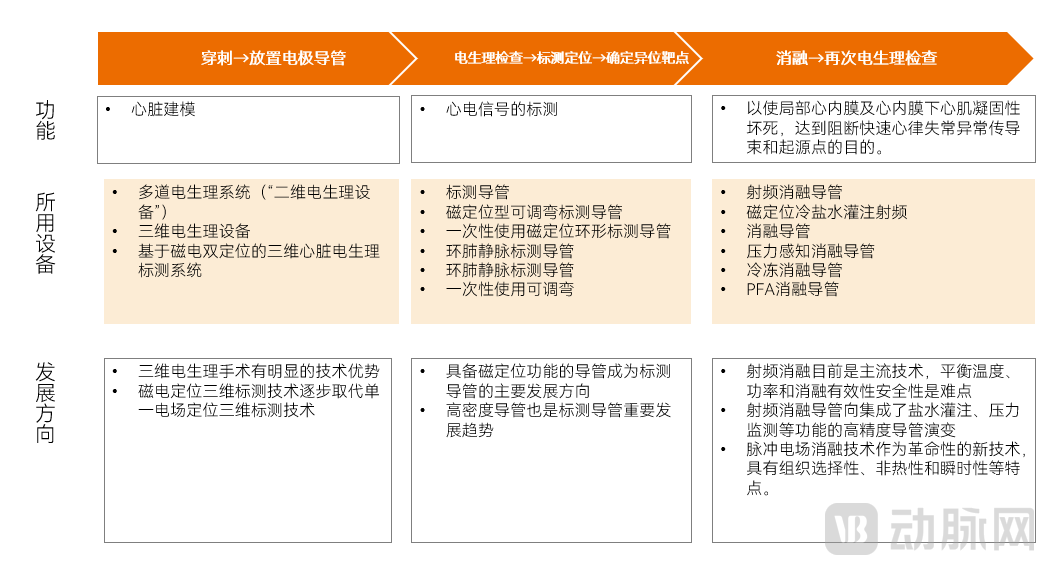
Cardiac Electrophysiology Diagnosis and Treatment Process and Main Products Required
Global players have undergone multiple iterations in equipment, mapping catheters, and ablation catheters since the 21st century, developing a rich product pipeline. In contrast, China-produced enterprises are still at the stage of obtaining the initial entry ticket in the product landscape shown above.
In terms of device products, cardiac electrophysiology navigation devices have evolved from two-dimensional to three-dimensional, and three-dimensional technology has advanced from pure electrical navigation to magnetic-electric combined navigation. Currently, magnetic-electric dual positioning technology is the most advanced and mainstream technology in the industry.
Magnetic field signal positioning involves placing a positioning board under the corresponding thoracic cavity area of the operating bed to emit magnetic field signals. The three-dimensional mapping system uses magnetic field sensors installed in the mapping catheter to sense magnetic field signals at different positions, and then converts them into magnetic field position coordinates through an algorithm.
Electric field signal positioning involves attaching surface reference electrodes to the patient's chest and applying an excitation signal between the surface reference electrodes to establish a three-dimensional positioning electric field that covers the heart. The voltage difference between the intracardiac catheter electrode and the surface reference electrodes is then collected, and an algorithm is used to convert the voltage values into relative position coordinates under electric field positioning.
The magnetic and electric field-based 3D mapping system combines the advantages of magnetic field positioning and electric field positioning, improving the accuracy of mapping modeling and catheter positioning during cardiac electrophysiology procedures. This, in turn, enhances the success rate and safety of catheter ablation. Particularly in the high-end market of cardiac electrophysiology, such as the atrial fibrillation (AF) market, due to the complex pathogenesis of AF and the greater difficulty of ablation procedures, a 3D mapping system is typically required for more precise cardiac modeling to facilitate accurate treatment by physicians.
The magnetic and electric 3D system is currently the mainstream product in China. The industry benchmark products include Johnson & Johnson's CARTO 3 system and Abbott's EnSite PRECISION system. The fourth-generation magnetic and electric 3D navigation product, made in China, was approved in the past two years.
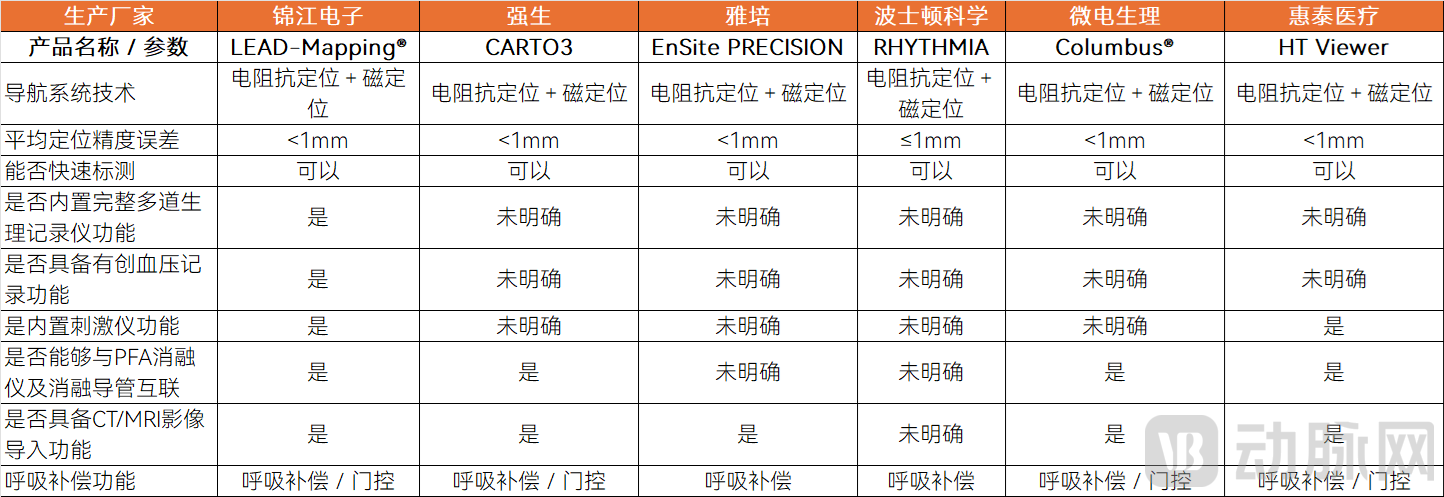
3D Electrophysiology Systems Available in China
Consumables barriers focus on mapping catheters and ablation catheters.
In addition to needing to close the generational gap in equipment, there is also a gap in consumables for domestically produced products.
Electrophysiology treatment consumables have also undergone several iterations, with mapping catheters evolving towards precise positioning and rapid modeling. A good mapping catheter needs to have multiple advantages, including the ability to reach various anatomical positions of the heart, accurately extract electrocardiographic signals, and quickly map and assist in three-dimensional modeling.High-density mapping catheters can simultaneously collect electrocardiographic signals and positional information from multiple sites in the patient’s heart during electrophysiological procedures, further reducing mapping and 3D modeling time as well as procedure duration. Additionally, the magnetic and electrical positioning 3D mapping system must be used in conjunction with mapping catheters that have magnetic positioning functionality.
Ablation catheters in electrophysiology consumables are developing towards precise and safe ablation. There are three types of electrophysiology ablation catheters: radiofrequency ablation, cryoablation, and pulsed electric field ablation.
Radiofrequency ablation, known as thermal ablation, is the predominantly applied technology globally and is also the most maturely developed technique. However, it requires control over thermal damage to surrounding tissues, typically combined with cold saline perfusion to prevent complications caused by excessively high local temperatures. Additionally, during the procedure, it is crucial to ensure adequate contact between the catheter tip and the tissue. Excessive force, however, may increase the risk of complications, necessitating high stability and precise monitoring of the pressure exerted by the catheter against the tissue. Pressure catheters can enhance the safety of this procedure. Johnson & Johnson remains the market leader in this field due to its product diversity.
From the market pattern perspective, Chinese-produced products have initially obtained certifications for high-end catheters such as high-density mapping catheters and pressure-sensing radiofrequency ablation catheters, meeting the standards to enter the high-end atrial fibrillation market with more demanding requirements for cardiac modeling.
Cryogenic ablation has a simple procedure and a short learning curve, but its scope of application is limited, mainly used for pulmonary vein isolation. The global market is dominated by cryoablation systems from Medtronic and Boston Scientific.
Pulsed Field Ablation (PFA) is a recently approved technology with tissue selectivity and high safety, becoming a focal point of market attention. The main challenges in PFA technology development lie in setting and optimizing pulse parameters, integrating with three-dimensional systems, and avoiding complications. Existing three-dimensional navigation systems are designed around radiofrequency ablation, and the difficulty lies in developing a three-dimensional system more suitable for PFA systems.
Currently, in the global PFA market, products from Boston Scientific and Medtronic have received FDA and NMPA approval for marketing. Boston Scientific dominates this market, while Johnson & Johnson and Abbott’s PFA systems are awaiting FDA approval. In China, products from Denovo Electrophysiology and Jinjiang Electronics have received NMPA approval for marketing. Other Chinese companies such as XuanYu Medical, ZhouLing Medical, Aikangmai Medical, Hanyu Medical, Jianhu Medical, Huitai Medical, and MicroElectroPhysiology have also developed PFA products.
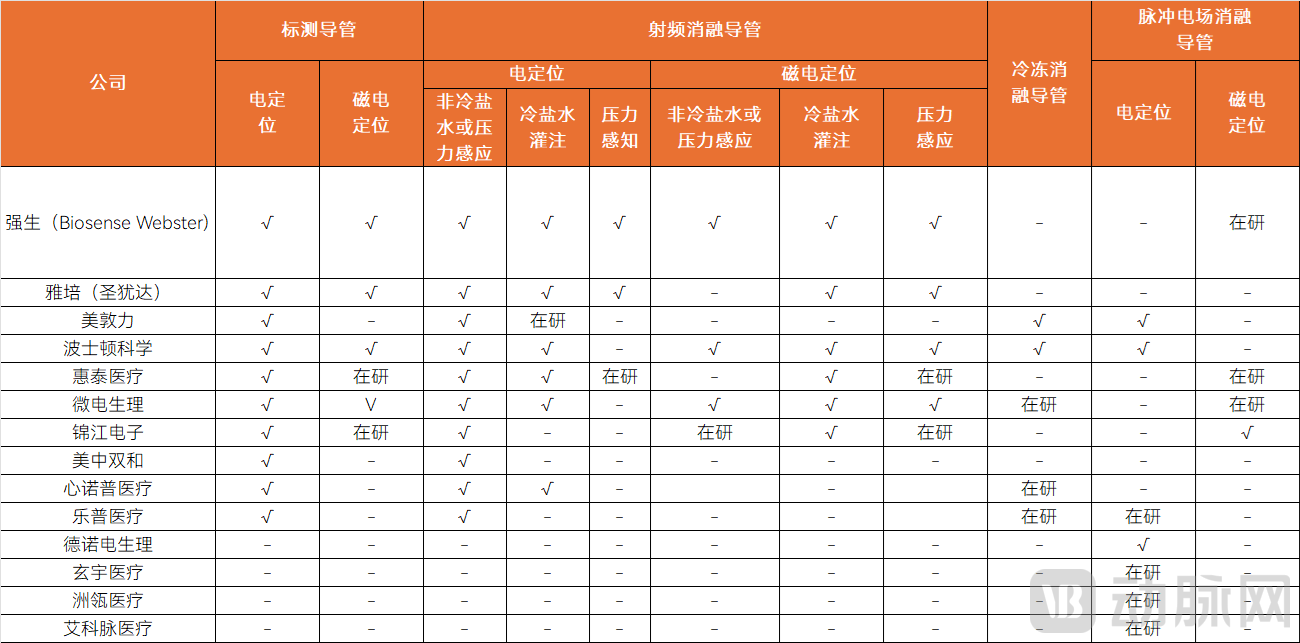
Overview of the Electrophysiology Consumables Market in China
It is not difficult to see that the electrophysiology market is highly complex, with different requirements for different consumables. Chinese manufacturers are still in the early stages of product launches, and most companies' product pipelines do not fully cover the latest generation of products. The stability of core performance and the accuracy of core algorithms need to be iterated through a large amount of clinical data.
How Will Chinese-Made Products Break Through as Imported Brands Continue to Increase Their Share in the Cardiac Electrophysiology Market?
PFA, an emerging technology, is expected to help Chinese-produced enterprises overtake on the curve. Compared with ablation methods such as radiofrequency and cryoablation, PFA technology offers advantages like tissue selectivity, fewer complications, faster ablation speed, higher surgical efficiency, simpler procedures, and shorter learning curves for operators, effectively addressing the clinical pain points of existing cardiac electrophysiology procedures.
At present, the global electrophysiology market landscape is being rewritten by PFA. In less than six months since its launch, PFA has already captured 15% of the cardiac electrophysiology market share, and it is expected to continue its rapid growth. Analysts predict that PFA will seize 30% of the market share within a year, partially eroding the markets for cryoablation and radiofrequency ablation, with cryoablation being the most affected.
PFA is developing strongly and is the product with the most domestic corporate investment. In the future, the approval and commercialization of domestically produced PFA+3D products in China is expected to accelerate. Chinese companies can leverage PFA, an emerging technology, to gain more market share in the cardiac electrophysiology market.
Centralized procurement has also brought opportunities for domestic cardiac electrophysiology companies. On the one hand, the implementation of centralized procurement for electrophysiology surgeries has driven the growth in the number of surgeries, expanding the overall market size for cardiac electrophysiology. On the other hand, it has lowered the threshold for domestic companies to enter hospitals, promoting an increase in the number of domestically performed cardiac electrophysiology surgeries.
Chinese Companies Also Leverage Bulk Purchasing to Achieve Rapid Growth in Surgical Volume. The inter-provincial alliance for bulk purchasing of medical consumables used in cardiac interventional electrophysiology, formed by multiple provinces including Fujian and Hebei, has, to a certain extent, increased the surgical volume of domestically produced products. In the first half of 2024, HuTai Medical completed approximately 7,500 three-dimensional electrophysiology surgeries across more than 800 medical institutions, representing a year-over-year increase of over 100%. As of the first half of 2024, MicroPort Electrophysiology's global volume of three-dimensional surgeries surpassed 70,000 cases. The number of electrophysiology heart surgeries performed with domestically produced devices is growing rapidly.
The wide range of surgical applications provides domestic companies with opportunities to iterate and refine their products, and Chinese manufacturers will seize this opportunity to expand their market share.
References:
Jinjiang Medical Electronics Prospectus
Huitai Medical Prospectus
Ping An Securities: Frontier High-Value Consumables Research Series (I) — Electrophysiology Industry Panorama — A Booming Blue Ocean Track