NLRP3 Inhibitors May Become the Potential Second Choice for Obesity Drugs for Companies That Missed the GLP-1 Agonist Trend.Recently, Ventyx Biosciences received a $27 million investment from Sanofi. The target of this investment by Sanofi is the company’s NLRP3 inhibitor VTX3232, which also has central nervous system penetrability and can be used for neurodegenerative diseases such as Parkinson's disease and Alzheimer's disease.This article will provide a brief overview of the current research status of NLRP3 inhibitors.Therapeutic Mechanism of NLRP3 Inhibitors
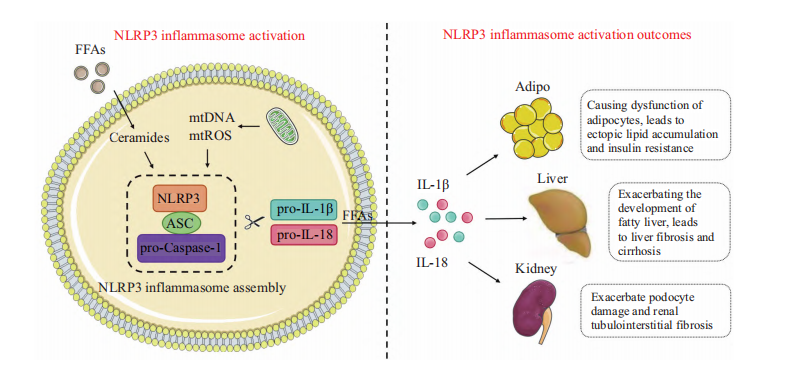
When the body experiences excessive nutrition, surplus calories that exceed its energy consumption are stored in the form of triacylglycerols (TGs) in white adipose tissue (WAT). In obese patients, these white adipocytes excessively proliferate and store TGs, leading to adipocyte hypertrophy. When fat accumulation exceeds the load capacity, it degrades into free fatty acids (FFAs), which, upon recognition by macrophages, generate toxic ceramides.The NLRP3 inflammasome can sense lipotoxicity-related ceramides, inducing Caspase-1 cleavage in macrophages and adipose tissue. Prolonged obesity can lead to insulin resistance, adipose dysfunction, and mitochondrial dysfunction, closely associated with metabolic dysfunction-associated fatty liver disease and obesity-related chronic kidney disease.NLRP3 inhibitors can precisely target the NLRP3 inflammasome, inhibiting its assembly and activation, thereby reducing the release of downstream inflammatory factors such as IL-1β and IL-18.In addition, preclinical studies have shown that NLRP3 inhibitors can significantly reduce cardiovascular inflammation biomarkers associated with obesity, such as fibrinogen, sVCAM-1, suPAR, and PCSK9. The reduction of these biomarkers suggests that NLRP3 inhibitors have potential in improving cardiovascular health.The combined effects of these mechanisms help reduce weight, improve metabolic abnormalities, and lower cardiovascular risks. VTX-3232, mentioned earlier, was initially developed as a cardiovascular drug.Current Status of NLRP3 Inhibitors in Treatment
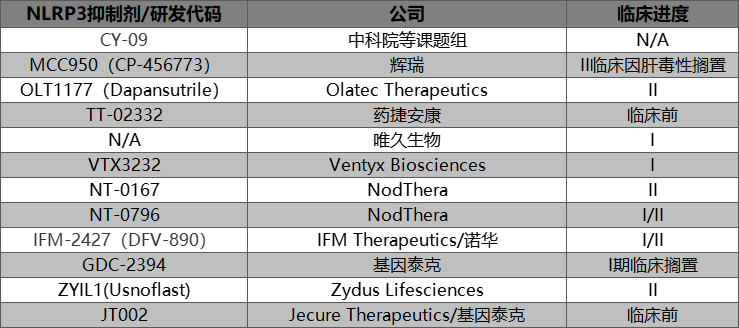
In addition to some traditional Chinese medicines that naturally have NLRP3 inhibitory effects and tranilast, which was later found to have anti-NLRP3 effects, the early developer of NLRP3 small molecule inhibitors was Pfizer.Last century, researchers such as Luke A. J. O’Neill from Ireland and Matthew A. Cooper from Australia discovered the selective NLRP3 inhibitor CP-456773, which was then handed over to Pfizer for development. Pfizer plans to use it for rheumatoid arthritis.However, CP-456773 exhibited severe hepatotoxicity and appeared to have off-target risks at high doses, leading to the abandonment of its development. Early clinical failures temporarily dampened enthusiasm for NLRP3 inhibitors, with subsequent development efforts led mainly by biotech companies such as Inflazome, Jecure Therapeutics, IFM Therapeutics, and NodThera.Inflazome has developed two drugs, inzomelid and Somalix, which they intend to use for the development of a rare disease — Cryopyrin-Associated Periodic Syndromes (CAPS) — a rare condition caused by mutations leading to NLRP3 activation.Following the acquisition of Inflazome by Roche's Genentech in 2020, Genentech developed GDC-2394, a relatively safer derivative based on CP-456773, intended for cardiovascular diseases. However, GDC-2394 still exhibited toxicity and posed drug interaction risks with statins due to CYP3A4 substrate issues. Given that most cardiovascular disease patients take statins, during the Drug-Drug Interaction (DDI) phase, two participants experienced Grade 4 drug-induced liver injury, leading to the trial's termination. Genentech subsequently abandoned its development.Genentech also acquired Jecure Therapeutics, which holds a substantial portfolio of preclinical NLRP3 inhibitor assets intended for development in inflammatory diseases such as NASH, liver fibrosis, gout, inflammatory bowel disease (IBD), and cardiovascular conditions. The acquisition of Jecure occurred earlier than that of Inflazome (2017) and led to the development of JT002, currently in the preclinical stage and proposed for use in inflammatory diseases.During the time when Genentech acquired Jecure Therapeutics, Novartis also acquired IFM Tre, a spin-off from IFM Therapeutics, another company holding patents for the NLRP3 pipeline, and obtained IFM-2427 (DFV-890). Currently, in healthy subjects, single and multiple doses of DFV890 have been well tolerated for up to 14 days without any safety or tolerability issues.NodThera, backed by Novo Nordisk Fund and Sanofi Fund, has successively developed derivatives of CP-456773, namely NT-0167 and NT-0796. NT-0167 seems to have been shelved due to the iteration to NT-0796, which has shown certain weight loss potential. Data released in June this year showed that NT-0796 can effectively reduce C-reactive protein (CRP) levels in patients and cause significant weight loss.This time, Ventyx Biosciences is an early validation of NLRP3 inhibitors in the field of obesity. Current preclinical data shows that VTX3232 has a certain weight loss effect, but the gap compared to semaglutide is relatively large, and its combination with semaglutide shows some improvement in weight loss effects.Overall, the development prospects of NLRP3 inhibitors remain unclear. Current preclinical data indicate that they may have a certain weight-loss effect, but need to be used in combination with semaglutide. Whether the combination can expand the market is worth looking forward to in the future.Tang F, Kunder R, Chu T, Hains A, Nguyen A, McBride JM, Zhong Y, Santagostino S, Wilson M, Trenchak A, Chen L, Ly J, Moein A, Lewin-Koh N, Raghavan V, Osaghae U, Wynne C, Owen R, Place D. First-in-human phase 1 trial evaluating safety, pharmacokinetics, and pharmacodynamics of NLRP3 inflammasome inhibitor, GDC-2394, in healthy volunteers. Clin Transl Sci. 2023 Sep;16(9):1653-1666. doi: 10.1111/cts.13576. Epub 2023 Jul 23. PMID: 37350225; PMCID: PMC10499406.Wang Zhe, Sun Cheng. Research Progress of NLRP3 Inflammasome in Obesity and Its Metabolic Syndrome [J]. Chinese Journal of Cell Biology, 2024, 46(09): 1730-1736.McBride C, Trzoss L, Povero D, Lazic M, Ambrus-Aikelin G, Santini A, Pranadinata R, Bain G, Stansfield R, Stafford JA, Veal J, Takahashi R, Ly J, Chen S, Liu L, Nespi M, Blake R, Katewa A, Kleinheinz T, Sujatha-Bhaskar S, Ramamoorthi N, Sims J, McKenzie B, Chen M, Ultsch M, Johnson M, Murray J, Ciferri C, Staben ST, Townsend MJ, Stivala CE. Overcoming Preclinical Safety Obstacles to Discover (S)-N-((1,2,3,5,6,7-Hexahydro-s-indacen-4-yl)carbamoyl)-6-(methylamino)-6,7-dihydro-5H-pyrazolo[5,1-b][1,3]oxazine-3-sulfonamide (GDC-2394): A Potent and Selective NLRP3 Inhibitor. J Med Chem. 2022 Nov 10;65(21):14721-14739. doi: 10.1021/acs.jmedchem.2c01250. Epub 2022 Oct 24. PMID: 36279149.Ambrus-Aikelin G, Takeda K, Joetham A, Lazic M, Povero D, Santini AM, Pranadinata R, Johnson CD, McGeough MD, Beasley FC, Stansfield R, McBride C, Trzoss L, Hoffman HM, Feldstein AE, Stafford JA, Veal JM, Bain G, Gelfand EW. JT002, a small molecule inhibitor of the NLRP3 inflammasome for the treatment of autoinflammatory disorders. Sci Rep. 2023 Aug 19;13(1):13524. doi: 10.1038/s41598-023-39805-z. Erratum in: Sci Rep. 2023 Nov 16;13(1):20081. doi: 10.1038/s41598-023-47251-0. PMID: 37598239; PMCID: PMC10439952.
Scan the WeChat QR code to add the editor of the Antibody Circle.Those who meet the requirements can join the Antibody Circle WeChat group!Please indicate: Name + Research Direction!All reproduced articles in this official account are intended to convey more information, with the source and author clearly stated. Media or individuals who do not wish to be reproduced can contact us (cbplib@163.com), and we will immediately proceed with deletion. All articles represent the views of the author and do not represent the position of this site.