

AstraZeneca Inks $100M Upfront Deal with CSPC Pharma for Novel Oral Lp(a) Inhibitor YS2302018
CSPC
Innovative Drug Research and Development, Manufacturer

AstraZeneca
Biopharmaceutical Manufacturer
On October 7, AstraZeneca and CSPC announced an exclusive licensing agreement to advance the development of a preclinical innovative small molecule lipoprotein(a) inhibitor, YS2302018. AstraZeneca will obtain the exclusive global rights to develop, manufacture, and commercialize YS2302018, as well as any pharmaceuticals or biologics composed of or containing this compound in subsequent developments.
CSPC will receive a $100 million upfront payment and is entitled to receive up to $370 million in potential development milestone payments, up to $1.55 billion in potential sales milestone payments (totaling $1.92 billion), as well as tiered sales royalties.
YS2302018 has the potential to bring more benefits to patients with dyslipidemia and further strengthens AstraZeneca's cardiovascular product pipeline, helping to address major risk factors leading to chronic cardiovascular diseases.According to the agreement, AstraZeneca will develop it as a novel lipid-lowering therapy for a range of cardiovascular disease indications, potentially as a monotherapy or combination therapy, including in combination with the oral small-molecule PCSK9 inhibitor AZD0780.
It is reported that YS2302018 was discovered by CSPC's AI-driven small molecule drug design platform. The platform uses AI technology to analyze the binding modes of target proteins with existing compound molecules, optimizes their drug-like properties in a targeted manner, and ultimately screens out highly efficient and well-developable lipoprotein(a) (Lp(a)) small molecule inhibitors.
Lp(a) is a lipoprotein particle formed by the interaction between low-density lipoprotein (LDL) particles and apolipoprotein(a) (Apo(a)).Epidemiological studies have shown that Lp(a) is an independent risk factor for cardiovascular disease, and research has indicated a positive correlation between Lp(a) levels and the presence and severity of coronary heart disease.
On one hand, unlike other types of blood lipids, Lp(a) levels vary greatly between individuals and are significantly influenced by genetic factors, making it difficult to improve through lifestyle changes. Although the threshold for elevated Lp(a) has not been determined, approximately 20% of adults have Lp(a) >125nmol/L, indicating higher serum Lp(a). It is estimated that more than 8 million people worldwide suffer from elevated Lp(a) levels and cardiovascular disease, resulting in 2.6 million deaths annually.
On the other hand, even when plasma LDL cholesterol is effectively reduced, Lp(a) can still increase the risk of cardiovascular events. Therefore, existing conventional lipid-lowering therapies also struggle to reduce Lp(a) to a level that achieves significant benefit. Targeted Lp(a) lipid-lowering therapy has become one of the key breakthroughs in the prevention and treatment of cardiovascular diseases.
YS2302018 demonstrates effective binding with Apo(a), thereby preventing its assembly with ApoB-100 particles to form Lp(a). Preclinical data shows that YS2302018 exhibits excellent pharmacokinetic properties and superior efficacy in both in vitro and animal models, with no significant safety risks, making it a potential new therapy for controlling cardiovascular risk in populations with high Lp(a).
As a track with a broad population of indications and the potential for blockbuster drugs, specifically targeted Lp(a) drugs have become a key focus for multinational corporations (MNCs). The critical factor is that the leading Lp(a) pipelines have demonstrated excellent efficacy in clinical data.
Currently, there are over 10 pipelines globally for reducing Lp(a) levels. The fastest progress is seen in antisense oligonucleotides (ASO) and small interfering RNA (siRNA) drugs, with three projects already entering Phase III clinical trials. However, most of these pipelines are already controlled by various MNCs.
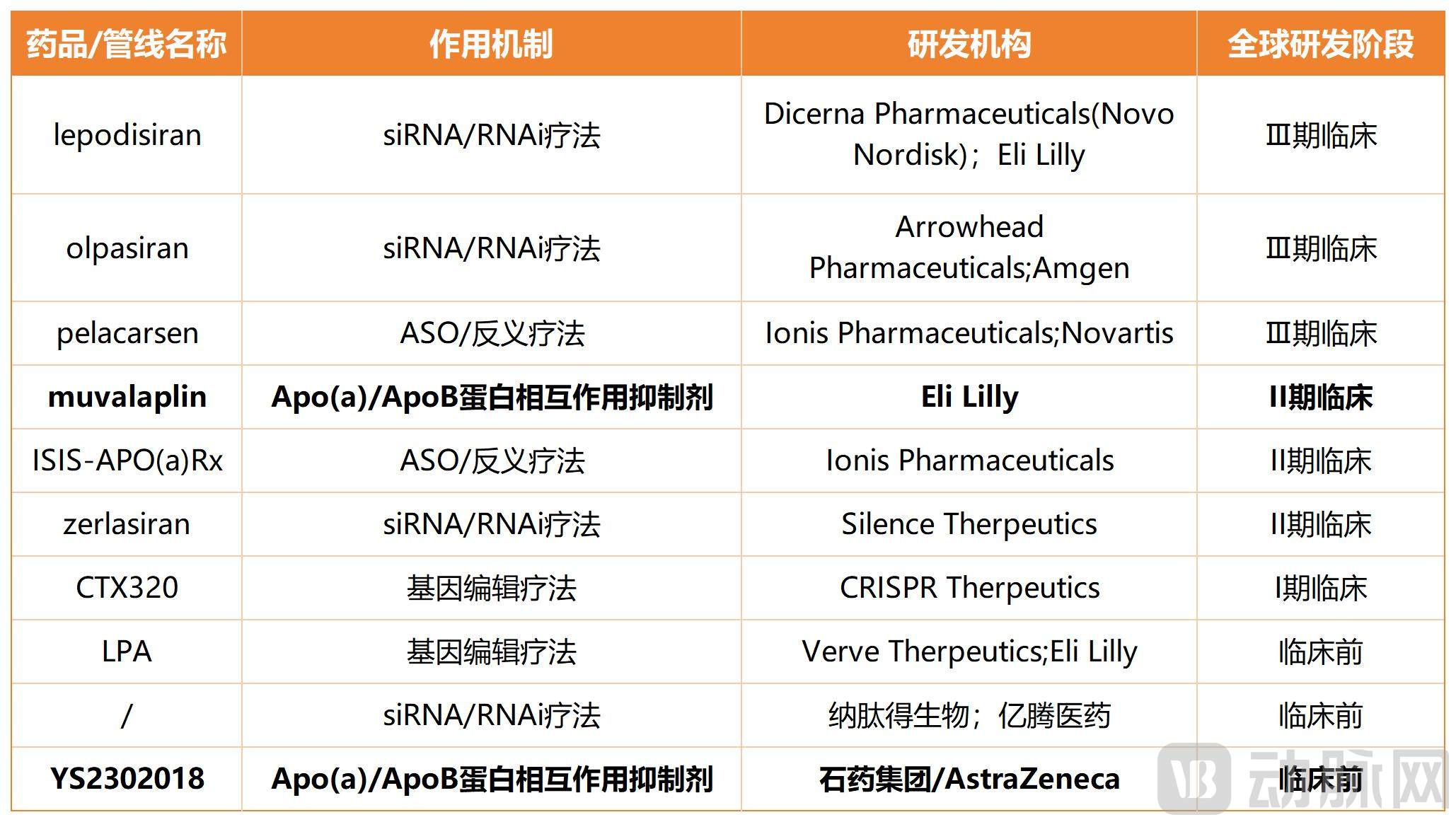 Lp(a) Target Pipeline (Source: Public Data, Chart by VCBeat)
ASO Therapy PelacarsenThe original research party is Ionis, which granted Novartis the exclusive global rights for development, manufacturing, and commercialization in 2019. Pelacarsen enters hepatocytes and selectively cleaves the messenger ribonucleic acid (mRNA) of Apo(a), inhibiting its translation into the Lp(a) protein, thereby suppressing the synthesis of Lp(a) and effectively reducing the level of Lp(a) in plasma.
Phase II clinical trial data show that pelacarsen can reduce Lp(a) by 80%. A dosing regimen of 80mg/month can lower Lp(a) levels to below 50 mg/dL in 98% of patients, potentially bringing significant benefits in cardiovascular prevention and treatment. In addition, in August 2023, based on their prior collaboration, Novartis and Ionis reached a new collaboration and licensing agreement with a $6 million upfront payment to jointly develop next-generation Lp(a)-driven therapies for cardiovascular diseases following pelacarsen.
siRNA therapy utilizes the RNA interference mechanism to limit the synthesis of apo(a), thereby preventing the assembly of Lp(a) and reducing its plasma concentration.
siRNA Pipeline OlpasiranFrom Arrowhead, one of the leading companies in siRNA. As early as 2016, Amgen obtained the global exclusive license rights to Olpasiran from Arrowhead. Phase II clinical trial data showed that patients receiving 75mg or higher doses of olpasiran every 12 weeks experienced a reduction of over 95% in blood Lp(a) levels at 36 weeks of treatment. In the latest data, nearly a year after the last dose, Lp(a) levels continued to show sustained reduction.
Another siRNA pipeline, lepodisiranThis stems from a 2018 strategic collaboration between Eli Lilly and the original research partner Dicerna. Phase I clinical trial data showed that a single subcutaneous injection of lepodisiran at 608mg can reduce plasma Lp(a) concentration by up to 97%, with effects lasting at least 48 weeks (337 days), demonstrating good safety. Notably, Dicerna was acquired by Novo Nordisk in 2021 for $3.3 billion. Based on this acquisition, Novo Nordisk has accelerated its layout in the RNAi field, with cardiovascular and metabolic diseases being among its potential areas of expansion.
However, all three of the above Phase III clinical drugs are injectable therapies.
The world's first orally administered small-molecule drug for reducing Lp(a), muvalaplinA team of scientists from Eli Lilly is currently in Phase II clinical trials. Muvalaplin inhibits Lp(a) formation by blocking the apo(a)-apoB100 interaction while avoiding interaction with the homologous protein plasminogen. Phase I clinical trials showed that muvalaplin reduced Lp(a) levels by 65%.
It is not difficult to see that YS2302018, which AstraZeneca has recently acquired, will directly compete with muvalaplin, another oral small-molecule drug, in the future.
Moreover, combination therapy may represent AstraZeneca's long-term differentiated focus in the cardiovascular, renal, and metabolic (CVRM) field.In previous reports, AstraZeneca's oral small molecule PCSK9 inhibitor in Phase 1 clinical trials reduced LDL cholesterol by 52% compared to standard-of-care statins. In the future, combining it with YS2302018 to simultaneously reduce Lp(a) may yield further clinical benefits.