China's AI-Driven Pharma Sector Secures $2 Billion Deal with AstraZeneca Following $850 Million GeneTech Agreement
CSPC
Innovative Drug Research and Development, Manufacturer

AstraZeneca
Pharmaceutical Technology Research and Development Provider
Regor Therapeutics
Pharmaceutical R&D Developer

Recently, there have been frequent BD transactions in AI pharmaceuticals.
On October 7, global pharmaceutical giantAstraZenecaAnnouncement andCSPCJointly announce an exclusive licensing agreement to advance the development of a preclinical innovative small molecule lipoprotein(a) (Lp(a)) inhibitor.YS2302018。
According to the terms of the agreement, CSPC will obtain$100 million upfront payment,and is entitled to receive up to $370 million in potential development milestone payments and up to $1.55 billion in sales milestone payments.Totaling USD 2.02 billion。
AstraZeneca has obtained the rights to develop, manufacture, and commercialize this Lp(a) inhibitor on a global scale.
CSPC's press release specifically pointed out that the drug was developed by the company.AI-Driven Small Molecule Drug Design PlatformDiscovered and ultimately selected as an efficient Lp(a) inhibitor.
Coincidentally, on September 30th, an AI pharmaceutical companyRegor TherapeuticsFinal Purchase Agreement Reached with Genentech: Next-Generation CDK Inhibitor Portfolio for Breast Cancer Treatment to be Acquired by Genentech.
According to the terms of the agreement, Regor Therapeutics will receive$850 Million Upfront Payment`, and is eligible for additional milestone payments, setting a new record for the highest upfront payment in AI pharmaceuticals.`
AI Drug Development Is Mass Producing High-Priced BDs.
 "The Last Frontier" in the Field of Lipids
Lp(a) is a special large molecule lipoprotein rich in cholesterol, and is considered one of the "bad factors" in blood lipids. Its structure is similar to low-density lipoprotein cholesterol, capable of carrying large amounts of cholesterol and playing a role in promoting atherosclerosis.
In recent years, numerous studies have confirmed that high Lp(a) levels are an independent risk factor for various cardiovascular diseases, including atherosclerosis, coronary heart disease, and others.
Patients with elevated LP(a) levels have a 2-3 times higher risk of developing cardiovascular diseases compared to the general population.
Therefore, many drugs for treating hyperlipidemia and cardiovascular and cerebrovascular diseases are targeting the reduction of Lp(a) levels.Lp(a) is also known as "the last frontier" in the field of blood lipids.
Currently, there are no specific drugs targeting Lp(a). The efficacy of existing lipid-lowering drugs in reducing Lp(a) levels is limited, and the clinical benefits remain unclear.
Nowadays, this direction is being deployed in RNAi, small molecules, and gene-editing therapies. Previously, Eli Lilly's LP(a) small molecule inhibitorMuvalaplinIt is the company's only oral drug currently in Phase II clinical trials.
According to the Phase I data previously released by Eli Lilly, Muvalaplin reduced Lp(a) levels by 65% after 14 days of daily dosing.
In China, the layout of Lp(a) includes not only CSPC but also TopAll Bio, a subsidiary of Hengrui Medicine.
AstraZeneca’s acquisition of YS2302018 will not only be used for lowering blood lipids; the company stated that the drug can be combined with other drugs in its pipeline, including the small molecule PCSK9 inhibitor AZD0780.
 AI Makes a Big Contribution
AboutThe development of YS2302018 owes much to AI.
The company stated that by utilizing AI technology to analyze the binding patterns of target proteins with existing compound molecules, drug-likeness was optimized, leading to the successful development of the Lp(a) small molecule inhibitor YS2302018.
And even YS23020 is only a preclinical molecule, which shows that AstraZeneca has high expectations for the efficacy of this drug and values the market in China.
Preclinical data show that the compound has excellent pharmacokinetic properties and better efficacy in both in vitro and animal models, with no serious safety risks. Therefore, it has the potential to become a new therapy for controlling cardiovascular risk in populations with high Lp(a).
In fact, as the leading traditional pharmaceutical company in transformation, CSPC's R&D investment in recent years has consistently ranked among the top five pharmaceutical companies in China.
In 2023, CSPC's R&D investment was 4.83 billion yuan, accounting for 18.84% of its operating revenue.
CSPC PHARMACEUTICAL GROUP LIMITED once stated in its annual report that the company's R&D focus for small molecule drugs is to buildPROTAC, LYTAC, and AI-based screening platforms.
In August 2023, CSPC PHARMACEUTICAL GROUP LIMITED partnered with two leading AI pharmaceutical companies—XtalPi and Insilico Medicine—in a move considered a significant step into the AI pharmaceutical field.
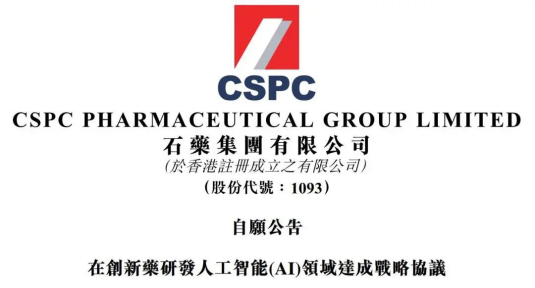
In these two collaborations, CSPC stated that it hopes to focus on drugs with high clinical needs by integrating the AI platforms of Insilico Medicine and XtalPi, utilizing AI-assisted drug design to improve the efficiency of new drug screening.
Currently, CSPC has not disclosed the R&D details of YS2302018, and it is still unknown whether the drug was fully self-developed by CSPC or involved AI collaboration partners.
Previously, CSPC had set ambitious goals, expecting to file for the market launch of nearly 50 innovative drugs and new formulation drugs, as well as over 60 generic drugs in the next five years.
Clearly, AI is helping CSPC improve the efficiency of new drug research and development, achieve a transformation into an innovative pharmaceutical company, and enhance its international influence.
 Continuously Refreshing AI Authorization Records
The significance of this deal lies in the fact that not only AI-driven pharmaceutical companies are involved in out-licensing, but also traditional pharmaceutical enterprises like CSPC are deeply utilizing AI technology and gaining recognition from international pharmaceutical giants.
Just before the CSPC deal, AI pharmaceutical companyRegor TherapeuticsAnnounced that it has reached a definitive purchase agreement with Genentech, under which Genentech will acquire the next-generation CDK inhibitor portfolio for the treatment of breast cancer.
According to the terms of the agreement, Regor Therapeutics will receive$850 Million Upfront Payment`, and is eligible for additional milestone payments.`
Genentech will be responsible for global clinical development, manufacturing, and commercialization. Regor Therapeutics will continue to manage the two ongoing Phase I clinical trials until their completion.
An upfront payment of up to $850 million not only ranks among the top in China's biopharmaceutical out-licensing deals but also sets a new record for the highest upfront payment in China's AI-driven drug discovery out-licensing.
According to the statistics from Pharma Intelligence, since 2023, the number of outbound licensing deals by Chinese AI-driven drug discovery companies has significantly increased.
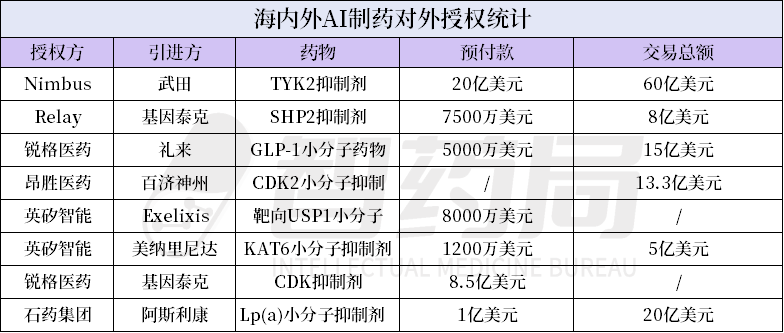
This trend also aligns well with Chinese pharmaceutical companies.The wave of License-out.In 2023, the number of License-out deals by Chinese domestic pharmaceutical companies exceeded License-in for the first time.
This also encourages companies in the financing winter to actively adjust their strategies, accelerate the pace of external licensing, and obtain cash flow, thereby gaining the opportunity to stay on the table.
Zhi Pharmacy Bureau learned that many companies are hoping to use AI assistance to accelerate drug development and then complete the commercial loop by means of external licensing, while reducing investment in businesses such as SaaS products.Among them, Insilico Medicine and Regor Therapeutics are particularly notable.License-outRich results.
In any case, the successful external authorization of a small molecule optimized by AI empowerment is good news for the entire industry.
We also look forward to AI pharmaceuticals and Chinese medicine resonating together, gaining more recognition from large pharmaceutical enterprises both at home and abroad.