

ExoRNA Bio's ER2001, First IV-Administered siRNA Therapy Enabling CNS Targeting via In Vivo Self-Assembled Exosomes, Presents Promising Initial FIH/IIT Data in Huntington’s Disease

ExoRNA
miRNA Nucleic Acid Drug Developer
Professor Pei Zhong from the First Affiliated Hospital of Sun Yat-sen University was invited to give a presentation titled "AnIn Vivo Self-assembled Exosome (IVSATM) Based Therapy – ER2001 Intravenous Injection for Huntington's Disease Treatment" presented the first introduction of the preliminary results of the IIT study on ER2001 injection. ER2001 injection is the world’s first investigational siRNA drug delivered intravenously, utilizing in vivo self-assembled exosome-packaged siRNA to cross the blood-brain barrier and achieve targeted delivery to the central nervous system. This study (NCT06024265) is also the first exploratory clinical trial for Huntington’s disease conducted in a country outside Europe and America (China). In 2023, ER2001 injection received Orphan Drug Designation (ODD) from the FDA, and in the first half of 2024, it obtained IND clearance for clinical research from both the FDA and NMPA. In the report, Professor Pei Zhong elaborated on the mechanism of action of ER2001 injection, its First-in-Human safety, tolerability, initial efficacy, and the upcoming Phase I clinical research plan. Data obtained from the IIT study shows that ER2001 has good safety and tolerability. Among the 10 treated patients, clear improvements were observed in overall clinical scale scores, particularly in total motor score, mental state, and comprehensive cognitive function enhancement. The progression of the disease was controlled or improved in all patients during the clinical study period. These IIT study results will be further validated in the upcoming Phase I clinical trial.
Particularly noteworthy is that, unlike other existing investigational Huntington's disease drugs, the improvements in clinical symptoms among these patients were observed within a relatively short study period after treatment began (weeks rather than one to two years). This is also the first clinical study of a small nucleic acid drug achieving central nervous system delivery via intravenous administration. ExoRNA Bio’s proprietary IVSA.TMSmall nucleic acid delivery platform, which can easily achieve treatment for genes related to different diseases by modifying the active components, brings hope and promise to the treatment of other neurodegenerative diseases through the progress of ER2001 injection in HD treatment.
The report attracted high attention and strong reactions from representatives of all participating parties. After the session, several representatives engaged in in-depth discussions with Professor Pei Zhong and expressed their intention to continue following the subsequent progress of ER2001 injection. Representatives from star companies in the Huntington's disease field, such as Alnylam, Roche, AskBio, and PTC Therapeutics, also gave presentations during the same period.
Finally, yesterday, Sweden's Karolinska Institute announced the 2024 Nobel Prize in Physiology or Medicine. Professor Victor Ambros of the University of Massachusetts Medical School and Professor Gary Ruvkun of Harvard Medical School were awarded for their discovery of miRNA and its role in post-transcriptional gene regulation. ExoRNA’s small RNA therapeutic system, realized through the IVSA™ delivery platform, is a miRNA-like siRNA therapeutic system that mimics the endogenous miRNA maturation and secretion pathway, representing a continuation, clinical application, and translation of the Nobel-winning discovery.
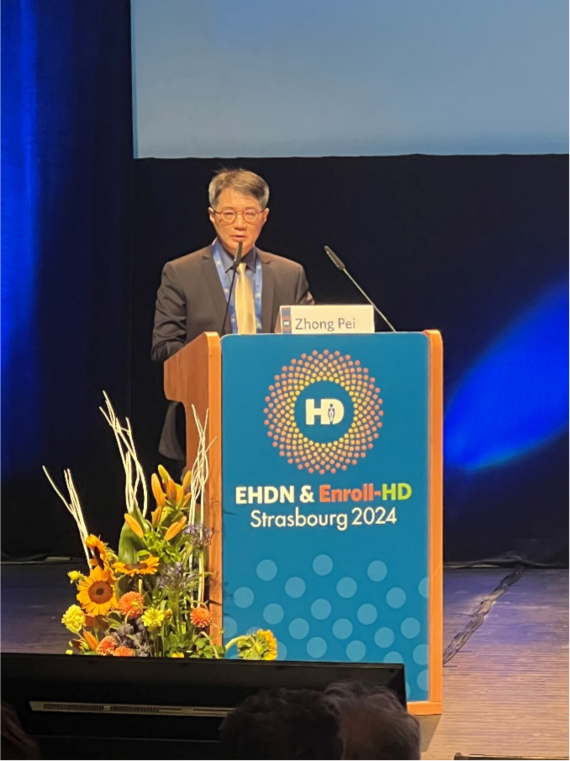
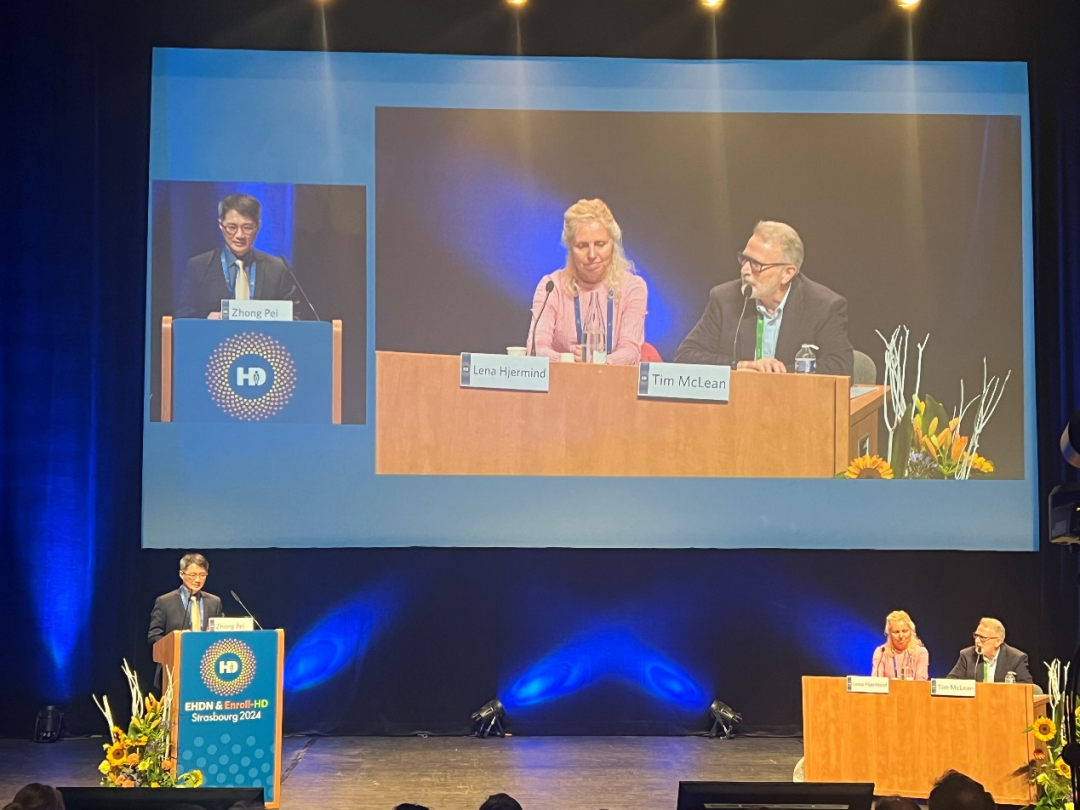
About EHDN & Enroll-HD 2024
EHDN & Enroll-HD 2024 is a comprehensive event that combines the European Huntington's Disease Network (EHDN) plenary meeting and the Enroll-HD conference. This three-day event provides delegates with the opportunity to learn about the latest advances in fundamental, translational, and clinical research on Huntington’s disease (HD), and to meet top experts in the HD field. All sessions are open to clinicians, scientists, HD advocacy representatives, and family members affected by HD. Leading companies and research institutions in the field of HD therapeutic drug development attended this conference.
About Professor Pei Zhong
Professor Zhong Pei is the Deputy Director of the Neurology Department at the First Affiliated Hospital of Sun Yat-sen University, doctoral supervisor, and Deputy Director of the Key Laboratory for the Diagnosis and Treatment of Major Neurological Diseases in Guangdong Province. He is a co-founder of the China Huntington Disease Network (CHDN), a member of the Huntington Disease Redefinition Task Force of the International Movement Disorder Society (MDS), a professional member of the Huntington Study Group (HSG) in the United States, and an editorial board member of several international academic journals on psychiatric disorders. Professor Pei has long been engaged in the diagnosis, treatment, and molecular mechanism research of neurodegenerative diseases, including Parkinson's disease, chorea, and Alzheimer's disease. As a talent introduced through Sun Yat-sen University’s "Hundred Talents Program," he has successively received funding from the National Natural Science Foundation of China, the National New Drug Innovation Project, the Guangdong Science and Technology Plan Project, and the Sun Yat-sen University Hundred Talents Program Funding Project, as well as participated in multiple funds such as the 973 Program. His research achievements have been published in journals like PNAS, Nature Neuroscience, and Stroke, with over 70 SCI papers published.
About ExoRNA Bio
ExoRNA Bio was founded by Professor Zhang Chenyu and Dr. Meng Xia in September 2021, with its headquarters located in Shenzhen and subsidiaries in Nanjing and Shanghai.
ExoRNA Bio focuses on the development of drugs for diseases that currently have no available treatments and unmet clinical needs, particularly for central nervous system disorders, with the vision of becoming a globally leading platform-based innovative nucleic acid drug company.
ExoRNA Bio has mastered a globally unique self-assembling exosome nucleic acid drug delivery platform, which boasts unique advantages such as multi-organ targeting, the ability to cross the blood-brain barrier, high safety, and low cost, providing a one-stop solution to the current delivery challenges of RNA drugs.
E.N.D
Previous article recommendations:
New Drug for ALS Approved! Biogen's "Tofersen Injection" Launched in China
Nature Headline! Chinese Scholars Publish the World's First Universal CAR-T Therapy Achievement
2024 Nobel Prize in Physiology or Medicine Announced!
YueSai Bio's iPS Cell-Derived Cell Therapy IND Accepted for Review
Covering an Area of Over 30,000 Square Feet, Legend Biotech Builds a New Cell Therapy R&D Base
Zehui Bio Submits Application for HKEX Listing
Chinese CXO Leader May Sell Off Some Overseas Assets
Seven Companies in China Complete New Round of Financing, Focusing on Cell and Gene Therapy Fields
The World's First Approved Universal Cell Therapy for Eye Diseases Officially Launched
Ten Key Areas in China's Biopharmaceutical Industry to Watch in the Next Decade
The Competitive Landscape of Gene Editing Therapy in China
Gene Editing Therapy Breakthroughs Continue in China, Set to Enter a Period of Rapid Development
A Cell Therapy Specialty Hospital in Beidaihe Officially Begins Operation
AAV Gene Therapy Improves Patients' Vision Over a Hundredfold