

XBIOME and WonderLab Announce Joint Research Breakthrough: Lacticaseibacillus paracasei GOLDGUT-Lpc969 Shows Promise in Preventing Allergic Rhinitis

Xbiome
AI Drug Developer for Gut Microbiota

Recently,Xbiome Partners with China's Leading Probiotics Company, WonderLabThe collaborative research achievement "Prevention and Alleviation of Allergic Rhinitis by Oral Administration of Lacticaseibacillus paracasei GOLDGUT-Lpc969"Frontiers in ImmunologyOfficially published. This finding discovered a strain of Lactobacillus paracasei, isolated from the gut of a healthy adult, named GOLDGUT-Lpc969 (Lpc969), which is expected to becomePrevention of Allergic Rhinitis (AR)Probiotics.
According to the introduction, Xbiome and WonderLab previously collaborated on scientific research and product development related to probiotics and respiratory health. This time, the teams from both sides jointly discussed and finalized the research plan, and are working together to advance its completion.
Allergic Rhinitis (AR) is an upper respiratory tract disease with a large patient population, characterized by nasal inflammation, usually caused by allergic reactions to allergens such as pollen, dust mites, or animal dander. According to the World Allergy Organization, AR in adults...Global prevalence as high as 10%-30%, the patient's work efficiency and living conditions will be seriously affected.
The disease is immunologically mediated through a Type I hypersensitivity mechanism, primarily caused by an imbalance in Th2/Th1 immune responses induced by immunoglobulin E binding to allergens. Currently, treatments for AR patients include costly immunotherapy, leukotriene receptor antagonists (LTRA), and intranasal corticosteroids; however, these therapies haveHigh incidence of side effects and limited therapeutic benefitsSuch disadvantages. Therefore, it is essential to develop safe and effective treatments and preventive methods for such public health issues.
In recent years, an increasing number of scientific studies have linked the emergence of allergic diseases to changes in the microbiome. Research has confirmed that newborn rhesus monkeys with gut flora disrupted by antibiotics exhibit impaired pulmonary immune systems; reports have found a significant reduction in several specific microbes in the intestines of children with allergic asthma; and as inflammatory factors rise in the peripheral blood serum of children with asthma, the probability of intestinal flora imbalance and gastrointestinal discomfort symptoms also increases.
The above scientific reports are all conveying a message:The relationship between gut microbiota and systemic immunity is inseparable, and the introduction of certain probiotics may be a potential strategy for preventing allergic inflammation in the respiratory system.Thus, the potential of probiotics in preventing and improving AR is receiving widespread attention from both the scientific community and the general public.
In this study, the research team conducted isolation and screening from their proprietary strain library through a series of in vitro and in vivo experiments.A strain of Lactobacillus paracasei, GOLDGUT-Lpc969 (Lpc969), was ultimately discovered, which, through oral administration, can achieve the purpose of preventing and alleviating AR.
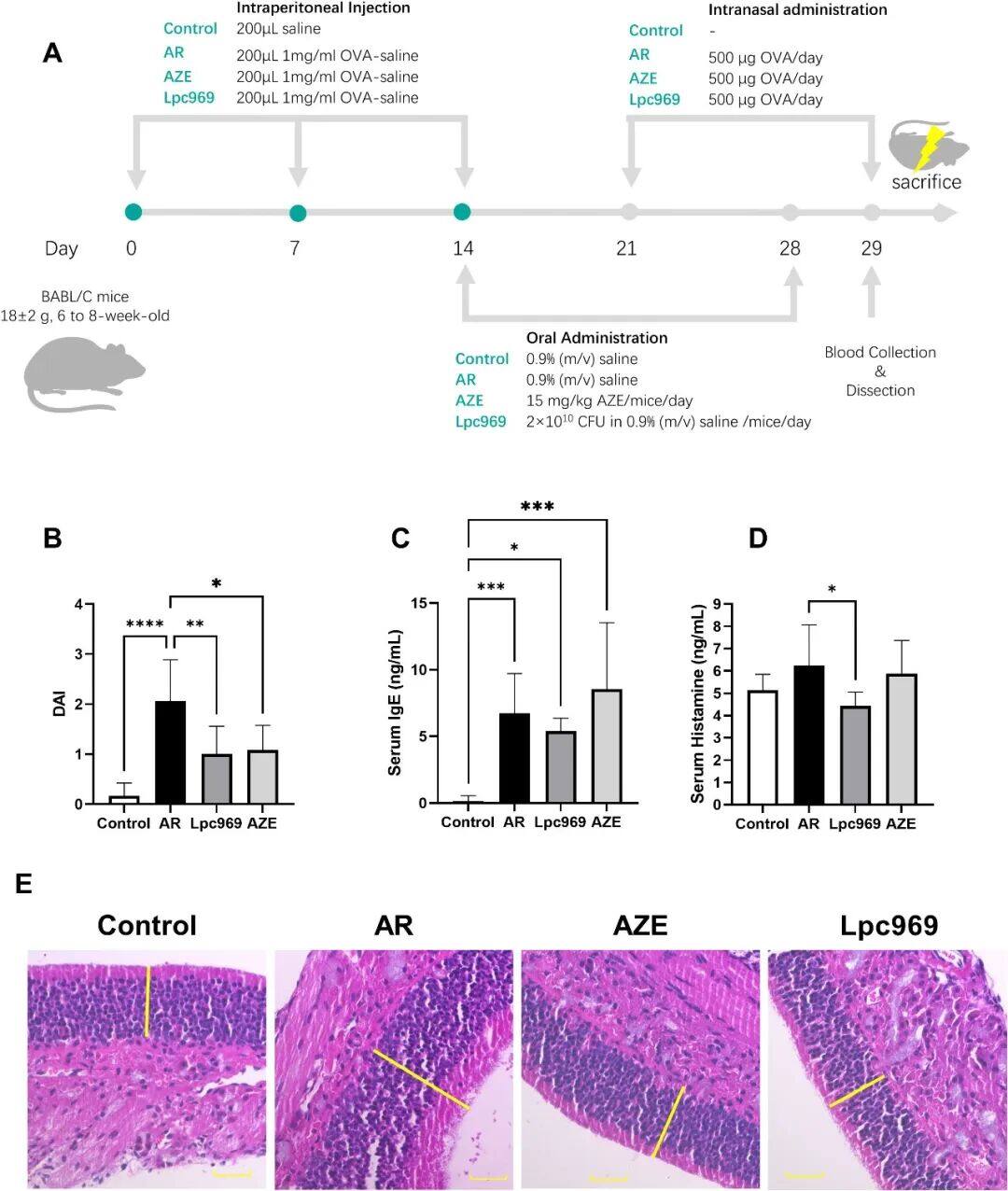
Researchers first tested the effect of the strain on histamine secretion and degranulation in the RBL-2H3 cell line, finding that the Lpc969 strain exhibited significant inhibitory effects (RBL-2H3 cell line: rat basophilic leukemia cell line, used as a model cell line for allergic rhinitis experiments). Subsequently, by evaluating the disease activity index in mice, serum immunoglobulin E (IgE) levels, inflammatory cell infiltration, and serum cytokines, the impact of the Lpc969 strain on OVA-induced allergic mice was assessed. It was found that this strain significantly reduced the activity index, serum histamine, and inhibited serum IgE levels. Moreover, treatment with the Lpc969 strain significantly suppressed Th2-related cytokines IL-4, IL-5, IL-6, IL-13, and TNF-α in mouse serum. Additionally, researchers conducted comparative genomic analysis at the genomic level between the Lpc969 strain and other AR-effective/ineffective strains to explore potential functional genes of effective strains in AR prevention and alleviation, deciphering the genetic "code" of the therapeutic mechanism, which aids researchers in further exploring and understanding the potential mechanisms of probiotic treatment for AR.
It is reported that this achievement was published in a well-known journal.Frontiers in Immunology's publication,It is the full-chain embodiment of the collaboration between Xbiome and its leading probiotics partner, WonderLab, from scientific research origins to strain screening, functional validation, and commercial transformation.In the future, through the cooperation between WonderLab Health Science Innovation Center and Xbiome's AI Microbiome Research and Industrial Transformation Technology Platform, both parties will continue to leverage their respective strengths to jointly explore a new paradigm for driving industrial development with science-based evidence as the engine.
-End-
About Xbiome
Xbiome Co. Ltd., founded in 2017, owns a leading AI microbiome research and industrial transformation platform, strategically focusing on FMT, drug discovery, and probiotics. In drug discovery, the team has completed layouts in the fields of oncology, digestive diseases, immune-related diseases, and urinary system diseases, with four pipelines entering clinical stages, two of which have reached phase II clinical trials. Regarding FMT, Xbiome has collaborated with nearly 20 well-known tertiary hospitals in China, such as Peking University Cancer Hospital and Peking Union Medical College Hospital, on gut microbiome clinical research across various indications. It has also developed the AI-FMT personalized precision treatment project for gut microbiota, targeting the broader health market to benefit patients with chronic diseases and sub-health populations. In the field of probiotics, Xbiome has successfully completed commercial collaborations and transformations with several top domestic and international health companies and is continuously advancing the development of proprietary strains.
Click below "Read the Original Text", view the full article.