

Pfizer Launches Phase 3 Clinical Trial in China for Mevrometostat, an EZH2 Inhibitor Showing Strong Anti-Cancer Activity in Earlier Studies

Pfizer
Pharmaceutical R&D Developer
Intelligent Finance APP learned that the official website of China Drug Clinical Trial Registration and Information Disclosure Platform recently announced that Pfizer (PFE.US) has launched an international multicenter (including China) Phase 3 clinical study (MEVPRO-1). This study aims to evaluate PF-06821497 in combination with enzalutamide versus enzalutamide or docetaxel forPatients with metastatic castration-resistant prostate cancer who have previously received abiraterone acetate treatmentEfficacy and safety. According to the public information, this study plans to enroll 600 participants internationally and 90 participants in China.
Public information shows,PF-06821497 (mevrometostat) is an investigational EZH2 inhibitor.According to Pfizer's disclosure during its Oncology Innovation Day in March this year, by 2030, its oncology R&D pipeline is expected to launch more than eight blockbuster therapies, including this EZH2 inhibitor.

Screenshot source: Official website of the Chinese Clinical Trial Registry and Information Disclosure Platform
Currently, EZH2 has become one of the leading targets in cancer treatment. EZH2 is a histone methyltransferase, and its abnormal expression is associated with the progression and poor prognosis of various cancers, including prostate cancer, breast cancer, lung cancer, and hematological malignancies, among others. Studies have shown,The overexpression of EZH2 can promote the occurrence and progression of cancer through various mechanisms, including silencing the expression of tumor suppressor genes, promoting the expression of genes involved in cell proliferation and survival, and so on.Moreover, EZH2 has been shown to promote cancer metastasis by regulating the expression of genes involved in epithelial-mesenchymal transition.
Mevrometostat is an EZH2-targeted inhibitor developed by Pfizer.It can block the abnormal gene expression driven by EZH2 overexpression in cancer cells, thereby reducing cancer cell proliferation, inducing cell death, and inhibiting cancer cell migration and invasion, ultimately achieving the purpose of treating cancer.
According to the clinical data disclosed by Pfizer at the Oncology Innovation Day in March this year,Mevrometostat in Combination with Enzalutamide (Xtandi) Shows Promising Anticancer Activity in Phase 1 Clinical Trial for Treated Metastatic Castration-Resistant Prostate Cancer (mCRPC) PatientsAmong them, mevrometostat + enzalutamide for the treatment of mCRPC patients previously treated with abirateroneThe median radiological progression-free survival (rPFS) was 17.1 months, showing a significant benefit compared to historical data (rPFS of 4.8 months).
According to the ClinicalTrials website, Pfizer has already launched one of its Phase 3 clinical trials (MEVPRO-1 study) in the United States this August, targeting mCRPC patients who were previously treated with abiraterone acetate. This is also the clinical study that Pfizer has initiated in China.
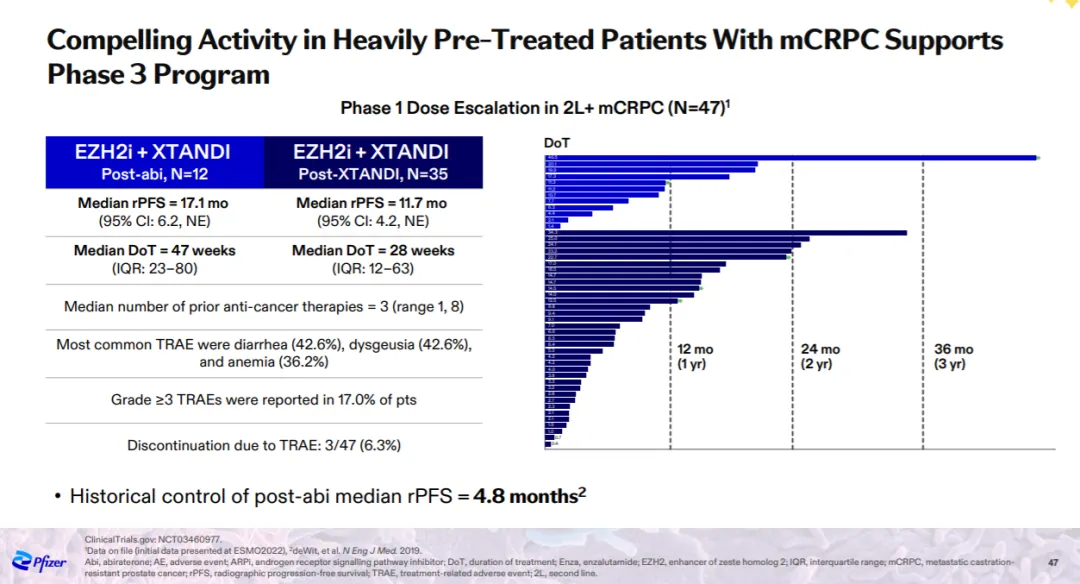
Clinical Trial Results of Mevrometostat (Source: Pfizer's Official Website)
In addition, Pfizer has recently initiated another Phase 3 MEVPRO-2 study, which plans to evaluate mevrometostat + enzalutamide in men with metastatic castration-resistant prostate cancer who have not been treated with abiraterone. The clinical trial application (IND) for this indication has also been approved in China, and it is expected to start in China soon.
Studies have shown that EZH2 inhibitors have demonstrated potential in treating various types of cancers, including B-cell lymphoma, solid tumors, and certain other hematological malignancies. For instance, tazemetostat has been approved for the treatment of some types of hematologic tumors. Meanwhile, multiple EZH2 inhibitors are currently under development worldwide for the treatment of various tumor types.