

Roche's Breakthrough Small Molecule Combination Therapy Receives FDA Approval with PFS More Than Doubled

Roche
Oncology Drug Research, Development, and Manufacturing
▎Edited by the WuXi AppTec content team

Today, the U.S. FDA announced the approval of Genentech's oral small molecule therapy developed by Roche.Itovebi (inavolisib) in combination with the CDK4/6 inhibitor Ibrance (palbociclib) and fulvestrant for the treatment of tumors carryingPIK3CAMutations, endocrine therapy resistance, hormone receptor (HR)-positive, human epidermal growth factor receptor 2 (HER2)-negative locally advanced or metastatic breast cancer in adult patientsThese patients experienced disease recurrence while receiving or after completing adjuvant endocrine therapy. Roche stated,Itovebi is a potential "best-in-class" PI3Kα inhibitor.

In addition,The objective response rate (ORR) was 58% in the inavolisib group and 25% in the control group. The median duration of response (DOR) was 18.4 months for inavolisib and 9.6 months for the control group.The interim analysis of overall survival has not yet reached statistical significance, but inavolisib reduced the risk of patient death by 36% (HR=0.64, 95% CI: 0.43-0.97).
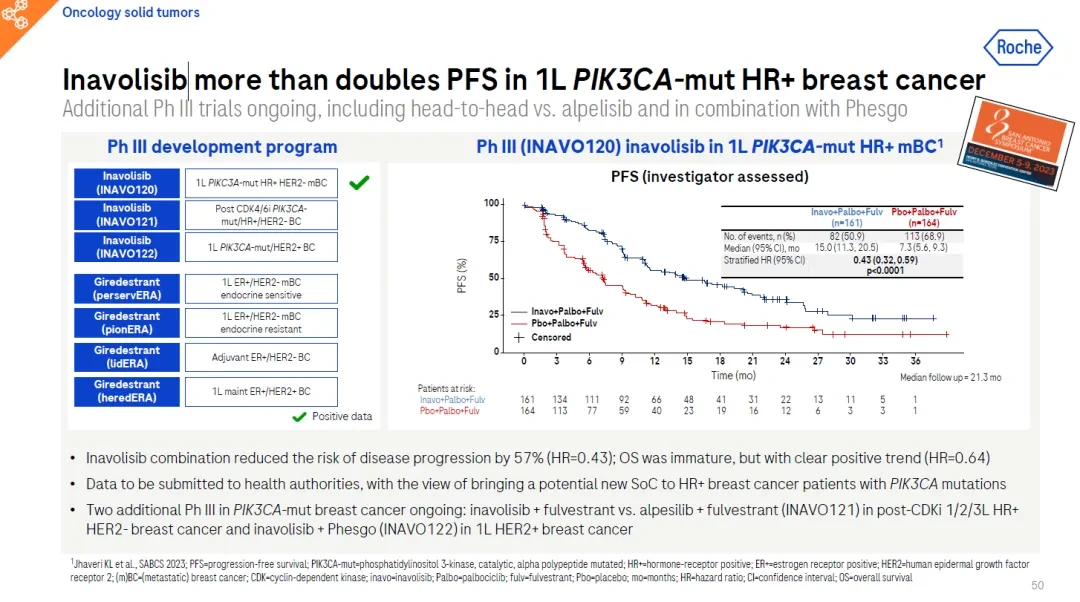
▲Results of Inavolisib in Breast Cancer Trials (Source: Roche Official Website)
Inavolisib is an oral therapy with high in vitro potency and selectivity for PI3Kα inhibition, capable of specifically triggering the degradation of PI3Kα protein mutants.Through this unique dual mechanism of action, inavolisib may provide a new treatment option for HR-positive/HER2-negative,PIK3CAPatients with mutated advanced breast cancer achieve well-tolerated, durable disease control and potentially improved outcomes.It has previously received Breakthrough Therapy Designation from the U.S. FDA.
HR-Positive Breast Cancer is the most common type of all breast cancers, accounting for approximately 70%. HR-Positive Breast Cancer refers to those breast cancers that express estrogen receptors (ER) and/or progesterone receptors (PR), which can promote tumor growth. Patients diagnosed with HR-positive metastatic breast cancer often face the risks of disease progression and treatment side effects, thus requiring additional treatments. The PI3K signaling pathway is frequently dysregulated in HR-positive breast cancer, mostly due toPIK3CAThe activation mutation is one of the potential mechanisms underlying resistance to standard endocrine therapy combined with CDK4/6 inhibitors.
Learn More About FDA-Approved New Drugs
Please click the image below to access our mini program



▲To learn more about the application of cutting-edge technologies in the biopharmaceutical industry, please long press and scan the QR code above to access "WuXi Live Studio" and watch live discussions and exciting replays on related topics.


Share,PointLike,In view, Focus on Global Biomedical Health Innovation