Johnson & Johnson Submits NDA in China for 5-Minute Subcutaneous Amivantamab Plus Lazertinib Combination Therapy in NSCLC

Johnson & Johnson
Healthcare Product Manufacturers, Health Service Providers
▎WuXi AppTec Content Team Report
Today (October 11), the official website of the Center for Drug Evaluation (CDE) of the China National Medical Products Administration (NMPA) has just announced that two product marketing applications from Johnson & Johnson have been accepted, respectively.EGFR/MET Bispecific Antibody TherapyAmivantamab Injection (Subcutaneous Injection) andThe Third Generation EGFR-TKI Oral DrugLanreotide Mesylate Tablets.Based on the public information from Johnson & Johnson, the combination therapy consisting of the two drugs may be the subject of this marketing application, with indications possibly including those already approved for the intravenous formulation of Amivantamab.
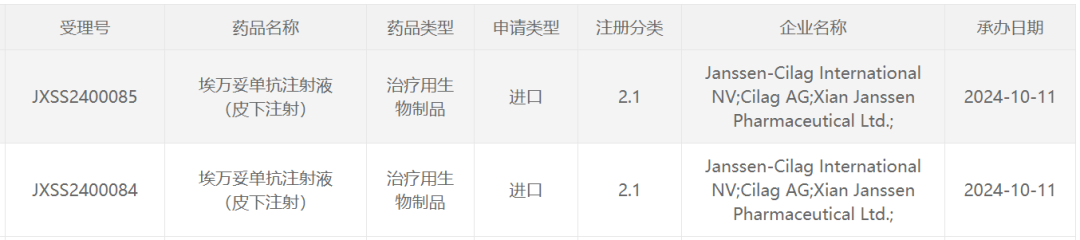
 Screenshot source:CDE Official Website
Amivantamab (amivantamab)YesA bispecific antibody targeting EGFR and MET that is under research and fully humanized,In addition to blocking EGFR and MET-mediated signal transduction, it can also direct immune cells to target those with activating and resistant mutations.EGFR/METTumors with Mutations and Amplifications。Lazertinib Tablets (lazertinib)It is an orally administered third-generation brain-penetrant EGFR TKI that targetsT790MMutations and activation of EGFR mutations, while retaining the wild typeEGFR。
AmivantamabThe intravenous formulation received accelerated approval from the FDA in May 2021 and has since been approved for multiple indications, covering different types of non-small cell lung cancer patients, including:Combined with third-generation EGFR-TKI oral medicationLanreotideFirst-line treatmentTested and proven to carry with FDA approvalEGFRExon 19 deletion or exon 21L858RAdult patients with locally advanced or metastatic NSCLC harboring substitution mutations。
FDA Approves This Combination Therapy,Mainly based on the positive results of the MARIPOSA Phase 3 clinical study, the analysis shows,Amivantamab and Lazertinib Mesylate TabletsCompared with the active control drug,Can reduce the risk of disease progression or death by 30%, the median progression-free survival (PFS) for patients in the combination therapy and active comparator groups were23.7 months vs. 16.6 months;Combined Therapy GroupMedian DOR is 9 months longer than the active control drug (25.8 months vs 16.7 months)。

AmivantamabTheSubcutaneous Injection FormulationThe listing applications were also successively approved in June and September this year.FDAAndNMPAAcceptance,PossibleFor all currently approved or submittedAmivantamabIndications for intravenous formulations, covering different types of non-small cell lung cancer (NSCLC), including combination therapy with Lanzetinib。According to a previous press release from Johnson & Johnson, patients are able to complete the injection of this subcutaneous formulation within 5 minutes.Significantly shorten the administration timeBetweenAt the same time, the subcutaneous formulation also showed advantages such as a 5-fold reduction in infusion-related reactions, longer overall survival, progression-free survival, and duration of response.
Hope this bispecific antibody new drug combination therapy proceeds smoothly in subsequent development, and new progress comes soon.
This article is from the content team of WuXi AppTec. Individuals are welcome to share it on their social media circles, but unauthorized reproduction by media or institutions in any form to other platforms is prohibited. For reprint authorization or other cooperation inquiries, please contact wuxi_media@wuxiapptec.com.
Disclaimer: The content team of WuXi AppTec focuses on introducing the research progress in global biopharmaceuticals and health. This article is for information exchange purposes only, and the views expressed in the article do not represent the position of WuXi AppTec, nor does it mean that WuXi AppTec supports or opposes the views in the article. This article is not a recommendation for treatment plans. If you need guidance on treatment options, please visit a regular hospital.