

AviadoBio and Astellas Strike $2.2 Billion Gene Therapy Deal for AVB-101 in Frontotemporal Dementia

AviadoBio
Developer of Neurodegenerative Disease Therapies

Astellas
Pharmaceutical R&D Manufacturer
On October 8, AviadoBio and Astellas announced an exclusive option and license agreement for AVB-101. Under the terms of the agreement, Astellas will have the right to obtain a global exclusive license for the development and commercialization of AVB-101 in frontotemporal dementia (FTD-GRN) and other potential indications.
Astellas will make a $20 million equity investment and up to $30 million in upfront payments for the licensing rights to AVB-101. If Astellas exercises its option, AviadoBio is also eligible to receive up to $2.18 billion in licensing fees, milestone payments, and royalties.
AVB-101 is a one-time gene therapy based on adeno-associated virus (AAV), with the first indication for FTD-GRN caused by pathogenic mutations in the GRN gene, currently in the phase 1/2 clinical stage.Previously, AVB-101 has been granted Orphan Drug Designation by the FDA and the European Commission, as well as Fast Track Designation by the FDA.
Frontotemporal Dementia (FTD) is a devastating early-onset dementia that typically leads to death within 3 to 13 years after diagnosis. Patients with FTD often experience a rapid decline in executive functions (such as attention control, working memory, problem-solving, etc.) and exhibit atypical behaviors, personality changes, behavioral disorders, language loss, apathy, and limited mobility.
FTD is a significant cause of dementia in people under 65, often underestimated and misdiagnosed. The estimated prevalence is 4.6 cases per 1,000 individuals. FTD typically has an earlier onset age compared to Alzheimer's disease, with most FTD cases occurring between the ages of 45 and 68. Due to its earlier onset, the impact of FTD on work, family, and society may be much greater than that of Alzheimer's disease.
Up to 40% of FTD cases are familial, with approximately one-third caused by mutations in one of the following genes: GRN, MAPT, or C9orf72.Among them, GRN gene mutations account for 5%-10% of all frontotemporal dementia patients and 22% of familial frontotemporal dementia patients.These patients have a mutation in a single allele of the GRN gene, resulting in an approximately 50% reduction in the level of progranulin (PGRN) that it encodes, which in turn leads to FTD symptoms.
The GRN gene encodes PGRN, a key regulator of human immune response, lysosomal function, and neuronal survival in the brain, and is genetically associated with many neurodegenerative diseases.The mechanism by which PGRN deficiency leads to FTD has not been fully elucidated and may be related to lysosomal dysfunction and inflammation in the central nervous system. GRN gene mutations affect the production of PGRN protein in neuronal lysosomes, thereby causing progressive neuronal degeneration and death.
Dr. David Cooper, Chief Medical Officer of AviadoBio, said, "There is an urgent need for new treatment options for FTD-GRN patients. This devastating and progressive disease currently lacks effective mitigation and treatment methods, making it especially difficult for patients and their families."
Like most gene therapy companies, the first key challenge for AviadoBio lies in delivery, particularly in achieving micro-dosing across the blood-brain barrier. This is precisely where its founding team excels: In 2019, AviadoBio was established based on research from Professor Chris Shaw's lab at King’s College London. Professor Chris Shaw has long focused on methods to directly inject micro-doses of therapeutics into brain tissue and currently serves as AviadoBio's Chief Scientific and Clinical Advisor.
AVB-101 aims to restore normal PGRN expression in the brain by delivering a normal gene copy expressing PGRN through the AAV9 vector. In terms of delivery method, AVB-101 utilizes minimally invasive stereotactic neurosurgery to administer the treatment directly into the thalamus, leveraging the brain's neural network to enhance the vector's biodistribution and achieve maximal widespread gene expression.The thalamus has extensive connections with other parts of the brain, including the frontal and temporal lobes, which play an important role in FTD symptoms.
Preclinical studies show that AVB-101 can widely express normal gene copies expressing PGRN in the brain, while avoiding the presence of this gene in serum or liver, thereby reducing off-target effects. A previous press release noted that the phase 1/2 clinical trial ASPIRE-FTD for AVB-101 isFirst-in-human thalamic gene therapy for the treatment of adult neurodegenerative diseases.
Moreover, the $2.2 billion high price may also come from the clinical efficacy and safety data of the competitor, Eli Lilly:Prevail Therapeutics, a subsidiary of Eli Lilly, released interim Phase 1/2 clinical data in Nature Medicine this year. Its in vivo gene therapy pipeline, PR006, also targets the FTD-GRN indication. The results showed that a single injection of PR006 into the cisterna magna was safe and well-tolerated. All patients produced treatment-induced anti-AAV9 antibodies in the cerebrospinal fluid, but no anti-PGRN antibodies were detected. Meanwhile, PGRN levels increased in the cerebrospinal fluid of all patients, and most patients experienced a temporary rise in PGRN levels in their blood.
In this collaboration, Astellas will make a $20 million equity investment and a $30 million upfront payment to AviadoBio. The collaboration model of "equity investment + upfront payment" may be a measure for Astellas to diversify cooperation risks and establish extensive partnership connections.
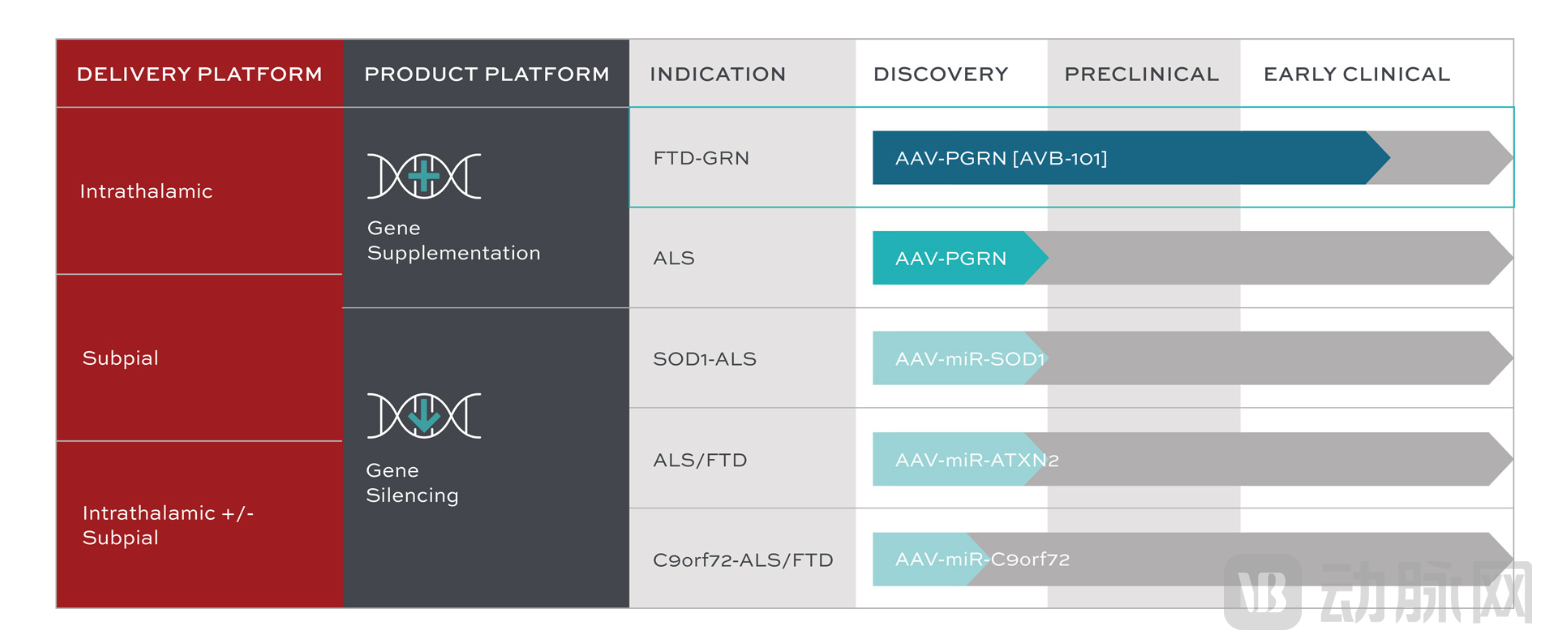
In addition to the core pipeline of AVB-101 for the treatment of FTD, AviadoBio has also laid out a pipeline for Amyotrophic Lateral Sclerosis (ALS).
Cell and gene therapy is a long-term bet for Astellas.Including the acquisition of Audentes Therapeutics, a leading gene therapy company, at a 110% premium for $3 billion in 2019; and a strategic collaboration with Dyno Therapeutics in 2021, with an estimated total value exceeding $160,000, to develop gene therapies for skeletal and cardiac muscles using the AAV vector platform CapsidMap™.
In the field of cell therapy, in 2018, Astellas acquired Universal Cells to obtain universal donor cell technology based on gene editing. It also reached a cooperation agreement with Adaptimmune Therapeutics to jointly develop and commercialize allogeneic T-cell therapies based on stem cells (including CAR-T and TCR-T), with potential payments up to $897.5 million.
But in recent years, there have been repeated reports of clinical holds and results falling short of expectations:In 2022, the development of gene therapies AT702, AT751, and AT753 for Duchenne muscular dystrophy, originating from a $3 billion acquisition, has been terminated. In 2023, Astellas announced the termination of its TCR-T cell collaboration with Adaptimmune Therapeutics, which is expected to result in an impairment loss of 4.7 billion yen (approximately $35.1 million). In 2024, Astellas revised its financial forecast for the fiscal year 2023, with Audentes' AT808 project expected to bring an impairment loss of nearly $260 million.
According to the official website, Astellas is focusing on building a portfolio of gene therapies delivered via adeno-associated virus (AAV) for the treatment of rare neuromuscular and central nervous system (CNS) diseases.From the latest product pipeline, Astellas has only three gene therapies under development, all acquired from Audentes: AT132 for X-linked myotubular myopathy (on clinical hold), AT845 for Pompe disease, and ASP2016 for Friedreich's ataxia.
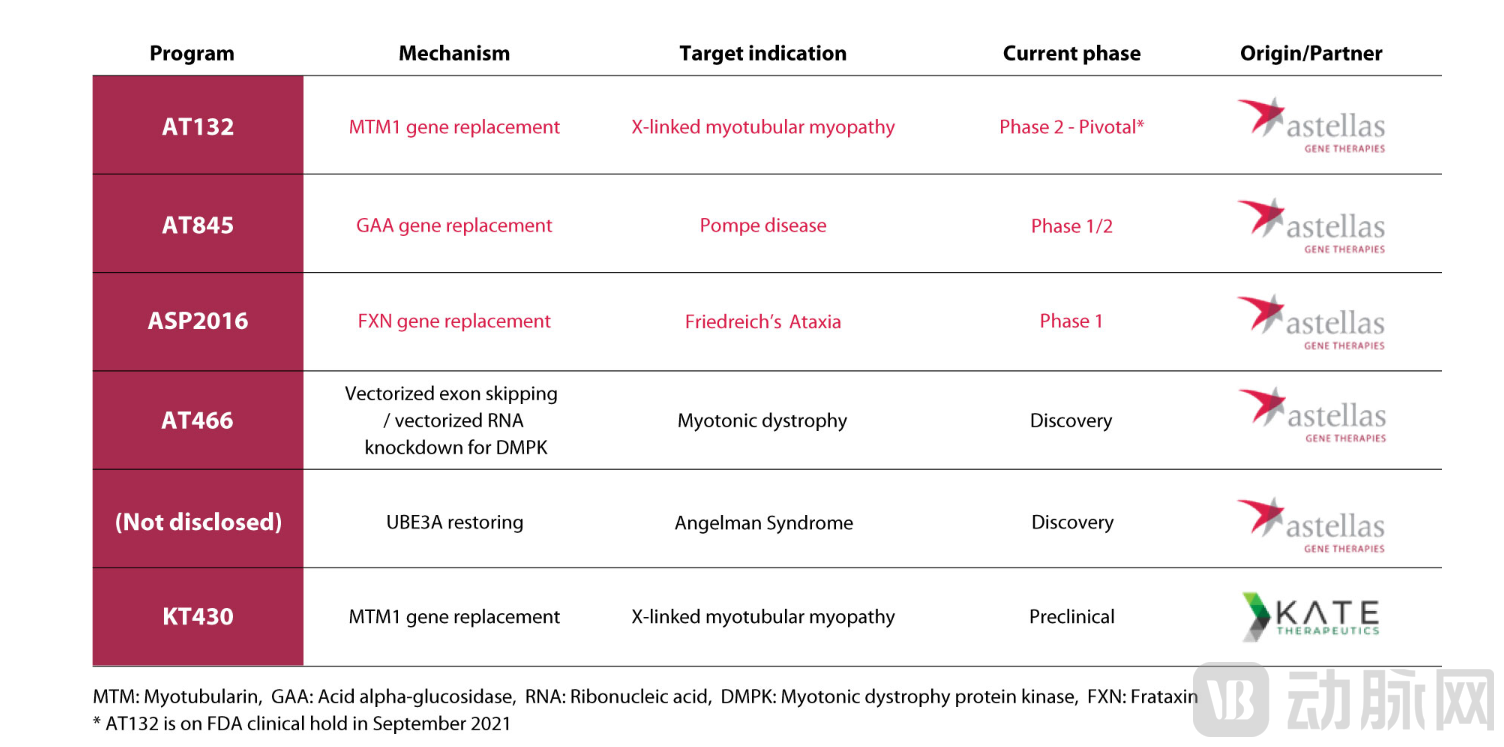
Astellas Gene Therapy Pipeline (Official Website)
Previously, a total of four patient deaths were reported in the clinical trials of AT132, during which the FDA issued two clinical holds, raising concerns about the hepatic risks associated with high-dose AAV vectors. The clinical trial of AT845 was also placed on hold by the FDA due to a peripheral sensory neuropathy adverse event in one participant and was not lifted until 2023.
On one hand, clinical trials are constantly halted due to safety issues; on the other hand, Astellas is withdrawing previously established production resources such as factories, and instead, building smaller-scale, more operationally efficient R&D innovation centers.In May this year, Astellas opened a $90 million laboratory and innovation center in South San Francisco, aiming to create a "central location" to connect the work of its subsidiary, Xyphos Biosciences. In September, Astellas' subsidiary, Astellas, announced it would close its gene therapy plant in San Francisco and shift production to its North Carolina facility. In October, Astellas revealed plans to establish a cell therapy research institute for Universal Cells in Tsukuba, Japan, while cutting 24 employee positions from its former Seattle base, 12 of which will be filled by local employees in Japan.
But from a broader perspective, resource adjustments and clinical setbacks can be interpreted as short-term measures and temporary difficulties. Whether it is the recent $2.2 billion AVB-101 gene therapy pipeline collaboration or the nearly $800 million in vivo CAR-T therapy development partnership (with Kelonia Therapeutics) in February this year, Astellas’ long-term commitment and ambition in cell and gene therapies are evident.