On September 16, 2024, the team of Professor John P.A. Ioannidis from Stanford University released the 7th edition of the global top 2% scientist list, selecting the top 2% of scientists in various fields from nearly 7 million scientists worldwide, covering 22 fields and 174 sub-disciplines.
Zhang Linfeng, founder and chief scientist of DP Technology, and Ke Guolin, head of machine learning algorithms at DP Technology, have been selected for the 2024 list. Both have been consecutively selected for three years since 2022, with their rankings rising significantly year by year.
It is reported that the list is based on the Scopus database, covering papers from SSCI, SCI, EI journals, and EI conferences, etc. It conducts a comprehensive evaluation through metrics such as citation counts, h-index, and hm-index, providing an affirmation of scientists' work in various fields with straightforward data.
In addition, the 2024 list has also added data on retracted papers as well as citations/self-citations of retracted papers to provide a more comprehensive evaluation.The inclusion of Lin Feng and Guo Lin on the list is an affirmation of their years of dedication to AI for Science, as well as recognition of the substantial achievements made by the DP Technology team under their leadership.Lin Feng, as the founder and chief scientist of DP Technology, successively obtained a Bachelor of Science from Peking University and a Ph.D. in Applied Mathematics from Princeton University. Lin Feng has long been committed to research on interdisciplinary issues in AI for Science, with abundant achievements in machine learning, computational physical chemistry, materials, and drug design. His works have been published in top academic journals such as *Nature*, *PNAS*, and *Physical Review Letters (PRL)*, as well as in top academic and AI conferences like APS March, AIChE, ACM/IEEE Supercomputing, NeurIPS, ICLR, and were featured in the list released by Stanford University.List of the Top 2% Scientists Worldwide". Zhang Linfeng, as the core developer, led the development of Deep Potential."DeePMD、DeePKS、DeePWF、DeePCGAnd a series of microscale simulation algorithms and corresponding open-source software. In 2020,DeePMD Wins ACM Gordon Bell Prize, the Highest Honor in High-Performance Computing, which was also selected by the academicians of the two academies for evaluation.Top Ten Scientific and Technological Advances in China in 2020. As the founder and chief scientist of DP Technology, Linfeng Zhang led his team and collaborators to jointly developReinforced Dynamics/Uni-Mol/Uni-Fold/Uni-FEP Algorithms and pre-trained large models. In addition, Linfeng Zhang has been actively involved in and promoting the largest open-source community in the AI for Science field.DeepModeling's development and expansion, leading community infrastructure construction, project collaboration and development, etc. Among them,OpenLAM Large Atomic Model PlanWe sincerely invite dozens of top universities worldwide to build together, including a team of advisors composed of Nobel Prize winners, academicians of the Chinese and American academies of sciences and engineering, and top technical experts. The initial achievements have been reported by the People's Daily, Xinhua News Agency, and CCTV.Repeated ReportsIn addition, Lin Feng has received numerous awards for his outstanding contributions to AI for Science and intelligent computing applications, including being featured on the Forbes Asia U30 cover, recognized as a DeepTech China Innovator in Intelligent Computing, and named one of Fortune China's 40 Business Elite.As a partner of DP Technology and Senior Vice President of AI, Guo Lin currently leads the research and application development of artificial intelligence and machine learning algorithms at DP Technology. He previously served as a senior researcher in the Machine Learning Group at Microsoft Research Asia (MSRA) and has published dozens of papers in top conferences such as NeurIPS, ICLR, and ICML.Notably, one of Guolin's representative works is LightGBM, an efficient distributed decision tree algorithm tool. Due to its excellent performance, LightGBM has been widely used in predictive modeling tasks such as finance, advertising, and recommendation systems.Its open-source code has garnered approximately 16,000 stars on GitHub, with over 370 million downloads, and the related paper has been cited about 14,000 times cumulatively. It was also recognized as one of the "AI100: Top 100 AI Achievements (1943-2021)."In recent years, Guolin has focused on research in the AI for Science field, achieving a series of significant results in multiple key application scenarios, including protein structure prediction, 3D small molecule drug representation modeling and generation, experimental characterization analysis, and scientific literature understanding.His representative achievements include Uni-Fold, the first work in China to reproduce AlphaFold2.It has gained widespread influence in the open-source community; and further launched more widely applicable versions, including Uni-Fold Multimer and Uni-Fold Symmetry, which offer better performance.In the field of 3D molecular modeling, Guolin led his team to launch Uni-Mol, the first universal 3D molecular representation model, along with its derived domain applications such as Uni-MOF, Uni-QSAR, and Uni-Mol Docking. Additionally, he has achieved outstanding results in international competitions multiple times, including the 2021 KDD CUP championship and the 2021 NeurIPS Open Catalyst championship.In the 7th edition of this year's Global Top 2% Scientists list, Professor E Weinan, academician of the Chinese Academy of Sciences, chairman of the Beijing Institute of Artificial Intelligence for Science, director of the International Machine Learning Research Center at Peking University, and chief scientific advisor of DP Technology, has been honored on both the "Lifetime Scientific Impact Rankings" and the "Annual Scientific Impact Rankings".Full list information: https://elsevier.digitalcommonsdata.com/datasets/btchxktzyw/6One more thing......
Scientists + Practitioners Drive the Advancement of AI for Science
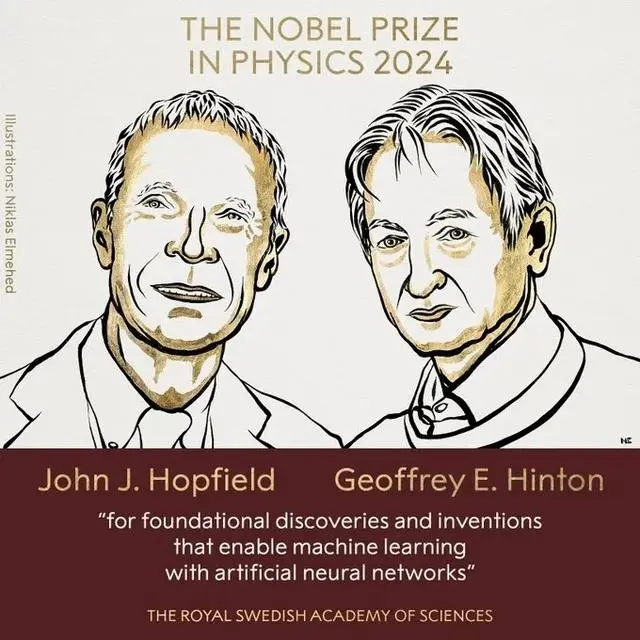
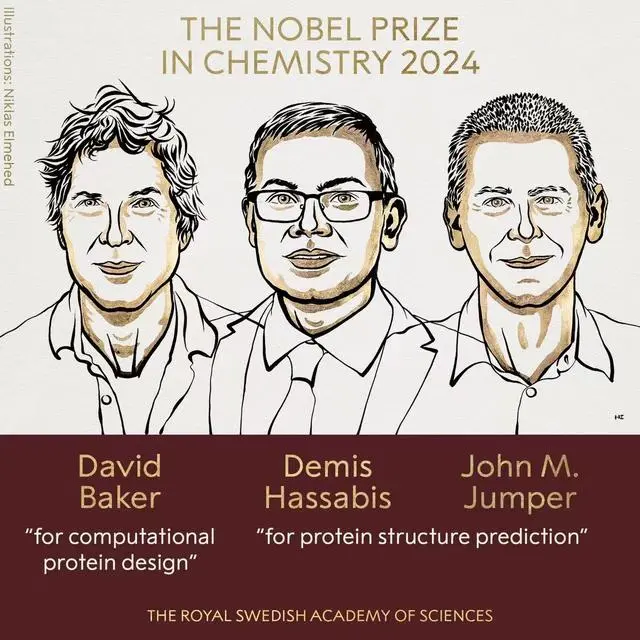
On October 8 local time, the Royal Swedish Academy of Sciences decided to award the 2024 Nobel Prize in Physics to John J. Hopfield and Geoffrey E. Hinton for their fundamental discoveries and inventions in using artificial neural networks for machine learning. On the 9th, the Nobel Prize in Chemistry was awarded to David Baker, Demis Hassabis, and John M. Jumper for their contributions to "computational protein design" and "protein structure prediction."This year's Nobel Prize in Physics is not only an affirmation of the achievements of the two scientists but also a strong emphasis on the importance of interdisciplinary research, showcasing the tremendous energy that can be generated when profound insights in physics "collide" with innovations in computer science.When people talk about artificial intelligence today, they often refer to machine learning using artificial neural networks. Ulf Danielsson, Secretary of the Nobel Physics Committee, emphasized that the research and application of artificial neural networks in physics have been ongoing for quite some time. This year's Nobel Prize in Physics is not awarded for the development of artificial intelligence over the past few years, nor is it for large language models or similar advancements, but rather for fundamental inventions.Long before artificial intelligence became today's tech buzzword, these two scientists had been doing important work in the field of artificial neural networks since the 1980s. This technology was originally inspired by the structure of the brain. Just as a large number of neurons in the brain are connected through synapses, an artificial neural network is composed of a large number of "nodes" connected by "links." Each node is like a neuron, and the strength of the connections is similar to the strength of synapses, determining the effectiveness of information transmission.A day later, the shock in the physics community had not yet subsided when the Nobel Prize in Chemistry once again bestowed honor upon the AI field.In fact, David Baker successfully completed an almost impossible feat by creating a new kind of protein. Hassabis and Jumper developed an artificial intelligence model to solve a problem that has existed for 50 years: predicting the complex structure of proteins.The Nobel Prize Committee commented: David Baker's contribution lies in moving protein design from test tubes in the laboratory to the virtual world of computers. Baker's "magic" involves deducing the most stable and efficient protein folding structures by simulating amino acid interactions through computer modeling. David Baker and his research team continuously create imaginative proteins, one after another, proving their potential applications in drugs, vaccines, nanomaterials, and micro-sensors, with broad prospects for use.Imagine that proteins are like Lego bricks in the biological world, and in the past, we could only piece these bricks together by luck and experience. Baker's computational tools, however, provide us with the ability to automatically assemble them—not only can they be quickly put together, but we can also design entirely new brick shapes according to our intentions. AI has already made tremendous contributions to scientific progress, and in the future, with the help of AI, protein design can better serve humanity.Demis Hassabis and John M. Jumper were recognized for developing AlphaFold2, an artificial intelligence model that solved a 50-year-old challenge by predicting the complex structures of approximately 200 million known proteins, and has been used by over 2 million people worldwide.Notably, Demis Hassabis and John M. Jumper both work at DeepMind, a leading AI company under Google. The former is the CEO of DeepMind, while the latter serves as a senior research scientist. In 2023, their team developed the AI model AlphaFold, an algorithm based on deep learning and neural network technologies. This innovation not only predicts the three-dimensional structures of proteins but has also become a crucial tool in all protein structure research. We are delighted by DeepMind's achievements and find great encouragement in the growing recognition and application of AI for Science across broader communities.The Power of the Chinese Version of AlphaFold Should Not Be Underestimated
As a pioneer and practitioner in the AI for Science field, DP Technology is committed to leveraging AI to learn a series of scientific principles and knowledge, further addressing key issues in scientific research and industrial R&D. With deep expertise in interdisciplinary fields, DP Technology has built the "DP · Universe®" AI for Science large model system, transitioning research methods across numerous disciplines from the "experimental trial-and-error/computer" era into the "pre-trained model era." Taking "microscale industrial design and simulation" as the entry point, DP Technology has developed Bohrium® Bohr Research Space Station, Hermite® Drug Computational Design Platform, RiDYMO® Difficult-to-Drug Target R&D Platform, and Piloteye® Battery Design Automation Platform—key infrastructures for scientific and industrial R&D. This forms an "innovation-to-application" chain and open ecosystem for AI for Science, empowering industries across the board and building a new generation of industrial design and simulation systems for the most fundamental areas of human economic development: biomedicine, energy, materials, and information science and engineering.Notably, under the leadership of Lin Feng and Guo Lin, DP Technology launched Uni-Fold in 2021, whichLatest Attention Mechanism Acceleration Technology: Flash-Attention WithUni-Fold Deep integration, further optimizing the model'sMemory UtilizationAndComputational Efficiency。After optimization, the end-to-end training speed of Uni-Fold increased by another 18% (http://www.bibdr.org/nd.jsp?id=279&groupId=-1), further enhancing the existing protein folding model (Jumperet al`, 2021) End-to-End Training Time`Reduced from 11 days to 4 days。In addition, this technology significantly reduces the video memory requirements for model inference, and when not using model parallelism and chunked computation techniques, it supports the maximum sequence length.Increased to 2 times。The relevant implementation has been open-sourced to the DP Technology Github repository.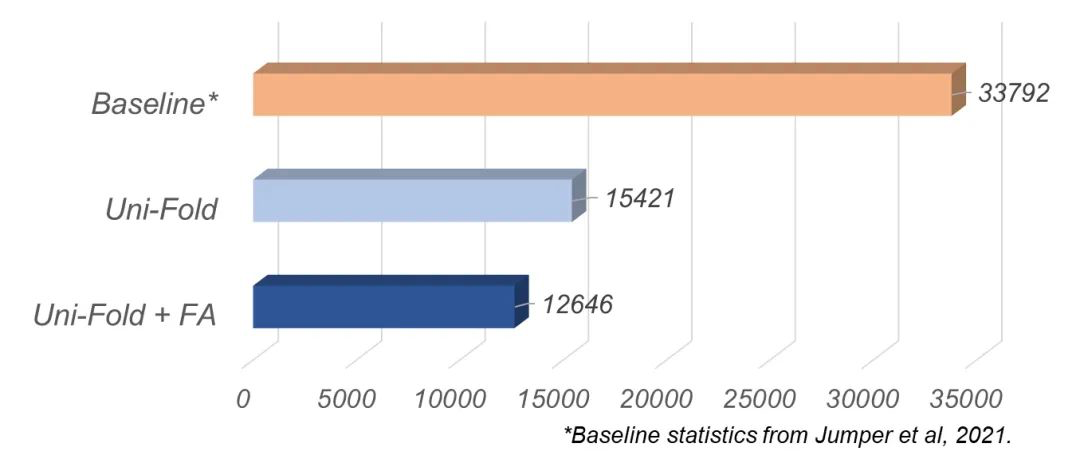
In November 2023, DP Technology released Uni-Mol Docking v2, which outperformed AlphaFold-latest released by DeepMind at the end of October 2023.On the PoseBuster dataset, Uni-Mol Docking v2 achieved a prediction accuracy of 77.6%, generating more reasonable molecular conformations and ensuring the accuracy of geometric shapes and chiral relationships. In May 2024, this model was included as an experimental baseline in AlphaFold3's official Nature paper, performing just slightly behind AlphaFold3.
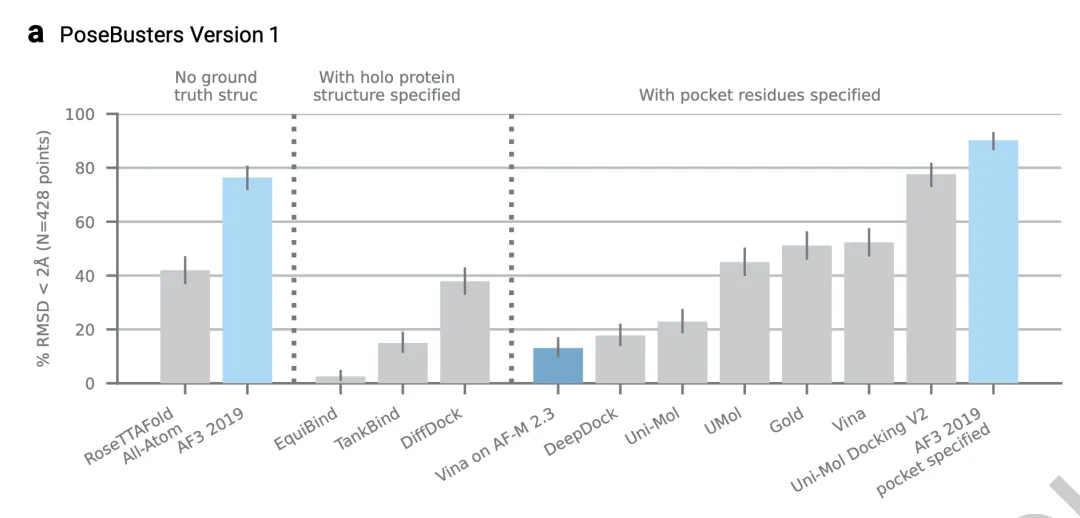
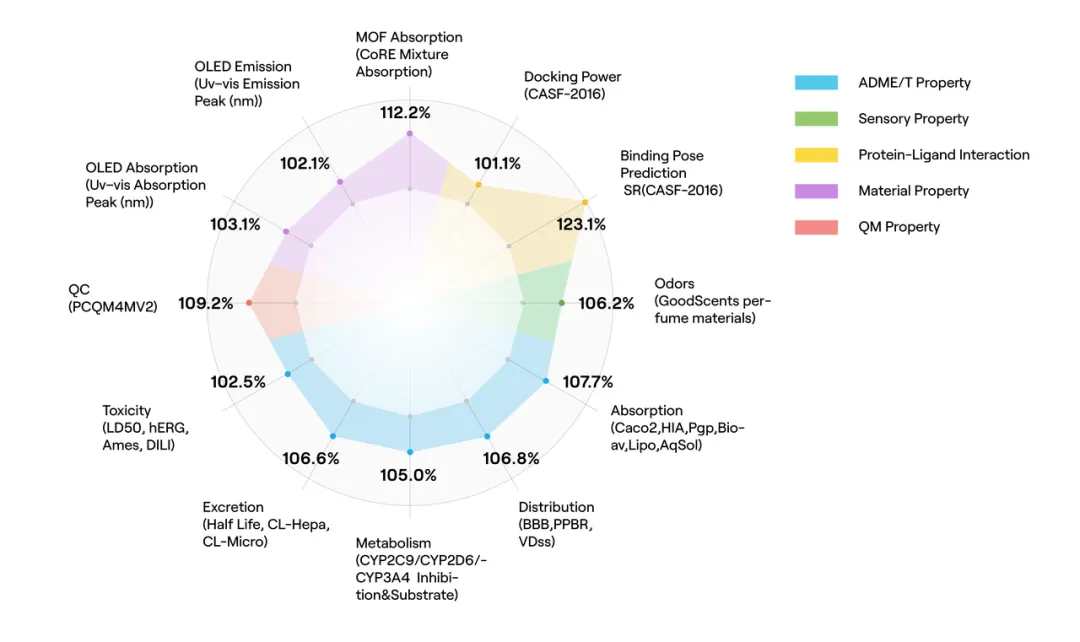
Previously, Uni-Mol, released by DP Technology in May 2022, garnered significant attention. It is a general molecular representation learning framework based on three-dimensional molecular structures, and the paper was accepted by the prestigious machine learning conference ICLR 2023.Uni-Mol demonstrates superior performance and strong model generalization capabilities, surpassing previous methods in tasks such as small molecule property prediction, protein target prediction, and protein-ligand complex conformation prediction. Uni-Mol has been applied to multiple products of DP Technology and has garnered significant attention from researchers in both academia and industry. Additionally, we have successfully applied Uni-Mol to more fields, such as material design, achieving excellent results. Subsequently, weThe model framework of Uni-Mol has been significantly upgraded to Uni-Mol+, enhancing the prediction capability of quantitative properties. The Uni-Mol+ paper was accepted by the international journal *Nature Communications* and ranked first in the authoritative international academic competition OGB-LSC for predicting quantum chemical properties.
 Conclusion: This year's Nobel Prizes in Physics and Chemistry awarded to scientists in the AI field are not only an affirmation of their outstanding contributions but also a profound revelation to the scientific community: in future scientific exploration, the interdisciplinary integration of technology and disciplines will become the norm. As one of the core driving forces in this fusion process, AI will continuously push scientific research beyond traditional frameworks, achieving broader and more profound innovations.As Academician E Weinan said: "We are standing at the starting point of a scientific revolution, and AI for Science is a revolutionary opportunity. It has the potential to spark a new scientific revolution, reshape many traditional industries and research models, and establish new business ecosystems. Such an opportunity is something we should seize and grasp as soon as possible."DP Technology is a leader and practitioner of the "AI for Science" research paradigm. AI for Science involves using AI to learn a series of scientific principles and knowledge, and further addressing key issues in scientific research and industrial R&D.DP Technology, relying on its deep cultivation in interdisciplinary fields, has built "Deep Potential · Universal Knowledge®"The AI for Science large model system brings research methods in numerous disciplines from the 'experimental trial and error/computer' era into the 'pre-trained model era,' using 'micro-scale industrial design and simulation' as the entry point to create..."Bohrium® Bohr®Research Space Station, Hermite® Drug Computation Design Platform, RiDYMO® Difficult-to-Drug Target R&D Platform and Piloteye®Research and industrial R&D infrastructure such as battery design automation platforms have formed the "innovation-implementation" chain and open ecosystem of AI for Science, empowering "thousands of industries." This creates a new generation of industrial design and simulation systems for the most fundamental areas of human economic development: biomedicine, energy, materials, and information science and engineering research.DP Technology is a national high-tech enterprise and a national specialized and new "little giant" enterprise, with research and development centers located in cities such as Beijing, Shanghai, and Shenzhen. The scientific research and technology team is led by an academician of the Chinese Academy of Sciences, gathering more than a hundred outstanding young scientists and engineers from various fields such as mathematics, physics, chemistry, biology, materials, and computer science. Among them, the proportion of PhDs and postdoctoral researchers in the company exceeds 35%. Core members have won the "Gordon Bell Prize," the highest award in the global high-performance computing field in 2020, and their related work was selected as one of China's top ten scientific and technological advances in 2020 and one of the ten major technological breakthroughs in the global AI field.