

Eli Lilly Expands $1.4B DACRA Collaboration with KeyBioscience to Challenge Novo Nordisk’s CagriSema in Obesity and Osteoarthritis

KeyBioscience
New Drug Developer

Eli Lilly
Global Pharmaceutical R&D and Production Company
On October 10, KeyBioscience AG, a Swiss biotechnology company, announced that it has agreed with Eli Lilly and Company to expand their collaboration on the development of Dual Amylin and Calcitonin Receptor Agonists (DACRA), a novel potential treatment for obesity and related conditions.
According to the terms of the extension agreement, Eli Lilly will obtain global rights to develop and commercialize DACRA molecules. KeyBioscience will receive an undisclosed upfront payment and is eligible for potential development, regulatory, and commercial milestone payments totaling up to $1.4 billion, as well as royalties.
This collaboration expands Eli Lilly and Company's rights to KeyBioscience's DACRA platform.This includes a new molecule expected to enter Phase 2 clinical trials later this year for obesity and osteoarthritis (OA) patients, with a planned recruitment of 600 participants and dual primary endpoints in weight loss and OA pain relief.
Dual amylin and calcitonin receptor agonists (DACRA) have been proven to be effective weight-loss drugs, with multiple drugs showing significant weight reduction in animal models or human clinical trials, including cagrilintide, davalintide, KBP-088, KBP-089, and KBP-042.
The principle of amylin receptor targeting is similar to the GLP-1 signaling pathway, acting as an appetite suppressant related to hunger and satiety. It can inhibit gastrointestinal motility after meals, delay gastric emptying, thereby reducing appetite. KeyBioscience believes that calcitonin and amylin are naturally occurring peptide hormones. Dual receptor activation can enhance insulin sensitivity and provide additional insulin-sensitizing potential, possibly affecting energy expenditure by targeting mitochondria, thereby suppressing food intake, reducing fat deposition, improving blood glucose levels, and promoting weight loss.
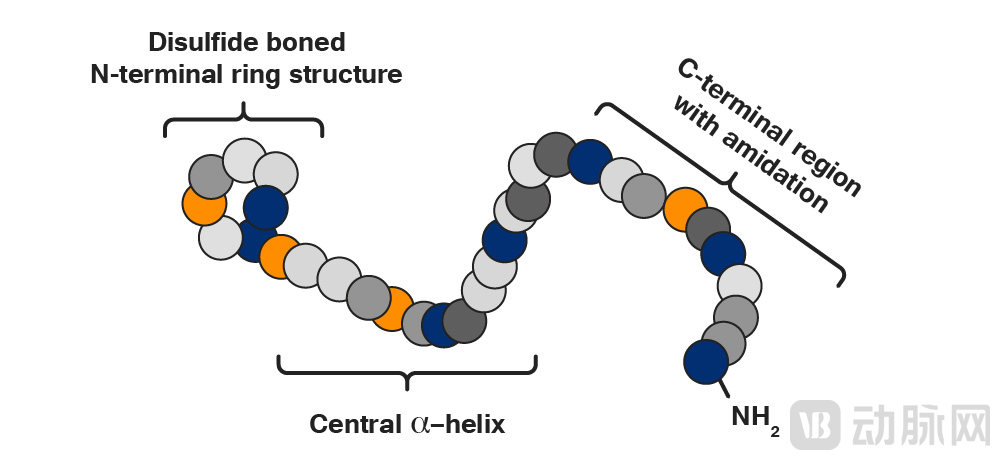
DACRA Structure Diagram
Previously, the FDA approved Pramlintide (Pramlintide Acetate), an amylin analog based on rat Amylin, as an adjunctive therapy to insulin for Type I and Type II diabetes, administered in multiple daily doses.And in clinical trials, it was observed that the effect of pramlintide on reducing food intake and body weight is not limited to patients with impaired glucose metabolism. Early evidence from KeyBioscience indicates that, compared with amylin analogs, DACRAs have a better mechanism of action with significantly improved potency and efficacy, especially in pain-related outcomes.
The first collaboration between the two parties dates back to 2017, when Eli Lilly paid an initial fee of $5.5 million and undisclosed potential payments to collaborate with KeyBioscience on developing new therapies based on the proprietary DACRA platform. The pipeline includes KBP-042, KBP-089, KBP-056, and other preclinical candidates, targeting indications such as type 2 diabetes and other metabolic disorders.
KeyBioscience is dedicated to discovering novel peptide therapies for the treatment of metabolic disorders. It has currently built an extensive peptide analysis platform to thoroughly investigate molecules inspired by the evolutionary variants of natural peptides. Based on this platform, KeyBioscience has identifiedThree peptides have entered the clinical development stage for type 2 diabetes, obesity, and osteoarthritis, two of which were licensed to Eli Lilly in 2017. The second-generation Lilly-KeyBio DACRA is currently under clinical development for the treatment of obesity. KeyBioscience is focusing on the long-acting formulation KBP-336, administered once a week, and is developing a once-weekly injectable metabolic osteoarthritis treatment.
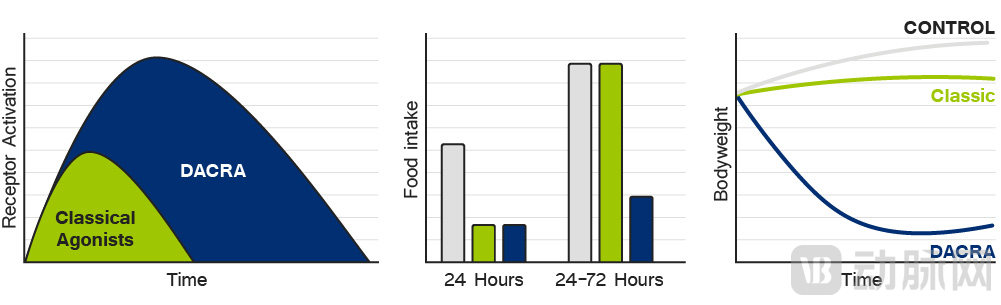 KeyBioscience-designed DACRAs can prolong target receptor activation, forming a long-lasting effect.
Notably, based on the findings of DACRA's role in pain, KeyBioscience and Eli Lilly's pipeline indications include osteoarthritis (OA), an obesity-related complication that has received less attention in the past.
Although treatment options for obesity are continually evolving, significant gaps remain in addressing obesity-related complications such as osteoarthritis (OA). According to WHO data, over 1 billion people worldwide are battling obesity, while osteoarthritis affects more than 600 million people globally, a considerable portion of whom are obese. Osteoarthritis causes joint pain and limits mobility. Research has confirmed that weight loss can alleviate these symptoms.DACRA is a potential new therapy that may offer a two-pronged approach: promoting weight loss and directly targeting the molecular pathways that drive the progression of osteoarthritis.
The $1.4 billion investment also signals that the weight-loss drug battle has moved on to innovative therapies and next-generation molecules.
Cagrilintide, developed by Novo Nordisk, is the first long-acting amylin analogue studied for weight management. Studies show that cagrilintide can act on the calcitonin receptor and three different subtypes of amylin receptors simultaneously.A Phase II clinical trial数据显示,作为生活方式干预的辅助手段,每周一次注射cagrilintide治疗,Average weight loss can reach 11.5 kg after 26 weeks.
Compared with the approved pramlintide, long-acting amylin analogs represented by cagrilintide have shown significantly improved efficacy, especially in combination formulations with GLP-1 incretins, and are considered the next generation of obesity treatment.
CagriSema, a combination of cagrilintide and semaglutide, demonstrated superior weight loss and glucose-lowering effects compared to either drug alone.Phase I data show that using 4.8 mg of CagriSema for 20 weeks can lead to a 17.1% weight loss. As a "response" to Eli Lilly's head-to-head trial, Novo Nordisk launched a head-to-head Phase III clinical trial of CagriSema versus tirzepatide in 2023. In addition, CagriSema injection, as a Class 1 new drug, has received the tacit approval for clinical trials from the CDE, and is intended for use as an adjunctive treatment in weight management for obese or overweight patients.
Nevertheless, KeyBioscience believes that the next generation of obesity treatments still requires more effective and better-tolerated compounds — clearly, DACRA is one of them.Early evidence suggests that, compared to amylin analogs, DACRA has a superior mode of action with significantly enhanced potency and efficacy, particularly in pain-related outcomes.
Now, Eli Lilly is going to "counterattack" with its DACRA that has been dormant for 7 years.