Before 2019, Hansoh Pharma was still a traditional pharmaceutical company mainly focused on generic drugs. The slowdown in revenue and profit growth from its generic drug business made the company determined to transition towards innovative drug development.However, innovative transformation has not been smooth sailing. In 2022, the number of innovative drugs from Hansoh Pharma increased from just one before 2019 to seven. The revenue share of innovative drugs also surpassed that of generic drugs for the first time, reaching 50.6%. Yet, it was also in this year that Hansoh Pharma’s revenue and net profit experienced negative growth for the first time.Until the mid-year report of 2024 was released, with revenue reaching 6.506 billion yuan, a year-on-year increase of 44.21%, and net profit at 2.726 billion yuan, a year-on-year increase of 111.47%. The proportion of innovative drug income reached as high as 77.34%. All doubts vanished, and Hansoh Pharma has evolved into an unstoppable phase.
Value Realization of Innovative Drugs
"From imitation to innovation is never just a slogan."
Founded in 1995, Hansoh Pharma started with generic drugs. After more than two decades of development, it has over 50 approved drugs on the market, including first-to-market generics with annual sales exceeding 1 billion yuan, such as Olanzapine Tablets, Pemetrexed Disodium for Injection, and Gemcitabine Hydrochloride for Injection.
Although it is often said that "a big ship is hard to turn around," the management of Hansoh Pharma has realized that with increasing competition, the era of rapid growth in the generic drug business has passed, and innovation-driven transformation is the only way forward.
To date, Hansoh Pharma has a total of 8 innovative drugs (including collaborative products) approved for marketing, including Almonertinib Mesylate Tablets (Ameile), Flumatinib Mesylate Tablets (Haosen Xinfu), Morinidazole Sodium Chloride Injection (Mailingda), Polyethylene Glycol Loosenatide Injection (Fulai Beauty), Aimitinovir Tablets (Hengmu), Inebilizumab Injection (Xinyue), Pegmoceptide Injection (Shengluolai), and Selinexor (Xivio). These drugs cover multiple fields such as oncology, autoimmune diseases, chronic diseases, and anti-infectives.
Hansoh Pharma's Innovative Drugs Already on the Market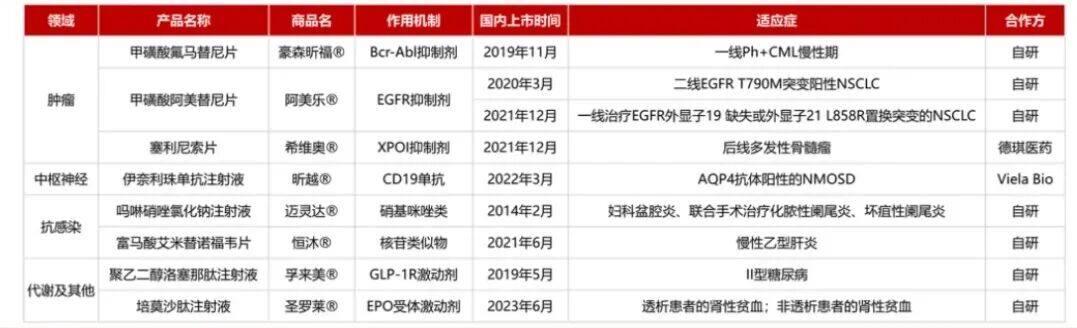 Source of the image: Huayuan Securities
These eight successfully commercialized innovative drugs directly account for nearly 80% of Hansoh Pharma's revenue, serving as the backbone of its successful transition from generics to innovation.Among them,Almonertinib (Ameile)Undoubtedly, Hansoh Pharma's most core innovative product is China's first self-developed third-generation EGFR-TKI class innovative drug, which was approved in March 2020 for second-line treatment of EGFR T790M and moved to the front-line in December 2021.As the first domestically produced third-generation EGFR inhibitor in China, Aumolertinib has benefited from significant first-mover advantages. In its third year on the market, 2022, its sales revenue reached 2.4 billion yuan. Although the 2023 data has not been disclosed, sample pharmaceutical sales data indicates that it maintained a rapid growth rate, with external forecasts estimating approximately 3.5 billion yuan. This makes Aumolertinib the absolute main driver of Hansoh Pharma's innovative drug sales growth.However, there are already six third-generation EGFR inhibitors approved for marketing in China. Additionally, Limertinib from Aosaikang and Lazertinib from Johnson & Johnson have applied for marketing in China. It is expected that by the end of this year or next year, there will be eight third-generation EGFR-TKIs competing in the market.Under fierce competition, Hansoh Pharma has chosen to continue expanding the indications for Aumetinib. Currently, multiple indications, including postoperative adjuvant therapy and first-line combination chemotherapy, are in Phase III clinical trials. Additionally, two other indications received NDA acceptance in July and August this year, respectively.In addition, other innovative drugs from Hansoh Pharma are also about to experience rapid growth in sales:Hansoh PharmaIt is the first independently developed novel second-generation Bcr-Abl TKI in China and the first novel TKI in China to undergo "bidirectional optimization" in terms of efficacy and safety. It has been recommended by the National Health Commission's Guidelines for the Diagnosis and Treatment of Chronic Myeloid Leukemia and Guidelines for the Diagnosis and Treatment of Malignant Hematological Diseases.HengmuIs the first domestically developed oral anti-hepatitis B virus (HBV) drug in China, and is currently celebrating its 3rd anniversary on the market, becoming Hansoh Pharma's main anti-infective drug.XinyueIt is the world's only approved humanized anti-CD19 monoclonal antibody for the treatment of adult patients with AQP4 antibody-positive neuromyelitis optica spectrum disorder (NMOSD). Amgen is currently conducting clinical work on IgG4-related disease and myasthenia gravis indications, which is expected to raise the sales ceiling...The increase in the revenue share of innovative drugs has boosted Hansoh Pharma's sales gross margin, which reached 91.1% in the first half of 2024, a 2.97 percentage point increase compared to the same period in 2023.
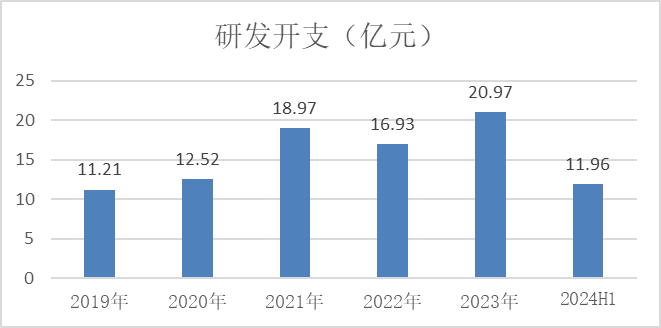
Hansoh Pharma's ability to completely transform its product structure in just five years is inseparable from its continuous investment in research and development. From 2019 to 2023, Hansoh Pharma's R&D investments were 1.121 billion yuan, 1.252 billion yuan, 1.797 billion yuan, 1.693 billion yuan, and 2.097 billion yuan respectively. In the first half of 2024, R&D investment continued to grow, reaching 1.196 billion yuan, a year-on-year increase of 28.7%.Hansoh Pharma R&D Expenditure (2019 - 2024H1)
In addition to its marketed products, Hansoh Pharma currently has over 30 innovative drug projects in various clinical stages, with more than 50 clinical trials underway, and several pipeline products entering pivotal clinical stages.Among them,HS-20093HS-20093, a B7-H3 targeted ADC drug developed in China with the fastest progress, is currently undergoing multiple Phase II clinical trials in China for the treatment of small cell lung cancer, sarcoma, squamous cell carcinoma of the head and neck, and other solid tumors. Research data presented at the 2024 ASCO meeting showed that HS-20093 demonstrated strong anti-tumor activity in patients with recurrent or refractory bone and soft tissue sarcoma who had received extensive prior treatment, surpassing historical data of existing standard treatments, with good safety and tolerability. It is expected to be approved for marketing in China by 2027.In addition to the traditional anti-tumor strengths, Hansoh Pharma's non-oncology product pipeline is also becoming increasingly robust.HS-20094It is a dual agonist of GLP-1 receptor and GIP receptor. Against the backdrop of the global popularity of GLP-1 drugs for lowering blood sugar and weight loss, the only dual-target GLP-1 tirzepatide achieved sales of $6.656 billion in the first half of 2024, representing a year-on-year increase of 329%. Currently, the development of HS-20094 for diabetes and weight loss indications is in Phase II clinical trials, with globally leading progress.In addition, TYK2 drugs for psoriasisHS-10374、P2X3 Drugs for Chronic CoughHS-10383ETA/AT1 Dual Receptor Antagonist for IgA NephropathyHS-10390、For schizophreniaHS-10380, both have broad market prospects, and their clinical research progress is in a leading position in China or globally.Hansoh Pharma, which started with generic drugs, has been able to build a strong innovative drug R&D pipeline in a short period of time, thanks to both its independent research and development efforts and its diversified BD strategy, which has played a pivotal role.Since 2019, Hansoh Pharma has actively expanded its pipeline through external collaborations, cumulatively reaching over 20 BD (Business Development) partnerships in the past five years. These include both mature innovative products and early-stage highly differentiated projects.In the first half of 2024, Hansoh Pharma continued to shine in BD, reaching licensing agreements totaling RMB 6.836 billion with Pumice, Quanxin Biotech, and Lupeng Pharma for EGFR/cMet bispecific antibody, IL-23 monoclonal antibody, and BTK inhibitor.Similar to its persistence in being the "first to market" with generic drugs, Hansoh Pharma also focuses on "me too" and "me better" strategies in its innovative drug development, aiming to capture the domestic market share through "first-in-China" innovations. Meanwhile, leveraging its abundant cash flow, the company actively seeks potential pipeline opportunities for business development (BD) collaborations to mitigate the risks associated with new drug research and development.Under this "pragmatic" strategy, Hansoh Pharma has developed a large number of well-staged R&D pipelines. It is expected that in the next three years, the company will file 8-10 IND applications and 2-3 NDA applications annually. By 2025, more than 15 innovative drugs (including new indications) will be launched, and the revenue from innovative drugs will account for over 80%.
Sail Overseas by Borrowing a Ship
Due to the gap in payment capabilities for innovative drugs between the Chinese and American pharmaceutical markets, which cannot be eliminated in the short term, domestically produced innovative drugs in China can only realize their full value by expanding overseas amidst increasing domestic competition.
Under the premise of having to "go global," how to go global has become a choice for innovative pharmaceutical companies, with two main models: "building ships to go global" and "borrowing ships to go global" (License out).
Unlike BeiGene and Junshi Biosciences, which have deployed large teams overseas to advance clinical and commercial operations, Hansoh Pharma, despite having substantial cash reserves, has chosen a more conservative License out approach after learning from the "lessons" of Hengrui Medicine's overseas expansion.
As the core of Hansoh Pharma's innovative drugs, Almonertinib had already transferred its overseas development and commercialization rights to the U.S.-based EQRx company for over 100 million USD back in July 2020. In June and December 2022, the marketing authorization applications for first-line treatment of EGFR-mutated advanced or metastatic NSCLC were respectively accepted by the UK (MHRA) and Europe (EMA).
However, in August 2023, EQRx was acquired by Revolution, and EQRx's original pipeline was abandoned, leading to the return of Almonertinib. Hansoh Pharma has regained its overseas rights. Currently, a head-to-head Phase III clinical trial of Almonertinib versus Osimertinib is underway, demonstrating Hansohn Pharma's confidence in the efficacy of Osimertinib. In the future, there may still be opportunities to license the overseas rights to a more commercially capable international pharmaceutical company.
If the collaboration with EQRx was just a small trial for Hansoh Pharma’s international expansion, then the partnership with GSK appears to be more mature.
In October 2023, Hansoh Pharma licensed the overseas rights of HS-20089 to GSK for an upfront payment of $85 million and potential milestone payments of up to $1.485 billion. In December 2023, it further licensed the overseas rights of HS-20093 to GSK for an upfront payment of $185 million and potential milestone payments of up to $1.525 billion. After the commercialization of these two products, Hansoh Pharma will also receive tiered royalties based on global net sales in overseas markets.
These two out-licensing deals, whether in terms of the collaboration partners or the financial terms, represent a significant advancement compared to the EQRx licensing deal for Aumolertinib. HS-20089 and HS-20093 are ADC drugs targeting B7-H4 and B7-H3, respectively. The collaboration with GSK fully validates the strengths of Hansoh Pharma's technology platform, placing them in the first tier of China-produced ADCs going overseas. In the future, with GSK’s full support, Hansoh Pharma’s ADC products will realize their innovative value more quickly.
As a pharmaceutical company that has been established for nearly 30 years, Hansoh Pharma's development fully demonstrates the charm of "stability." Whether it was focusing on "first generics" during the generic drug era or adopting a self-developed + business development (BD) model to reduce R&D risks in the innovative drug era, the company has always aimed for long-term profitability. With its performance remaining relatively stable, Hansoh Pharma has astonishingly transformed from a traditional generic drug company into an innovative pharmaceutical enterprise, fundamentally changing its valuation logic.- Hansoh Pharma Official Website, Annual Report
"Hansoh Pharma: China's Leading Innovation-Driven Big Pharma, Global Expansion Enhances Value Space," Huayuan Medicine, May 31, 2024