

Roche Reports Sustained Clinical Benefit of Prasinezumab in Slowing Motor Progression in Early-Stage Parkinson’s Disease

Roche
Oncology Drug Research, Development, and Manufacturing


Text by Wang Cong
Editor | Wang Duoyu
Typesetting | Shuicheng Wen
Parkinson's Disease(Parkinson’s Disease,PD), is a complex neurodegenerative disease and the second most common neurodegenerative disease in the world, second only toAlzheimer's Disease(AD),affecting approximately 1%-2% of elderly individuals aged 65 and above. With the global aging population, the prevalence of Parkinson's disease is expected to increase significantly.
Within the brainα-Synuclein(α-Syn)Fiber aggregation is a major pathological hallmark of Parkinson's disease. Numerous studies have confirmed,α-Synuclein aggregates and their propagation between neurons play a role in the progression of Parkinson's disease.
Recently, Roche(Roche)Researchers in top international medical journalsNature MedicinePublished an article titled:Sustained effect of prasinezumab on Parkinson’s disease motor progression in the open-label extension of the PASADENA trialResearch Paper.
The study revealedTargetToα-Synuclein(α-Syn)Monoclonal AntibodyPrasinezumabInPASADENA ClinicalData from the open-label extension study of the trial, showing that Prasinezumab has a long-term sustained effect on motor progression in patients with Parkinson's disease.
PrasinezumabIs aHumanized monoclonal antibody, isThe first designed to targetα-Synuclein(α-Syn)Thereby promoting its degradationExperimental monoclonal antibody, expected to inhibit byThe spread of pathogenic α-synuclein between cells to protect neurons and slow the progression of Parkinson's disease.
On April 15, 2024, researchers from Roche Holding AGNature MedicineThe journal published an article titled:Prasinezumab slows motor progression inrapidly progressing early-stage Parkinson’sdiseaseResearch Paper【2】。
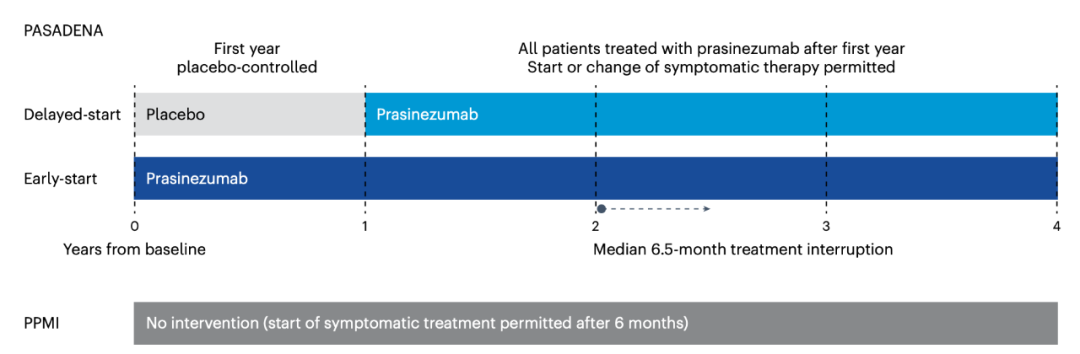
ThisData from large-scale Phase 2 clinical trials show,PrasinezumabClinical effects can only be seen in patients with rapidly progressing Parkinson's disease after one year of treatment. More research is needed to determine whether Prasinezumab is effective when used over a longer period in patients with slower progressing Parkinson's disease, and the open-label extension trial PASADENA is exploring this question.
In the latest published paper, the team announcedPASEDENA Open-Label Extension TrialTest Results,PASADENA is an ongoingMulticenter, randomized, double-blind, placebo-controlled clinical trial designed to evaluate intravenous infusion every four weeksPrasinezumabSafety and efficacy in the early stages of Parkinson's disease.
2. https://www.nature.com/articles/s41591-024-02886-y










PointIn view, Convey Your Taste