GSK's BCMA ADC Belantamab Mafodotin Receives Priority Review Designation in China for Relapsed/Refractory Multiple Myeloma

GSK
Pharmaceutical R&D Manufacturer

On October 15, the CDE website showed that the injection Belantamab mafodotin submitted by GSK is proposed to be included in the priority review, with the indication for...In combination with bortezomib + dexamethasonePreviously received at least one treatmentMultiple Myeloma (MM) Adult patients。
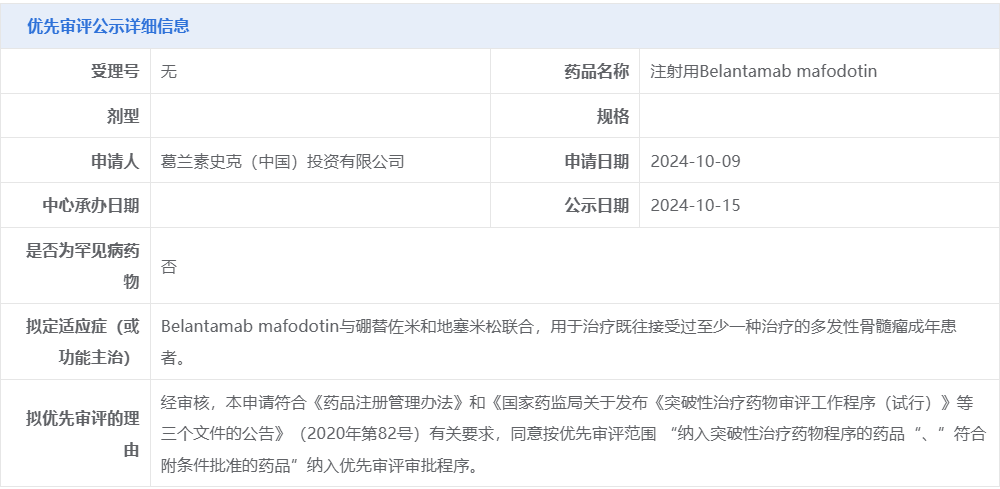
Screenshot source: CDE official website
Belantamab mafodotin isAn antibody-drug conjugate (ADC) targeting BCMA, its development history can be described as somewhat tortuous. Belantamab mafodotin has been granted Breakthrough Therapy Designation and Priority Review status by the U.S. FDA, as well as Priority Medicines (PRIME) status by the EU EMA.
In August 2020, based on the results of the pivotal Phase II clinical DREAMM-2 study, the drug first received accelerated approval from the FDA and then conditional approval from the EMA asMonotherapy for the treatment of adult patients with relapsed/refractory multiple myelomaThese patients had previously received at least four therapies, including anti-CD38 monoclonal antibodies, proteasome inhibitors, and immunomodulatory agents.Has become the world's first approved BCMA ADC。
However, both the FDA's accelerated approval and the EMA's conditional approval come with "conditions." The results of Belantamab mafodotinThis needs to be further validated in the subsequent Phase III clinical trial DREAMM-3.Only in reality. DREAMM-3 is an open-label, randomized head-to-head superiority trial designed to evaluate Belantamab mafodotin.MonotherapyEfficacy and Safety of Pomalidomide Combined with Low-Dose Dexamethasone in the Treatment of Relapsed/Refractory MM Patients.The primary endpoint is PFS., secondary endpoints include overall survival, safety, ORR, duration of response, and minimal residual disease assessment.
However, in November 2022, GSK announcedDREAMM-3 Study Did Not Meet Its Primary Endpoint of Progression-Free Survival (PFS)Based on this, GSK voluntarily withdrew the Belantamab mafodotin marketing application in the United States. Subsequently, the EU EMA also withdrew the marketing authorization for Belantamab mafodotin.
Although the listing of Belantamab mafodotin in Japan and the EU has not been smooth, studies show that it can still benefit some patients with multiple myeloma. Therefore, GSK is further exploring and tapping into the drug's therapeutic potential in clinical trials.
For example, in the Phase III clinical trial DREAMM-7, the researchers evaluatedBelantamab mafodotin + Bortezomib + DexamethasoneAndDaratumumab +Bortezomib + DexamethasoneEfficacy and Safety of Combination Therapy in Patients with Relapsed/Refractory Multiple Myeloma Who Have Previously Received at Least One Prior Line of Therapy, with PFS as the Primary Endpoint.
Data presented at the 2024 ASCO Annual Meeting showed that, in the intention-to-treat (ITT) population:
In terms of median PFS,Belantamab mafodotin Group: 36.6 months, significantly higher than the 13.4 months in the daratumumab group;
Compared with the standard treatment of daratumumab combination,Reduced the risk of disease progression or death by 59% in patients;
ORR,Belantamab mafodotin Group: 82.7%(vs daratumumab group 71.3%);
Belantamab mafodotin The group treatment showed a strong, clinically significant trend in terms of overall survival rate.The risk of death was reduced by 43%.
In addition, in the Phase III clinical trial DREAMM-8, researchers further evaluatedBelantamab mafodotin + Pomalidomide + DexamethasoneCombination Therapy withBortezomib + Pomalidomide + DexamethasoneEfficacy and Safety of Combination Therapy in Relapsed/Refractory MM Patients Who Have Previously Received at Least One Line of Treatment
Compared with the patient population studied in the DREAMM-7 trial, patients in DREAMM-8 received more prior treatments., because all patients had previously received lenalidomide treatment, 75% of patients were resistant to lenalidomide, and 25% of patients had previously receivedDaratumumabTreatment, most of which are forDaratumumabDrug-resistant.
Data from the DREAMM-8 study presented at this year's ASCO show that:
In terms of the primary endpoint mPFS,The experimental group has not yet reached, while the control group is 12.7 months.;
For secondary endpoints, the ORR in the experimental group was 77% (vs 72% in the control group), CR was 40% (vs 16% in the control group), mDoR has not yet been reached (vs 17.5 months in the control group), and the 12-month PFS rate was 71% (vs 51% in the control group); OS follow-up is still ongoing.
DREAMM-8 Study Demonstrates that in Relapsed/Refractory MM, the Belantamab Mafodotin Group Showed a Statistically and Clinically Significant PFS Advantage, as Well as Deeper and More Durable Responses, Exhibiting a Favorable OS Trend with Manageable Safety.
Based on the positive research data from DREAMM-7 and DREAMM-8, this July and September,The European EMA and Japan's Ministry of Health, Labour and Welfare (MHLW) have respectively accepted the marketing application for Belantamab mafodotin in combination with bortezomib plus dexamethasone (BorDex) or pomalidomide plus dexamethasone (PomDex) for the treatment of relapsed or refractory multiple myeloma.。
The proposed inclusion in the priority review in China means,Belantamab mafodotin +Bortezomib + Dexamethasone Combination TherapyPreviously received at least one treatmentMM adult patients will also be submitted for marketing approval in China soon.