

Johnson & Johnson Announces Positive Phase 2/3 Results for Nipocalimab in Adolescents with Generalized Myasthenia Gravis

Johnson & Johnson
Healthcare Product Manufacturers, Health Service Providers
▎WuXiEdited by Kant Content Team
Johnson & Johnson Announces Positive Results from Phase 2/3 Vibrance-MG StudyJohnson & Johnson today announced positive results from the Phase 2/3 Vibrance-MG study. Analysis shows that its investigational neonatal Fc receptor (FcRn)-targeted antibody therapy, nipocalimab, in combination with standard of care (SOC), achieved sustained disease control in AChR antibody-positive generalized myasthenia gravis (gMG) adolescent patients (ages 12-17). Detailed results of the study will be presented at the annual meeting of the American Association of Neuromuscular & Electrodiagnostic Medicine (AANEM).According to the press release, this is the first FcRn blocker that can continuously maintain disease control within 24 weeks in antibody-positive adolescent gMG patients aged 12-17.Due tonipocalimabHas the potential to treat a variety of autoimmune diseases,This therapy was listed by the industry media Evaluate earlier this year asTop 10 Potential Blockbuster Therapies in DevelopmentOne of.

Myasthenia Gravis is a rare chronic autoimmune disease that affects approximately 700,000 patients worldwide.The pathogenic mechanism of this disease involves immunoglobulin G (IgG) antibodies in the patient's body, which disrupt synaptic transmission between nerves and muscles, leading to muscle weakness., and in severe cases, it can even be life-threatening. More than 85% of patients will progress to generalized myasthenia gravis within 24 months after onset, characterized by extreme fatigue and significant difficulties in facial expressions, speech, swallowing, and mobility. According to statistics,Approximately 10% of newly diagnosed myasthenia gravis patients are adolescents.Children with myasthenia gravis experience more severe symptoms, with 43% of patients having been hospitalized more than five times in their lifetime, 46% of patients having been admitted to the intensive care unit (ICU) at least once, and 68% of patients having experienced periods of disease exacerbation.
The analysis shows,Nipocalimab in combination with SOC achieved the primary endpoint of the study, which was a reduction in total serum IgG levels (69%), as well as two secondary endpoints: the Myasthenia Gravis Activities of Daily Living (MG-ADL) score and the Quantitative Myasthenia Gravis (QMG) score, both indicators of disease activity.Four out of five patients achieved minimal manifestation status (MG-ADL score 0-1) at the end of the treatment period. Nipocalimab was well-tolerated over the six-month period, with a tolerability profile similar to that observed in adult subjects in the Vivacity-MG3 study. No serious adverse events occurred, and no patients discontinued the drug due to adverse events.
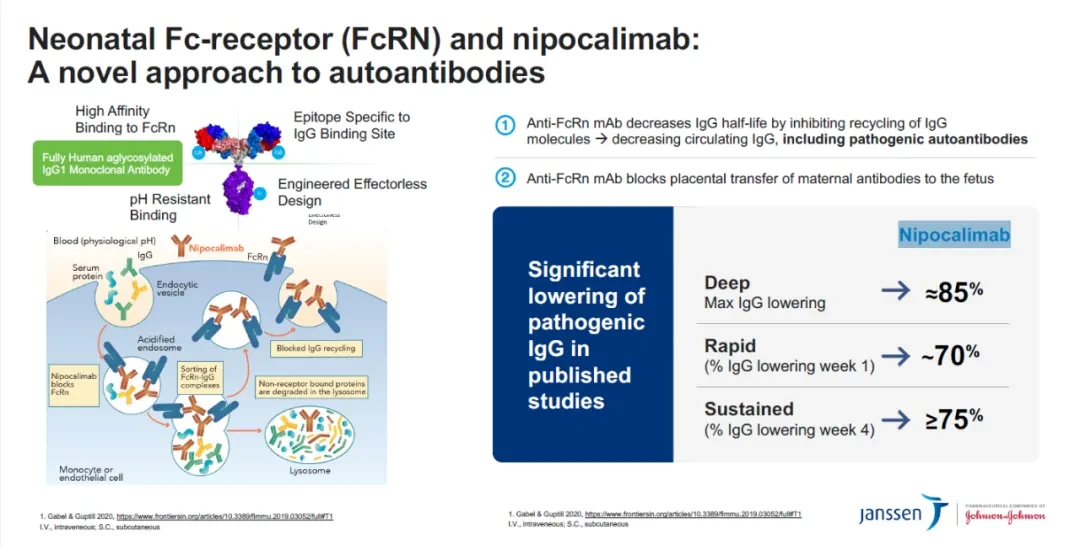
▲Introduction to Nipocalimab (Image Source:Johnson & Johnson Official Website)
Nipocalimab is a potential “best-in-class” antibody therapy targeting the neonatal Fc receptor. By binding to FcRn, it prevents autoantibodies taken up by monocytes and endothelial cells from being released back into the bloodstream, instead degrading them within the cells.Research has shown that it can reduce IgG levels, including pathogenic autoantibodies, in blood circulation by more than 75%. This antibody therapy has the potential to treat various autoimmune antibody-mediated immune diseases. The FDA has granted this therapy Breakthrough Therapy Designation for treating pregnant women at high risk of severe Hemolytic Disease of the Fetus and Newborn (HDFN), as well as Fast Track designation for treating HDFN, gMG, warm antibody autoimmune hemolytic anemia (wAIHA), and Fetal Neonatal Alloimmune Thrombocytopenia (FNAIT).
This is the first release of the open-label Phase 2/3 study results for nipocalimab in treating adolescent patients with gMG, compared to its application in adult patients with gMG.Key StudiesThe results are consistent. Johnson & Johnson submitted this therapy for the treatment of gMG patients in August this year.Biologics License Application(BLA)。

▲To learn more about the application of cutting-edge technologies in the biopharmaceutical industry, please long press and scan the QR code above to access "WuXi AppTec Live Studio" and watch live discussions and exciting replays on related topics.
References:
[1] Nipocalimab demonstrates sustained disease control in adolescents living with generalized myasthenia gravis in Phase 2/3 study. Retrieved October 15, 2024 from https://www.prnewswire.com/news-releases/nipocalimab-demonstrates-sustained-disease-control-in-adolescents-living-with-generalized-myasthenia-gravis-in-phase-23-study-302276365.html
Disclaimer: The content team of WuXi AppTec focuses on introducing the research progress in global biopharmaceuticals and health. This article is for information exchange only, and the views expressed in the article do not represent the position of WuXi AppTec, nor does it indicate that WuXi AppTec supports or opposes these views. This article is not a recommendation for treatment plans. For guidance on treatment options, please visit a正规 hospital.
Copyright Statement: This article is from the content team of WuXi AppTec. Individuals are welcome to share it on their social media circles, but unauthorized reprints by media or institutions in any form to other platforms are prohibited. For reprint authorization, please reply with "reprint" on the WeChat Official Account of "WuXi AppTec" to obtain the reprint guidelines.


Share,PointLike,In view, Focusing on Global Biomedical Health Innovation