Johnson & Johnson Q3 Earnings Report Released, Legendary CAR-T Up 87% Year-over-Year
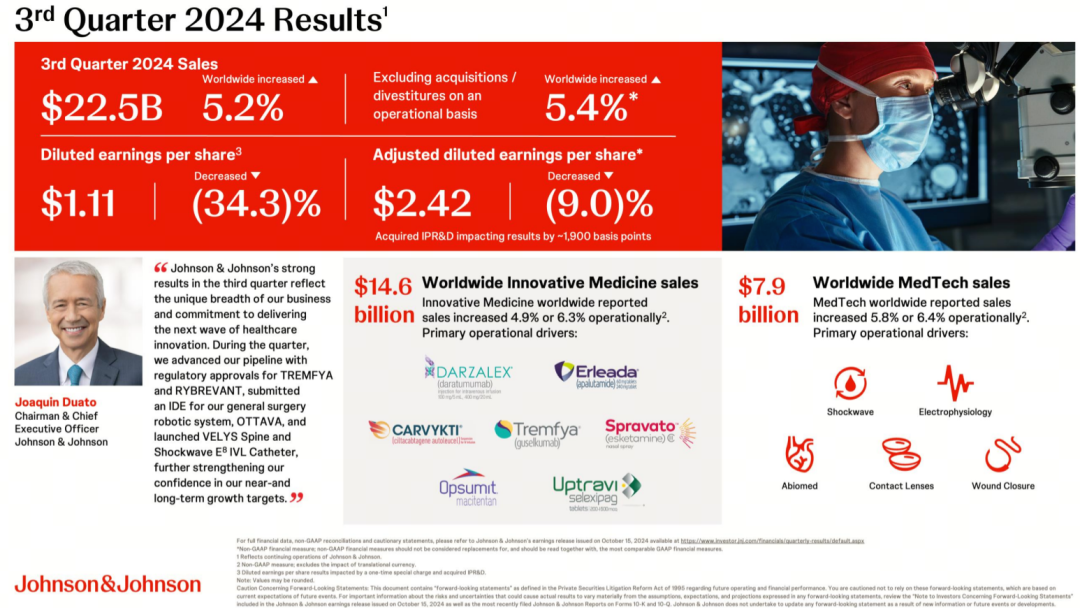
Recently, Johnson & Johnson announced its financial report for the third quarter of 2024.Total Revenue$22.5 billion, year-on-yearIncrease by 5.2%.ItsIn China, pharmaceutical business revenue$14.6 billion,Year-on-yearGrowth of 4.9%, mainly driven by Darzalex (Daratumumab)、Erleada (Apalutamide)And the performance growth of products like Caryvkti (Cilta-cel).DArzalex Q3 Sales Were$3.016 billion,Has become the top-selling drug for Johnson & Johnson in Q3, andStelara, on the other hand, has been impacted by biosimilars, affecting its sales.26.$7.6 billion,Decreased by 6.6% year-on-year.It is worth mentioning that the collaboration between Johnson & Johnson and LegendBCMA CAR-T Cell TherapyCaryvkti was the product with the strongest growth in the third quarter, increasing by 87.7% year-over-year.% to 286 million US dollars.Caryvkti's total sales in the first three quarters of 2024 have reached$6.29 billion, an increase of 84.3% year-over-year.Lundbeck $2.5 Billion AcquisitionLongboard,Capture Potential Heavyweight Anti-Epilepsy Drug
On October 15, Lundbeck and Longboard Pharmaceuticals announced an agreement,LundbeckWill acquire Longboard for approximately $2.5 billion and obtain its potential "best-in-class" lead project, bexicaserin (LP352). The transaction is expected to be completed in the fourth quarter of 2024.According to the press release, the therapy has the potential to become a blockbuster drug, and its global Phase 3 trial for the treatment of Dravet syndrome-related seizures is currently underway.
Bexicaserin is a highly selective, oral, novel 5-HT2C receptor agonist being developed for the treatment of seizures associated with DEE, including Dravet syndrome, Lennox-Gastaut syndrome, and other rare epilepsies. The global Phase 3 trial DEEp SEA was initiated in September 2024. This trial evaluates the efficacy of bexicaserin in treating seizures associated with Dravet syndrome in subjects aged 2 years and older. The DEEp SEA study is part of the broader DEEp program (DEEp SEA, DEEp OCEAN, and DEEp OLE), which is planned to be conducted at approximately 80 sites worldwide, with an expected enrollment of around 480 subjects with various types of DEE. Additionally, bexicaserin has been granted Breakthrough Therapy Designation (BTD) by the U.S. FDA.
Longboard Announces Results of PACIFIC Phase 1b/2a Clinical Trial in January This Year: Evaluation of Bexicaserin for the Treatment of Seizures Associated with DEEThe results showed that the median change from baseline in countable motor seizure frequency (primary efficacy endpoint) was a reduction of 53.3% in evaluable subjects (n=35) treated with bexicaserin, compared to only a 20.8% reduction in subjects (n=9) receiving placebo, representing a placebo-adjusted reduction in seizure frequency of 32.5%. The median change from baseline in countable motor seizure frequency in the Dravet syndrome, Lennox-Gastaut syndrome, and other DEE subgroup cohorts decreased by 72.1%, 48.1%, and 61.2%, respectively.
GSK's BCMA ADC Proposed for Priority Review in China
On October 15, the CDE website showed that the injectable Belantamab mafodotin submitted by GSK is proposed to be included in the priority review. The indication is for the combination treatment with bortezomib and dexamethasone in adult patients with multiple myeloma (MM) who have previously received at least one therapy. This drugIt has been granted Breakthrough Therapy Designation and Priority Review by the U.S. FDA, as well as Priority Medicines (PRIME) status by the EU EMA.Belantamab mafodotin is an antibody-drug conjugate (ADC) targeting BCMA, and its development history has been somewhat tortuous.In August 2020, based on the results of the pivotal Phase II clinical DREAMM-2 study, the drug first received accelerated approval from the FDA and then conditional approval from the EMA for use as a monotherapy to treat adult patients with relapsed/refractory multiple myeloma who had previously received at least four prior lines of therapy, including an anti-CD38 monoclonal antibody, a proteasome inhibitor, and an immunomodulatory agent, becoming the world’s first approved BCMA ADC.However, both the FDA's accelerated approval and EMA's conditional approval come with "conditions." The results of Belantamab mafodotin need to be further confirmed in the subsequent Phase III clinical trial, DREAMM-3. DREAMM-3 is an open-label, randomized head-to-head superiority trial designed to evaluate the efficacy and safety of Belantamab mafodotin monotherapy versus pomalidomide combined with low-dose dexamethasone in patients with relapsed/refractory MM. The primary endpoint is PFS, while secondary endpoints include overall survival, safety, ORR, duration of response, and minimal residual disease assessment.However, in November 2022, GSK announced that the DREAMM-3 study did not meet its primary endpoint of progression-free survival (PFS). Based on this, GSK voluntarily withdrew the marketing application for Belantamab mafodotin in the United States. Subsequently, the EU EMA also withdrew the drug's marketing authorization.Although the drug's subsequent journey has been challenging, studies show that Belantamab mafodotin can still benefit some patients with multiple myeloma. Therefore, GSK continues to further explore and unlock its therapeutic potential in clinical trials.For example, in the Phase III clinical trial DREAMM-7, researchers evaluated the efficacy and safety of Belantamab mafodotin + bortezomib + dexamethasone versus daratumumab + bortezomib + dexamethasone in patients with relapsed/refractory multiple myeloma who had previously received at least one prior line of therapy. The primary endpoint was PFS.Data presented at the 2024 ASCO Annual Meeting showed that, in the intention-to-treat (ITT) population:In terms of median PFS, the Belantamab mafodotin group was 36.6 months, significantly higher than the 13.4 months in the daratumumab group.Compared with the standard treatment combination of daratumumab, the risk of disease progression or death in patients was reduced by 59%;In terms of ORR, the Belantamab mafodotin group achieved 82.7% (vs 71.3% in the daratumumab group);Belantamab mafodotin treatment demonstrated a strong, clinically meaningful trend in overall survival, reducing the risk of death by 43%.In addition, in the Phase III clinical trial DREAMM-8, researchers further evaluated the efficacy and safety of Belantamab mafodotin + pomalidomide + dexamethasone combination therapy versus bortezomib + pomalidomide + dexamethasone combination therapy for relapsed/refractory MM. These patients had previously received at least one prior line of therapy.Compared with the patient population studied in the DREAMM-7 trial, patients in DREAMM-8 received more prior treatments, as all patients had been treated with lenalidomide, 75% were resistant to lenalidomide, and 25% had been treated with daratumumab, most of whom were resistant to daratumumab.Data from the DREAMM-8 study presented at this year's ASCO showed:In terms of the primary endpoint mPFS, the experimental group has not yet been reached, while the control group is 12.7 months;For secondary endpoints, the ORR in the experimental group was 77% (vs 72% in the control group), CR was 40% (vs 16% in the control group), mDoR has not yet been reached (vs 17.5 months in the control group), and the 12-month PFS rate was 71% (vs 51% in the control group); OS follow-up is still ongoing.The DREAMM-8 study demonstrated that in relapsed/refractory MM, the Belantamab mafodotin group showed a statistically significant and clinically meaningful PFS advantage, along with deeper and more durable responses, favorable OS trends, and manageable safety.Based on the positive research data from DREAMM-7 and DREAMM-8, in July and September this year, the European EMA and Japan's Ministry of Health, Labour and Welfare (MHLW) respectively accepted the marketing application for Belantamab mafodotin in combination with bortezomib plus dexamethasone (BorDex) or pomalidomide plus dexamethasone (PomDex) for the treatment of relapsed or refractory multiple myeloma.
www.yyjjb.com.cn
Insight into Industry Trends
Press and hold to followPharmaceutical Economy Report"Pharmaceutical Economy Herald"
Academic Official Account
Focus on the Frontiers of Oncology Academia
Press and hold to followImmunity Period"Pharmaceutical Economy Newspaper"Terminal Official Account
Record Major Events in the Pharmaceutical IndustryLong press to follow21st Century Pharmacy