

Novartis Inks $1.17B Deal for Chengdu-Based Baiyu Pharma's Novel Small Molecule Oncology Drug

Novartis
Drug Development and Manufacturing
Today, Chengdu Baiyu Pharmaceuticals Co., Ltd. announced an exclusive licensing agreement with Novartis for a small molecule anti-cancer drug. According to the agreement, Baiyu will receive an upfront payment of 70 million US dollars (approximately 499 million yuan), as well as milestone payments totaling up to 1.1 billion US dollars (approximately 7.8 billion yuan) for development, registration, commercialization, and corresponding royalties. Novartis will obtain global exclusive rights for the development and commercialization of this innovative small molecule drug.
Chengdu Baiyu Pharmaceuticals Co., Ltd. was founded in 2005, headquartered in Chengdu, Sichuan. It is a global-oriented pharmaceutical enterprise with a full industrial chain that focuses on innovative drugs, integrating R&D-driven, production, sales, and the cultivation of Chinese medicinal herbs.
10 pipelines under research, 5 oncology pipelines
According to the announcement, the asset involved in this transaction is a small-molecule innovative drug for the treatment of malignant tumors, discovered and invented by the Baiyu Innovative Drug team. The specific pipeline has not been disclosed yet.
According to the official website of Chengdu Baiyu Pharmaceuticals Co.,ltd., the company currently has 10 R&D pipelines, mainly involving two areas: tumor immunology and DNA damage. Among them, there are 5 R&D pipelines related to tumors.
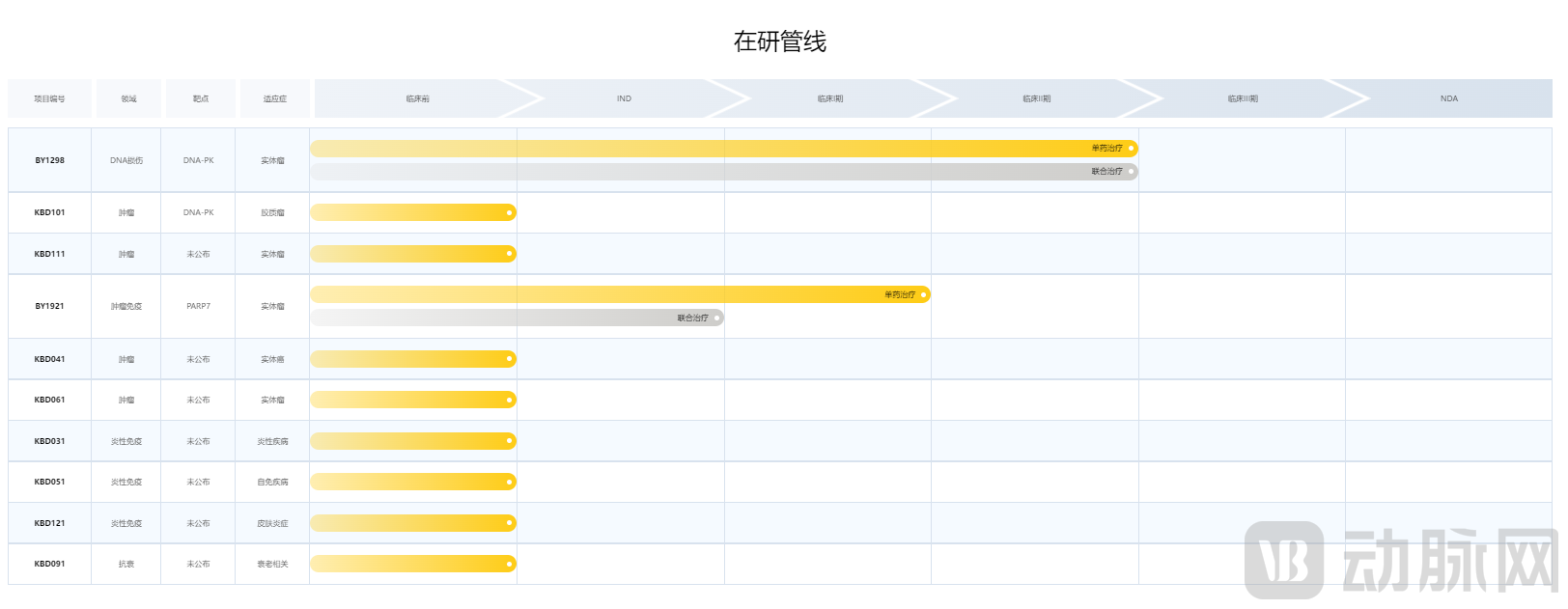 Source: Chengdu Baiyu Pharmaceuticals Co.,ltd. official website
Among them, the fastest progressing pipeline, BY101298, is an oral small molecule inhibitor targeting DNA-PK. It is currently undergoing Phase II clinical trials in China for the treatment of malignant solid tumors via both monotherapy and combination therapy pathways. DNA-PK is a serine/threonine kinase associated with DNA damage repair and plays a crucial role in the repair of DNA double-strand breaks. Targeting and inhibiting DNA-PK can enhance the efficacy of radiotherapy, chemotherapy, and other DNA-damaging agents (such as ADCs and RDCs).
Another Class 1 new drug approved for clinical trials by both the NMPA and FDA is BY101921, a Class 1 new drug submitted earlier this year by Chengdu Baiyu Pharmaceuticals Co., Ltd. and Sichuan Hongming BOSI Pharmaceutical Co., Ltd. It is currently undergoing Phase I monotherapy clinical trials in China. BY101921 is an oral small-molecule inhibitor targeting PARP7. Relevant studies have shown that inhibiting PARP7 can restore the interferon signaling pathway, activate the STING pathway of innate immunity, and upregulate phosphorylated STAT1, thereby suppressing tumor growth. According to an announcement by Baiyu, in preclinical studies, BY101921 demonstrated excellent anti-tumor efficacy and safety, showing potential to become a BIC (Best-in-Class) drug for the same target.
The core product of Chengdu Baiyu Pharmaceuticals Co.,ltd. is a Ginkgolide Injection — a traditional Chinese medicine injection made from raw materials extracted from ginkgo leaves, with a purity of up to 99%. This product has overcome the bottlenecks of unclear composition, uncertain mechanisms, and indefinite efficacy that are common in traditional Chinese medicine, reaching international leadership standards. The product was approved for marketing at the end of 2011 and has since accumulated nearly 5 billion yuan in sales.
In addition, Baiyu Pharmaceuticals has also made a layout in the field of high-end generic drugs. According to MiNeiNet, currently Baiyu Pharmaceuticals has 6 new classification application varieties under review (including joint applications), including Dobutamine Hydrochloride Injection, Magnesium Sulfate Injection, Memantine Hydrochloride Tablets, etc., covering drugs for the blood and hematopoietic system, respiratory system medications, cardiovascular and cerebrovascular system drugs, digestive system and metabolic drugs, and other fields. There is currently no approved Dobutamine Hydrochloride injection formulation in China. The already marketed Dobutamine Hydrochloride formulations mainly include Dobutamine Hydrochloride Tablets, Dobutamine Hydrochloride Capsules, and Dobutamine Hydrochloride Oral Solution, etc. Chengdu Baiyu Pharmaceuticals Co., Ltd.'s Dobutamine Hydrochloride Injection is the second to report production and is striving for the first generic approval.
Three Purchases of Chinese Pharmaceutical Companies in a Year
In 2024, China's innovative pharmaceutical companies become one of the most significant forces on the international stage: multiple innovative pharmaceutical companies continuously attract investments, while multinational corporations (MNCs) aggressively acquire assets. From domestically produced innovative drugs, biosimilars to improved new drugs, covering popular fields such as ADCs, small molecules, and GLP-1, China's biopharmaceutical enterprises successfully expand overseas through various cooperation models including License-out and co-development.
For Novartis, which has been actively making moves this year, Chinese pharmaceutical companies have become a destination for its acquisitions. To date, including Chengdu Baiyu Pharmaceuticals Co., Ltd., Novartis has reached cooperation or acquisition agreements with three Chinese pharmaceutical companies this year. In January, Novartis announced two exclusive licensing agreements with Bowang Pharmaceuticals, involving overseas rights to a Phase I/IIa cardiovascular pipeline, global rights to a Phase I cardiovascular pipeline, and options for no more than two additional cardiovascular pipelines targeting other indications, with a total transaction value of up to $4.165 billion.
During the same period, Novartis announced the acquisition of Chinese pharmaceutical company Sinopharm Rui Kang Pharmaceutical to strengthen its presence in the field of nephrology in China. Sinopharm Rui Kang will be fully integrated into Novartis China and become an indirectly wholly-owned subsidiary of Novartis.
In Novartis' positioning, it focuses on four core therapeutic areas: cardiovascular-renal-metabolism, immunology, neuroscience, and oncology. In terms of technology platforms, in addition to traditional small molecule and biologics platforms, Novartis is also actively developing RLT (Radioligand Therapy), CGT, and xRNA therapies.
So far this year, Novartis has announced more than a dozen collaborations, licensing, and M&A deals with a potential total value exceeding $20 billion. These cover areas such as AI-driven drug discovery, small nucleic acids, PD-1, CGT (gene and cell therapies), while further strengthening its focus on oncology, immunology, and nephrology.
In 2022, Novartis Global CEO Vas Narasimhan formally proposed the goal of Novartis "returning to the top five in the U.S. market" at an investor conference. To this end, Novartis established a separate U.S. innovative drug division. According to Novartis' half-year report for 2024, in the first half of 2024, Novartis' total net revenue was $5.9 billion, and net sales were $24.3 billion.