

Merck's Investigational Long-Acting Monoclonal Antibody Clesrovimab Shows Over 90% Reduction in RSV-Related Hospitalizations in Positive Phase 2b/3 Trial

MSD
Pharmaceutical R&D and Manufacturer
▎WuXiEdited by Kant Content Team
Recently, MSD announced positive results from its MK-1654-004 Phase 2b/3 clinical trial. Analysis shows that its investigational respiratory syncytial virus (RSV) preventive monoclonal antibody clesrovimab (MK-1654)Within 5 months, the RSV-related hospitalization rate and RSV-related lower respiratory tract infections were respectively...(LRI)Hospitalization rates decreased by more than 84% and 90%.Detailed study data were presented at the 2024 Infectious Diseases Week (IDWeek) conference.The press release noted that if approved, clesrovimab would become the first preventive antibody therapy to provide rapid and lasting protection through a single fixed-dose administration during an infant's first RSV season, regardless of the infant's weight.
RSVIt is a contagious virus that causes widespread seasonal infections among infants and the elderly worldwide.Globally,RSVIs the leading cause of hospitalization for healthy infants under one year of age.RSVCan cause severe respiratory diseases such as bronchiolitis and pneumonia, resulting in over1010,000 Deaths.
MK-1654-004 is a double-blind, randomized, placebo-controlled Phase 2b/3 clinical trial designed to evaluate the safety and efficacy of clesrovimab in healthy preterm and term infants (from birth to 1 year of age) entering their first RSV season. The study enrolled 3,632 participants who were randomly assigned in a 2:1 ratio to receive a single fixed dose of clesrovimab (105 mg) or placebo via intramuscular injection on Day 1.

Image Source: 123RF
The primary efficacy endpoint of the trial is to evaluate the effect of clesrovimab compared to placebo in reducing the incidence of medically attended lower respiratory tract infections (MALRI) associated with RSV within 150 days (5 months) after vaccination. These MALRIs present with at least one symptom indicative of lower respiratory tract infection and its severity.Analysis shows,The trial met the primary efficacy endpoint. The effectiveness of Clesrovimab was 60.4% (95% CI: 44.1-71.9, p<0.001).In addition,Clesrovimab also significantly reduced RSV-related hospitalization rates (secondary endpoint) and RSV-related LRI hospitalization rates (tertiary endpoint) by 84.2% (95% CI: 66.6-92.6, p<0.001) and 90.9% (95% CI: 76.2-96.5), respectively.At the same time, clesrovimab also showed a significant effect in reducing the incidence of severe MALRI (tertiary endpoint), reaching 91.7% (95% CI:62.9-98.1)。
Moreover, in post-hoc analyses, clesrovimab reduced MALRI with at least two LRI and its severity-related symptoms.(The incidence of MALRI, which is more severe than the primary endpoint, reached 88.0% (95% CI:76.1-94.0), the evaluation period was Day 150 post-vaccination.
More data on the burden of RSV disease in the MK-1654-004 trial is presented in detail in the table below, ordered by endpoints in decreasing severity.
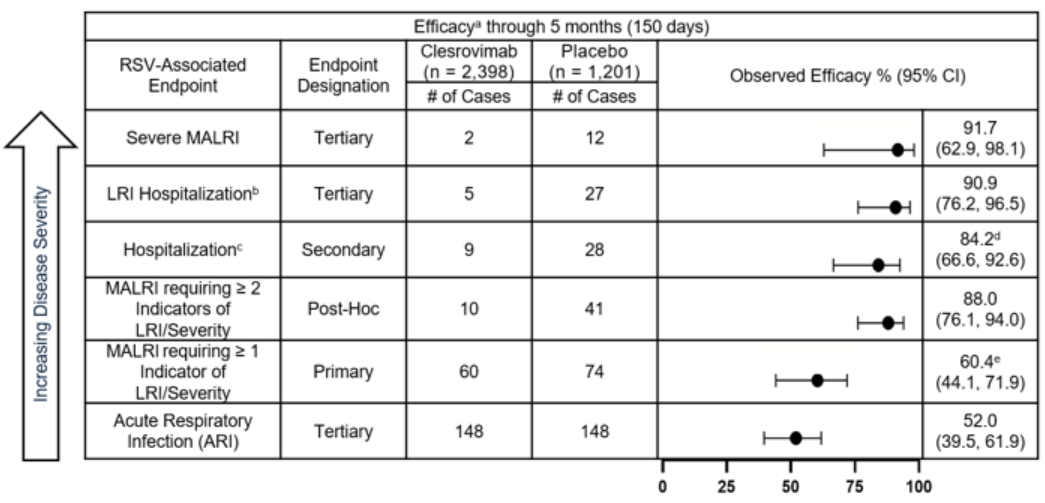
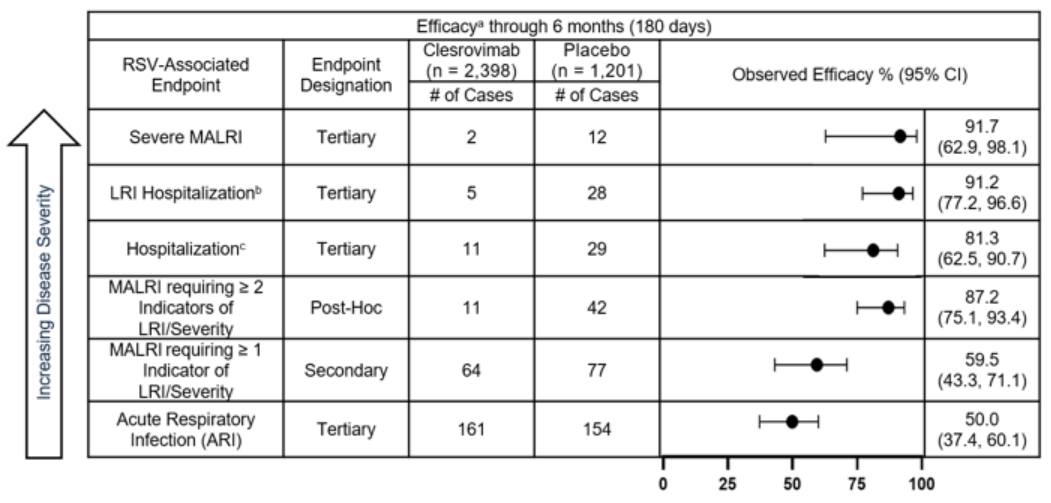
▲Data on the burden of RSV disease in the MK-1654-004 trial (Source: Reference [1])
MSD also announcedMK-1654-007Data from the pre-specified interim analysis of the trial3The trial period evaluatedclesrovimabCompared with the approvedRSVLong-acting Antibody TherapyBeyfortus(nirsevimab) Compared with, in high-risk infants for the prevention of severeRSVSafety and Efficacy of Diseases. AnalysisThe results showed,clesrovimabThe safety and activity are comparable to the control group, and no serious drug-related adverse events have been reported to date.The incidence of RSV-related MALRI and the RSV-related hospitalization rate (secondary endpoints) were also comparable between the clesrovimab group (3.6% and 1.3%, respectively) and the active comparator group (3.0% and 1.5%, respectively) during the 150-day observation period.
Clesrovimab is an investigational long-acting monoclonal antibody for passive immunization to prevent RSV.Clesrovimab is designed to be administered as a single, uniform dose regardless of the infant's birth weight, aiming to provide direct, rapid, and lasting protection for healthy preterm infants, full-term newborns, and high-risk infants, helping them combat mild, moderate, and severe RSV infections during their first RSV season.

▲To learn more about the application of cutting-edge technologies in the biopharmaceutical industry, please long-press and scan the QR code above to access "WuXi Live Studio" and watch live discussions and exciting replays on related topics.


Share,PointLike,In view, Focus on Global Biomedical Health Innovation