Infection Risks Associated with CD3/BCMA Bispecific Antibodies: Insights from Elranatamab and Teclistamab

Johnson & Johnson
Medical Device R&D and Manufacturer
On January 31, Pfizer's CD3/BCMA bispecific antibody Elranatamab (Elrexfio) was submitted for marketing approval in China, for the treatment of relapsed or refractory multiple myeloma (R/R MM) in patients who have received prior therapy.
Elranatamab is the second CD3/BCMA bispecific antibody, with the first being Teclistamab, developed by Johnson & Johnson, which was launched in China in August 2023.
Both drugs target BCMA on the surface of myeloma cells andCD3 on T cell surface,Different choices of immunoglobulin:
| Elranatamab | Teclistamab |
| IgG2 | IgG4 |
Targeting BCMA Increases Infection Risk
BCMA is a molecule highly expressed on myeloma cells, but it also has a certain level of expression on normal B cells. In mouse models, targeted inhibition of BCMA prevents the ability to produce antibody responses to antigens or vaccines, and the use of BCMA antibodies in human patients has been associated with a high incidence of infections.
According to the package insert of Elranatamab, its adverse reaction data:
| Serious Adverse Reaction | Proportion |
| Pneumonia | 25% |
| Sepsis | 13% |
| Chronic Sinusitis | 13% |
| Upper Respiratory Tract Infection | 4.4% |
| Acute Kidney Injury | 3.8% |
| Urinary Tract Infection | 3.3% |
| Encephalopathy | 3.3% |
| Fever | 2.2% |
| Fatal Adverse Reaction | |
| Pneumonia | 3.3% |
| Sepsis | 2.7% |
| Acute Respiratory Distress Syndrome | 0.5% |
| Cardiopulmonary Arrest | 0.5% |
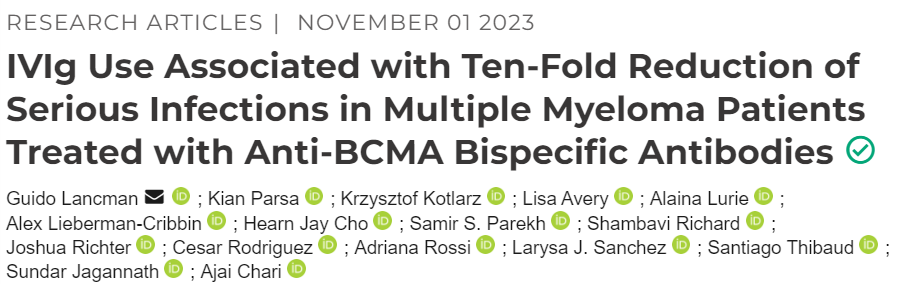
A total of 37 patients,During the 424-month follow-up period with single-drug treatment, a total of 118 infections occurred, with the following infection rates:
| Infection | Proportion |
| Upper Respiratory Tract | 33% |
| Lower Respiratory Tract | 22% |
| Urinary Tract | 14% |
| Skin/Soft Tissue | 14% |
| Gastrointestinal Tract | 9% |
| Bloodstream Infection | 4% |
| Oral Cavity | 3% |
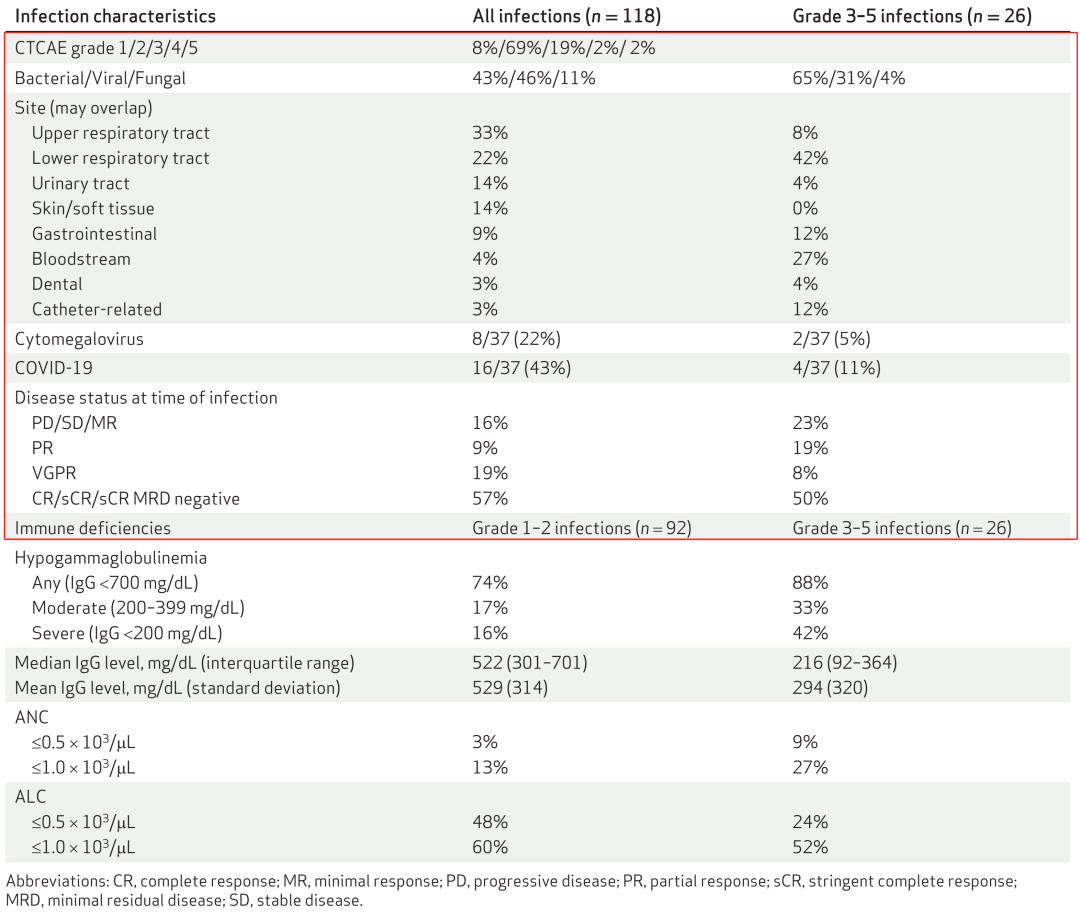
Blood Cancer Discov. 2023 Nov 1;4(6):440-451.
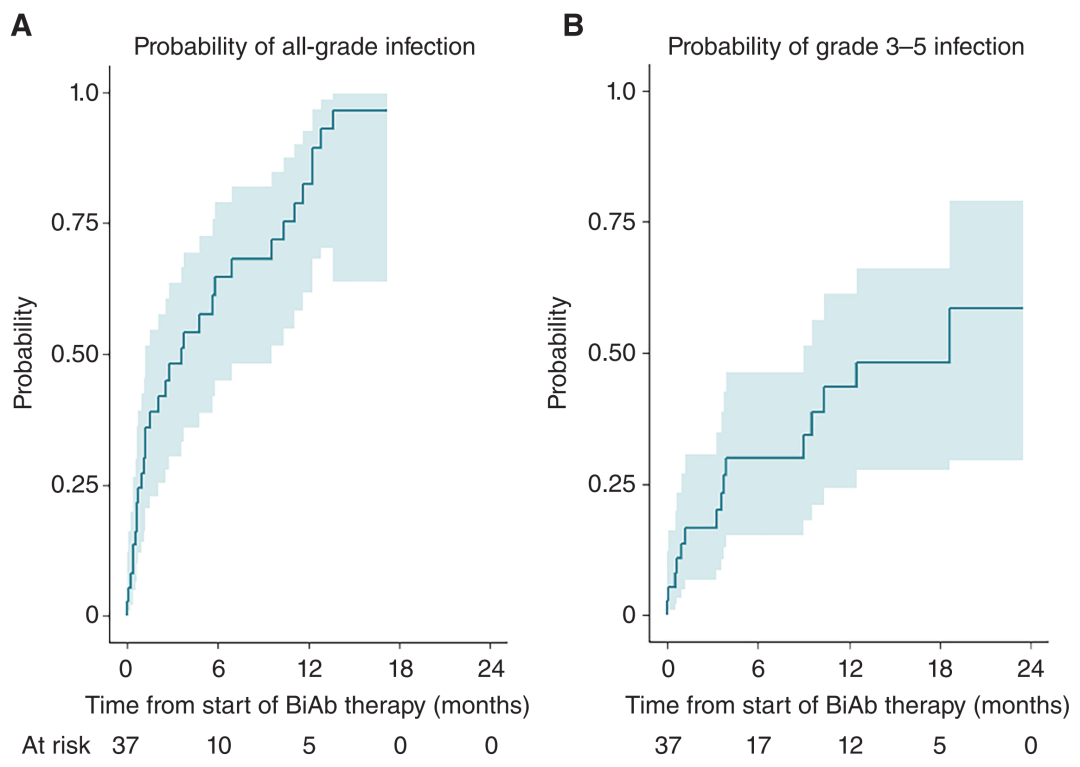
Blood Cancer Discov. 2023 Nov 1;4(6):440-451.
HGG as a Double-Edged Sword in Treatment
Most patients (35/37, 68%) who received treatment already had hypogammaglobulinemia (HGG) before treatment, but the severity was relatively low.
| IgG Level | All infections (n=118) | Grade 3-5 infections (n=26) |
| <700mg/dL | 74% | 88% |
| 200~399mg/dL | 17% | 33% |
<200mg/dL | 16% | 42% |
However, the study indicates that all patients who responded to the treatment had experienced severe HGG, nearly reaching an IgG-deficient state, which (HGG)Seemingly can be used asPredict Treatment OutcomesOne characteristic.
During the dual-antibody treatment process, HGG may worsen, which could also be an important reason for the increased risk of infection. Intravenous IgG administration can reduce the risk of infection.
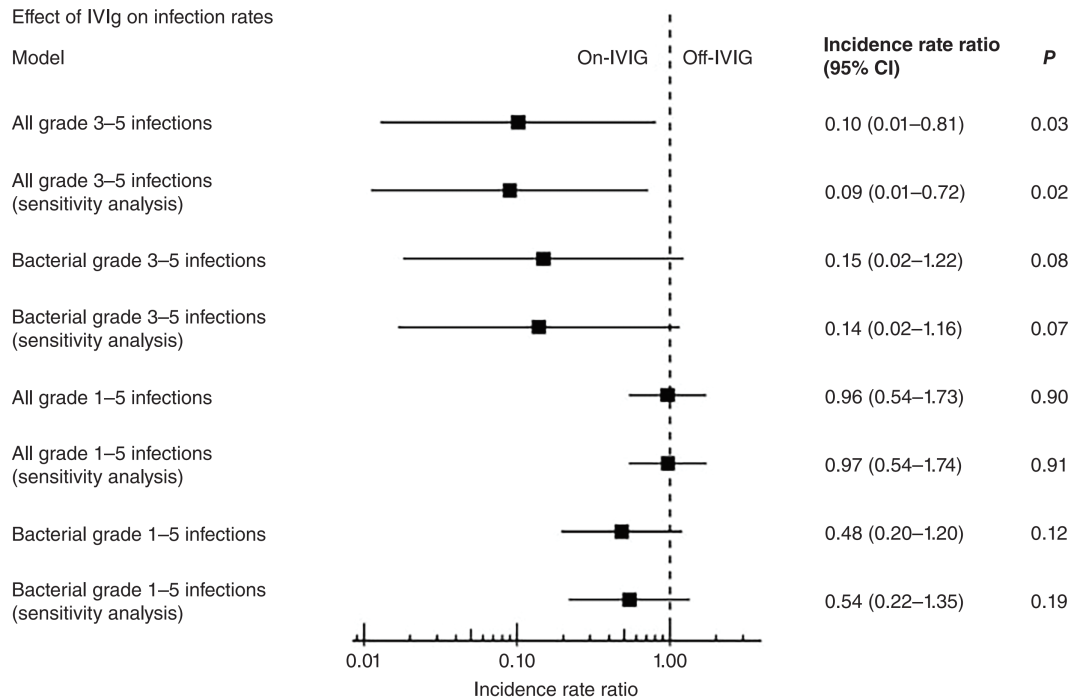
Blood Cancer Discov. 2023 Nov 1;4(6):440-451.
T Cell-Related Infections Also Require Attention
Although intravenous IgG is a good method for treating HGG and preventing infections, it may interfere with the determination of HGG duration, potentially making it difficult to identify the precise treatment timing.
Therefore, the recommendations in the article for dealing with infections areBefore treatmentVaccination。
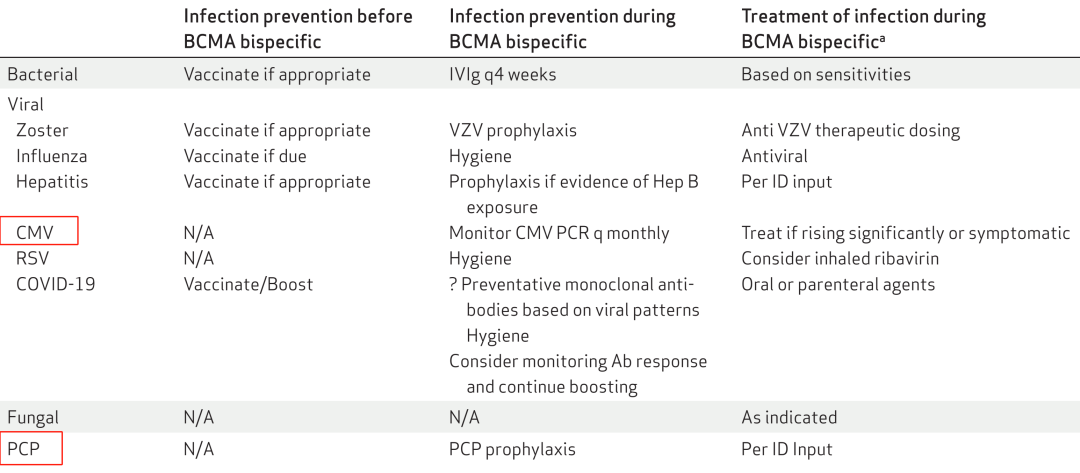
Blood Cancer Discov. 2023 Nov 1;4(6):440-451.
Moreover,Some infectious diseases are also associated with T-cell defects, such as cytomegalovirus (CMV) reactivation and Pneumocystis pneumonia (PCP). CD3/BCMA bispecific antibodies may affect T-cell redistribution, and attention should also be paid to these types of diseases.
Summary
CD3/BCMA Bispecific Antibody Effective for Treating Multiple Myeloma, Though Drug Tolerance Is BetterIncreased Risk of InfectionIs a serious side effect.Such risks may arise from defects in plasma cells themselves, HGG caused by BCMA targeting, and T-cell redirection caused by CD3 targeting.
Therefore, optimizing drug use strategies is also a noteworthy issue for the future.
Sammartano V et al. Anti-BCMA novel therapies for multiple myeloma. Cancer Drug Resist. 2023 Mar 22;6(1):169-181.
Lancman G et al. IVIg Use Associated with Ten-Fold Reduction of Serious Infections in Multiple Myeloma Patients Treated with Anti-BCMA Bispecific Antibodies. Blood Cancer Discov. 2023 Nov 1;4(6):440-451.
Middelburg J, Kemper K, Engelberts P, Labrijn AF, Schuurman J, van Hall T. Overcoming Challenges for CD3-Bispecific Antibody Therapy in Solid Tumors. Cancers (Basel). 2021 Jan 14;13(2):287.
Source: Chatting About Immunology 2024-02-04