Medtronic Initiates Class I Recall of 785,000 MiniMed 600 and 700 Series Insulin Pumps Amid Battery Safety Concerns

Medtronic
Medical Device Manufacturer


Recently, according to an announcement released by the FDA,Medtronic Recalls MiniMed 600 and 700 Series Insulin PumpsThe battery is defined as the most severeClass I Recall Event, which means that using such devices may cause serious injury or death.

In fact, Medtronic noticed the battery life issue of insulin pumps at an early stage. From January 2023 to September 2024, Medtronic received a total of170 casesHyperglycemia (>400mg/dL) and11 casesDiabetic Ketoacidosis Report: All may be related to this issue.
And according to the FDA's device recall database, Medtronic's Class I recall events in October involved approximately785,000 system products.
In this regard, Medtronic sent messages to customers separately in July and October this year.Two Warning Letters, notify its customers who use diabetes devices to followBuilt-in Alarms and Battery Status Alerts, and explain that if customers observe any changes in the battery life of the pump, they should contact Medtronic.
The specific product information for this recall is as follows:
Recalled Product:
Product Name: MiniMed 630g, 670g, 770g, 780g
Lot Number/Serial Number:All batch numbers and serial numbers
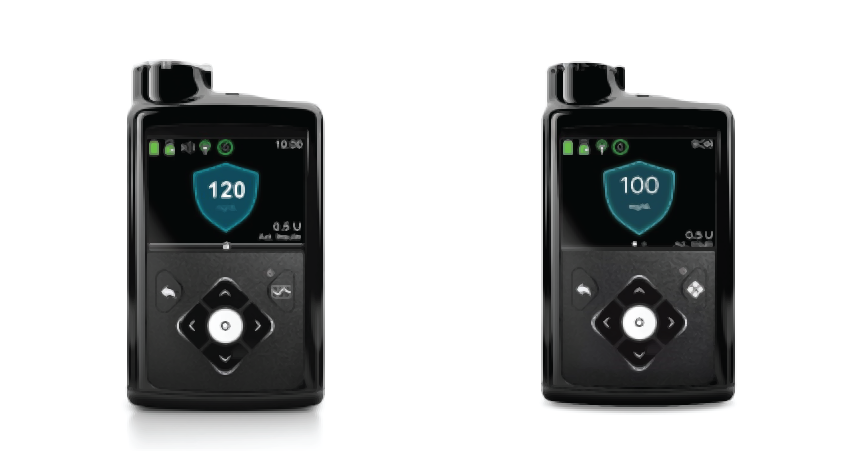
Fig: MiniMed 670g Insulin Pump and MiniMed 780g Insulin Pump
Reason for Recall:
All MiniMed 600 and 700 Series Insulin PumpsIncreased Risk of Shortened Battery Life for Users, and the time to shut down after a battery alarm occurs is shortened. Pumps that have been dropped, bumped, or experienced other physical impacts may damage electrical components, leading to this issue - even a single drop can affect battery life. This may cause the pump to stop insulin delivery faster than usually expected.
Using the affected products may lead to serious adverse health consequences, includingHyperglycemia(Hyperglycemia), excessive rapid breakdown of body fat (Diabetic Ketoacidosis) andDeath.
Although it is called a recall, Medtronic does not need to return the MiniMed 600 and 700 series insulin pumps this time. Users only need to replace the battery immediately after receiving the "Low Battery Pump" alert and carry an extra battery in case of unexpected battery replacement. Meanwhile, Medtronic provides a 24-hour technical support team to assist users at any time.
In fact, this is not the first FDA Class I recall event faced by Medtronic's insulin pump products.
As a leading company in the diabetes management market, Medtronic began producing insulin pumps as early as 1980 and was the first company to receive FDA approval in the United States for its insulin pumps. Its products and technology hold a significant share in the global market, once presenting a relatively monopolistic market structure.
However, the fruits of victory were not enjoyed for long before a wave of product malfunctions with insulin pumps arrived one after another, dealing consecutive blows.Medtronic's diabetes business nearly disrupted.
In November 2019, Medtronic faced safety issues with its MiniMed 600 Series insulin infusion pumps,First warning issued to patients using the product.
Subsequently, the FDA classified hundreds of thousands of Medtronic Minimed insulin pumps as the most severe level of recall, with the number of recalls in the United States being322,005 units, the number of recalls worldwide is481,875 units。
By 2021, Medtronic had expanded the recall scope of its MiniMed 600 Series insulin infusion pumps. The number of devices recalled this time in the United States alone reached463,464 units, which also led to Medtronic receiving fromA Warning Letter from the FDA。
Affected by multiple large-scale recalls and FDA warning letters, Medtronic's commercial progress of insulin pump-related products in the U.S. has been virtually halted, and its diabetes business has suffered a severe blow.
At the same time, while Medtronic has been deeply troubled by recalls, the aggressive positioning of its competitors has widened the gap between its U.S. and international businesses, even leading to negative growth at one point.
The "credibility crisis" triggered by a series of recalls and warning letters did not hinder Medtronic.High hopes for the diabetes business.
According toMedtronic CEO Jeff MarthaMedtronic stated that it will "continue to heavily invest" in its diabetes care business, and "is developing multiple projects," with the aim of "achieving strong growth in its diabetes business in the coming years."
With the FDA warning lifted, Medtronic seeks new breakthroughs in its diabetes business and commercialization strategy to regain market share.
In the business structure, there is a major change in the senior management of the diabetes division.
Medtronic replaces division president Que Dallara to address the downward trend and strengthen the diabetes business planning.Que DallaraPreviously served as President and CEO of Honeywell, and before that worked for a decade at sensor manufacturer TE Connectivity and spent a few years on business development and M&A strategy at Microsoft.
Commercially, a cooperation with Abbott has been reached.
In August this year, a global cooperation agreement was reached with Abbott. Based on Abbott's FreeStyle Libre technology, the two parties will develop an integrated continuous glucose monitoring system (CGM), which will be connected to Medtronic's automated insulin delivery (AID) and smart insulin pen systems. In the highly competitive diabetes market, the two companies have chosen a 1+1>2 commercialization model, cooperating to meet their respective needs.
Apart from the business adjustments in the U.S. and the high expectations the company has for its future, Medtronic's current relevant product technologies are also worth paying attention to.
AsThe Only OneCompanies that possess all three components of the hybrid closed-loop system (CGM, insulin pump, and algorithm), such as Medtronic's diabetes monitoring products, have considerable advantages and have successively launched several flagship products in recent years.
Such as the most advanced insulin delivery systemsMiniMed™780GAnd the first disposable all-in-one continuous glucose monitoring systemSimplera™Among them, the MiniMed™780G is called an "artificial pancreas," which uses software to assist in automatically regulating blood glucose levels, functioning like a human organ.
Excellent products have also driven the performance growth of Medtronic's diabetes business.
According to Medtronic's 2024 financial report, Medtronic's diabetes business grew from $2.262 billion in the fiscal year 2023 to$2.488 billion in fiscal year 2024, with a growth rate reaching double digits, far surpassing other departments. Medtronic itself revealed that the MiniMed™ 780G system was one of the main drivers behind its sales growth.
Obviously, the large-scale recall of insulin pumps and business crisis did not hinder Medtronic's progress in the diabetes field; instead, it has driven them further ahead. Thus, the diabetes sector indeed appears to be a lucrative long-term business.
Currently, diabetes has become the most common chronic disease worldwide, second only to cancer in terms of its harm to the human body. It is estimated that by 2050,Globally, there will be more than 1310 million people suffer from diabetes.
In clinical practice, diabetes cannot be cured at all. Patients need to control blood sugar levels through lifelong insulin injections or taking hypoglycemic drugs, thus giving rise toInsulin Pump, Continuous Glucose Monitoring System (CGM)The market for essential medical device products with rigid demand.
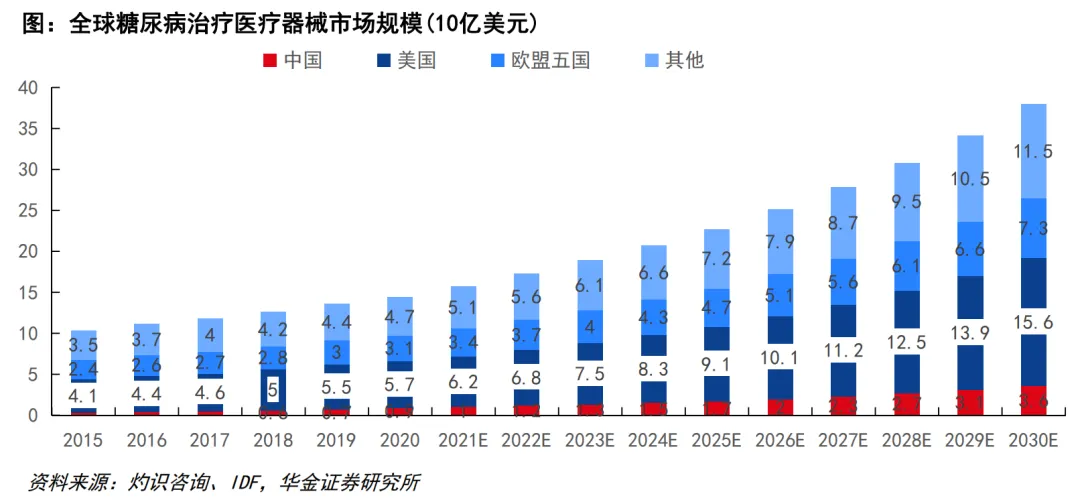
According to research data from multiple sources including CIC, IDF, and Huajin Securities Research Institute, the market size of the global diabetes management medical device market was $42.3 billion in 2020 and is expected to grow to$118.5 billion, with huge market potential.
With promising growth prospects, Medtronic is not the only player in this field.
During Medtronic's "quiet" days,Abbott, DexcomStrong competitors such as Medtronic are also increasing their efforts in the diabetes field to compete for market share.
As the leading powerhouse in diabetes care, Abbott's diabetes business also plays a significant role in its revenue.
As early as 2022, Abbott acquired a diabetes management software company.Bigfoot, and integrate its technology into Abbott's insulin pump system to provide a more comprehensive diabetes management solution.
In addition, Abbott's diabetes business has also focused on expanding its CGM product line. Investment440 million euros for constructionThe base for producing the Freestyle Libre 3 continuous glucose monitoring system. Abbott's FreeStyle Libre product has continued to maintain its performance growth myth. According to Abbott's annual report,FreeStyle Libre Revenue Reached $5.8 Billion in 2023(Approximately RMB 42.456 billion).
In recent years, Dexcom, the giant in the diabetes market second only to Abbott, has also made significant moves.
Announced last year withCollaboration with Tandem Diabetes Care, a diabetes care company, successfully launched the latest t:slim X2 insulin pump system, which is the "culmination of a decade of collaboration" between the two parties.
Following the launch of the new generation CGM product DexCom G7, which received FDA and CE approval, it will compete head-to-head with Abbott and Medtronic.
According to Dexcom's Q2 financial report, achievements have been made in international markets outside the United States.38% Sales Growth, and raised its full-year revenue growth forecast from 17% to 21%. During the earnings call, Dexcom attributed the reasons to the upgrade of G7 itself and the market strategy prepared in advance around G7.
It can be seen that giant medical device companies are eyeing the diabetes care business ambitiously, which is not an easy task for Medtronic, aiming to regain its market share.
At the same time, andIn the Chinese market, there are also continuously Chinese-produced products here.Begin to show one's talent.Since 2021,Silicon-based Bionics, Yuwell Medical, Microtech Medical, SinocareChinese brands have gradually made their mark. Now, three years later, the number of companies that have obtained registration certificates has increased to 13, and more players are actively making arrangements and breakthroughs.
Among them,MicroTech MedicalListedThe First in ChinaThe approved patch insulin pump Equil; its CGM productAiDEX G7 Outperforms Abbott's Similar Products in Performance`, rivaling the industry benchmark product, Dexcom G6.`
Currently, several products of the company have been commercialized, covering 30 provinces, municipalities, and autonomous regions in China as well as 60 overseas countries. According to the interim report of Medtronic, the company's revenue in the first half of 2024...151 million, an increase of 36.1% over the same period last year.
It can be seen that,In the global medical device"In the midst of 'involution,' companies in the diabetes management market are facing a new round of competition."。It is certain that, as daily management medical devices, equipment with excellent functionality, fewer malfunctions, and strong safety will be more favored by users.
As numerous enterprises rise successively, market competition becomes increasingly fierce. How to ensure product quality stands the test and corporate transformation meets challenges is a common issue faced by enterprises both in China and abroad.
To ensure you don't miss any content, everyone remembers toMedical Device Business ReviewSet as starred? Oh,
Looking forward to meeting you at the earliest opportunity every time.