

Merck Acquires Modifi Biosciences for Up to $1.3 Billion to Advance Next-Gen Glioblastoma Therapy
Modifi Biosciences
Preclinical Biotechnology R&D Provider

MSD
Pharmaceutical R&D and Manufacturer
On October 23, Modifi Biosciences announced that it had reached an agreement with MSD. MSD will acquire all outstanding shares of Modifi Bio through a subsidiary for an upfront payment of $30 million. Shareholders of Modifi Bio are also eligible to receive potential milestone payments totaling up to $1.3 billion.
Through this acquisition, MSD will gain access to its innovative cancer therapy. Modifi Biosciences' innovative treatment is a preclinical compound that leverages DNA repair defects to treat refractory cancers, targeting not specific proteins but directly the cell's DNA.
Modifi Biosciences, founded in 2021, is a company spun out from breakthrough technology developed by scientists at Yale University. Bypassing the traditional approach of indirectly targeting proteins in cancer cells, Modifi Biosciences is redefining the rules of cancer treatment: eradicating cancer through direct DNA modification.Modifi Biosciences' proprietary innovative platform has demonstrated potent anti-tumor activity in gliomas and many other cancers with inherent DNA repair defects.
Previously, Modifi Bio received seed funding from HighCape Capital, Advantage Capital, Connecticut Innovations, the American Cancer Society (ACS) BrightEdge, the National Brain Tumor Society's Brain Tumor Investment Fund, Pathway Bioventures, Sontag Innovation Fund, Yale Ventures, and other institutions and foundations.
The team at Modifi Biosciences includes world-renowned scientists, clinicians, and seasoned biotechnology entrepreneurs with deep expertise in synthetic chemistry, DNA repair, and translational research in oncology.

(Founding Team of Modifi Biosciences)
Currently, Modifi Bio has developed an innovative small-molecule drug that has demonstrated potent anti-tumor activity in cancer cells while sparing healthy tissue in laboratory studies. These novel therapeutic molecules fragment within cells and induce DNA modifications, which are irreparable in cancer cells with DNA repair deficiencies.
A recent study published in Nature by Modifi Biosciences shows that these "chameleon-like" novel molecular drugs can specifically target cancer cells lacking the key DNA repair protein O6-methylguanine-DNA methyltransferase (MGMT), directly causing damage to the DNA within the cells.In healthy cells expressing MGMT, this type of damage can be repaired, but in cancer cells lacking MGMT, this DNA damage subsequently converts into more severe secondary damage, leading to the death of cancer cells.
Approximately 50% of glioblastomas and up to 80% of gliomas lack MGMT, making such cancers a primary focus for the development of innovative therapies. Recent cutting-edge research indicates that MGMT deficiency is also present in various other tumor types, suggesting broad applicability of this strategy in cancer treatment.
Modifi Biosciences further demonstrated its efficacy through strong preclinical data across multiple tumor models, including patient-derived glioma and other cancer xenograft models with inherent DNA repair defects. The small molecule drug is designed as an oral formulation with good bioavailability and drug-like properties, which will enable them to quickly submit an IND application to the FDA.It is expected to initiate Phase I clinical trials in 2024.
As early as the release of its 2023 financial report, MSD had already forecasted future peaks in mergers and acquisitions:MSD CEO Rob Davis stated that the company is still looking for acquisition deals in the market ranging from $1 billion to $15 billion."Although I am very satisfied with the progress we have made in expanding the depth and diversifying our portfolio, we do believe more is needed." Behind the continuous search for acquisitions hangs the Sword of Damocles over MSD.
New "Drug King" K Drug Faces Countdown Threat of Patent Cliff. In 2008, MSD applied for the core patent protection of Keytruda - the compound amino acid sequence, with a term of 20 years. That is, in 2028, MSD will lose the core patent protection of Keytruda.
Generally speaking, innovative pharmaceutical companies facing a patent cliff have several ways out. One is the "patent thicket" strategy, which involves expanding new indications for core molecules or combining them with other drugs to build peripheral patents for the drug. This not only expands the audience for the drug but also effectively extends the product lifecycle.
MSD's official website shows that Keytruda is currently in clinical and submission review stages for several indications, including hepatocellular carcinoma, resectable non-small cell lung cancer, HER2-negative locally advanced unresectable or metastatic gastric cancer, locally advanced unresectable or metastatic biliary tract cancer, and newly diagnosed high-risk locally advanced cervical cancer. These indications involve countries and regions such as the United States, the European Union, and Japan.
In addition to broadening the indications for single-agent therapy, MSD's development of Keytruda also focuses on exploring the potential of various combination therapies. On one hand, the response rate of PD-1 monotherapy is relatively low, prompting a search for combination regimens that can enhance response rates. On the other hand, numerous collaborative explorations also reflect MSD's underlying anxiety about the "patent cliff."
In 2023, MSD launched several Phase III clinical studies on combination regimens, such as the powerful collaboration with Moderna to develop and commercialize the mRNA cancer vaccine mRNA-4157, initiating two studies on combination therapy for non-small cell lung cancer; TROP2 ADC MK-2870, introduced from Kelun Biotech, has started a pivotal Phase III study for first-line combination therapy in non-small cell lung cancer. Additionally, cutting-edge therapies such as oncolytic viruses, tumor electric fields, TIL, microbiota, and CAR-M also appeared in the combination regimens.
The second path to addressing the patent cliff lies in seeking pillar drugs and potential pipelines beyond the "blockbuster drug."MSD's 2023 financial data highlight the urgency of diversifying its investment portfolio.
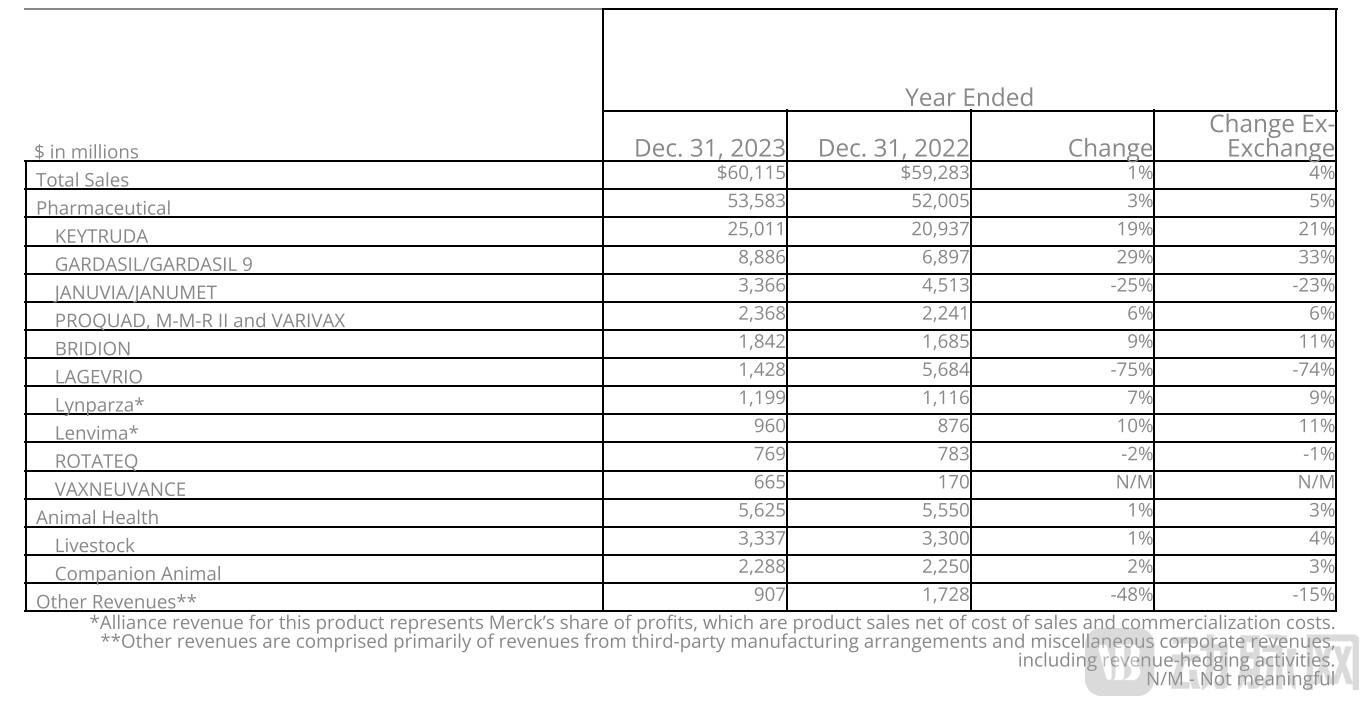
(Source: MSD 2023 Annual Report)
From the 2023 annual financial report, MSD's pharmaceutical business revenue reached $53.583 billion, a year-on-year increase of 3%. Among this, Keytruda generated $25.011 billion in revenue, contributing 41.6% of the total income. Following closely, the HPV vaccine GARDASIL/GARDASIL 9 achieved $8.886 billion in revenue, showing remarkable growth with a year-on-year increase of 29%, surpassing even Keytruda.
In addition to its commercialized drugs, MSD has over 80 assets in Phase II clinical trials and over 30 in Phase III. In 2023, MSD completed project approvals for over 25 drugs with major regulatory agencies worldwide, initiated Phase III trials for over 20 pipeline assets, and announced plans to "launch more Phase III clinical trials in 2024."
However, finding a drug that can match the scale of the "King of Drugs" is no easy task.
In 2021, MSD acquired Acceleron for $11.5 billion (the second-largest biopharmaceutical deal of the year). This acquisition brought Sotatercept, a drug for treating pulmonary arterial hypertension, which has already submitted a BLA application to the FDA and is expected to be approved in March. Data from Phase III clinical trials showed a significant improvement in exercise test scores in a key polycyclic aromatic hydrocarbon (PAH) trial.
In March this year, the "first-in-class" therapy Sotatercept (Winrevair) was approved for marketing by the FDA and rated by the industry media Evaluate as one of the potential blockbuster therapies in 2024. Currently, it appears that MSD has high hopes for Sotatercept and aims to make it a "successor" blockbuster drug.According to the latest report released by Evaluate, the net present value (NPV) forecast for Sotatercept is the highest, reaching up to $11.6 billion, with expected sales of $2.6 billion by 2028.
In 2023, MSD also acquired Prometheus for $10.8 billion (the third-largest biopharmaceutical deal of the year). This transaction is seen as MSD's attempt to enter the autoimmune field. Currently, the TL1A antibody MK-7240 has registered for Phase III clinical trials for ulcerative colitis.At the time of the deal, MSD said that PRA023, a treatment for ulcerative colitis, had "peak sales potential in the billions of dollars."
In October of the same year, MSD collaborated with Daiichi Sankyo to co-develop three ADC candidates: patritumab deruxtecan targeting HER3 (approval and market launch delayed due to production issues); ifinatamab deruxtecan targeting B7-H3; and raludotatug deruxtecan targeting CDH6. MSD invested $4 billion as an upfront payment and $1.5 billion in continuous payments over two years for this collaboration, with potential future milestone payments reaching up to $16.5 billion, totaling approximately $22 billion.
In May 2024, MSD acquired EyeBio, an ophthalmology biotechnology company, for up to $3 billion, including $1.3 billion in upfront cash and $1.7 billion in potential development, regulatory, and commercial milestone payments. EyeBio's lead candidate drug, Restoret (EYE103), is a potential "first-in-class" tetravalent tri-specific antibody expected to enter pivotal Phase 2b/3 clinical trials within the year.
In August, MSD exercised the exclusive option for Kelun-Biotech's bispecific antibody ADC project SKB571 and paid Kelun-Biotech $37.5 million. Upon reaching specific development and sales milestones, MSD will make additional milestone payments to Kelun-Biotech. After the commercialization of SKB571, MSD will pay tiered royalties based on net sales. Kelun-Biotech will retain the rights to develop, use, manufacture, and commercialize SKB571 in mainland China, Hong Kong, and Macao. The product mainly targets various solid tumors such as lung cancer and gastrointestinal tumors. Its Investigational New Drug (IND) application has been accepted by the CDE.