

Alto Neuroscience's Lead Antidepressant ALTO-100 Fails Phase 2b Trial, Wiping Out 76% of Market Value

Alto Neuroscience
Mental Health Treatment Drug Developer

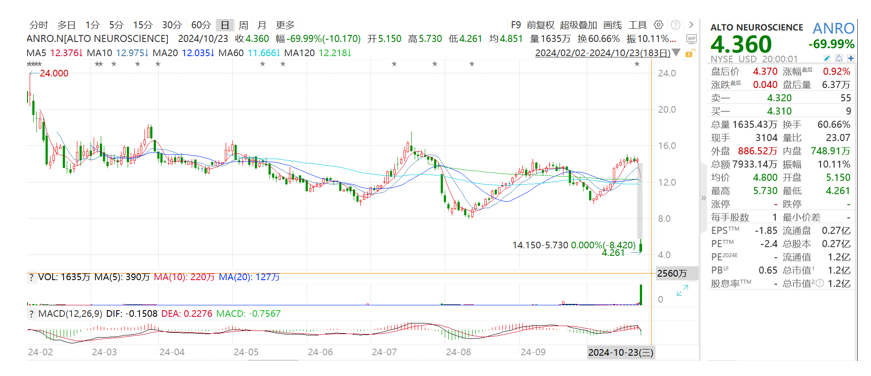
Local time on October 22,Alto Neuroscience Releases Press Release Stating ItsALTO-100, an investigational therapy for major depressive disorder (Major Depressive Disorder,MDD)2Phase B study did not meet its primary endpoint.The publication of the clinical trial results caused Alto Neuroscience, Inc.'s stock price to plummet nearly 70% during after-hours trading on Tuesday, leaving its market value at just $120 million, only a few months after its February debut on the capital market.
01
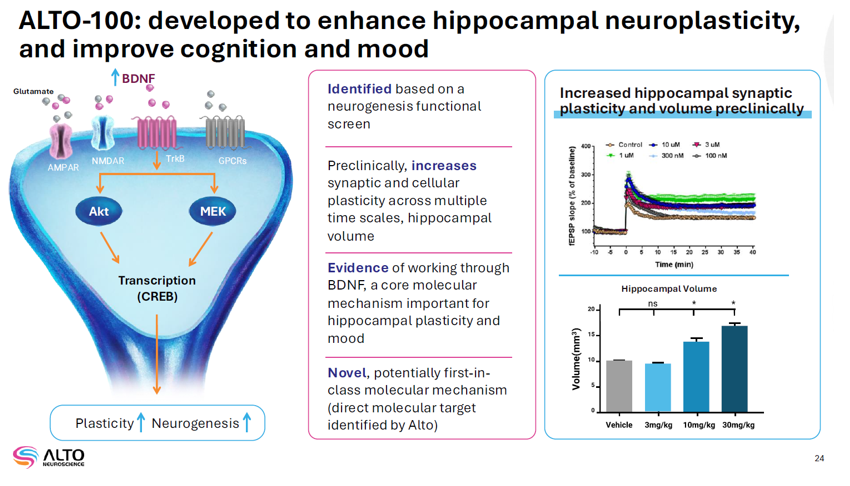
ALTO-100 is an orally administered drug developed by Alto Neuroscience using its biomarker platform. It targets brain-derived neurotrophic factor (BDNF) and can restore patients' neural plasticity, enabling the brain to flexibly adapt to new information.
This 6-week Phase 2b clinical trial aims to evaluate the efficacy and safety of ALTO-100 in treating patients with MDD. The study enrolled 301 adults diagnosed with MDD across 34 sites in the United States. Specific clinical results are as follows:
Compared with placebo, the biomarker-defined MDD patient group receiving ALTO-100 treatment did not show statistically significant improvement in depressive symptoms.
ALTO-100 did not show a benefit over placebo in the pre-specified key secondary analysis.
ALTO-100 continues to demonstrate good safety and tolerability, with no new safety signals observed in this study compared to previously completed ALTO-100 clinical trials.
The most common adverse events associated with ALTO-100 treatment in the trial were headache, nausea, and abnormal dreams – all of which occurred at rates similar to those of placebo.
The company hopes to complete the analysis of the full dataset to determine the most appropriate next steps (if any) to further evaluate the efficacy of ALTO-100 in MDD.
"We are disappointed with the results of this study because there is a significant unmet clinical need in the patient population that this drug targets," said Amit Etkin, M.D., Ph.D., founder and CEO of Alto Neuroscience. "While the results were surprising and disappointing, I am proud of our team for conducting pioneering psychiatry research based on precise biomarkers. We will move quickly to evaluate the full dataset to better understand these findings and integrate the lessons learned from these large datasets into our platform. We remain committed to our mission of helping patients recover more quickly by bringing precision medicine to psychiatry, and our strong cash balance will support us through multiple near-term clinical milestones across our pipeline."
After Alto announced the failure of this clinical data, the company's market value dropped from $500 million at the close of the IPO to $120 million, a 76% decrease.
In addition, there are not many global drugs targeting BDNF in development. Apart from ALTO-100, the only drug in the clinical stage is Methylone (TSND-201) developed by Transcend Therapeutics.
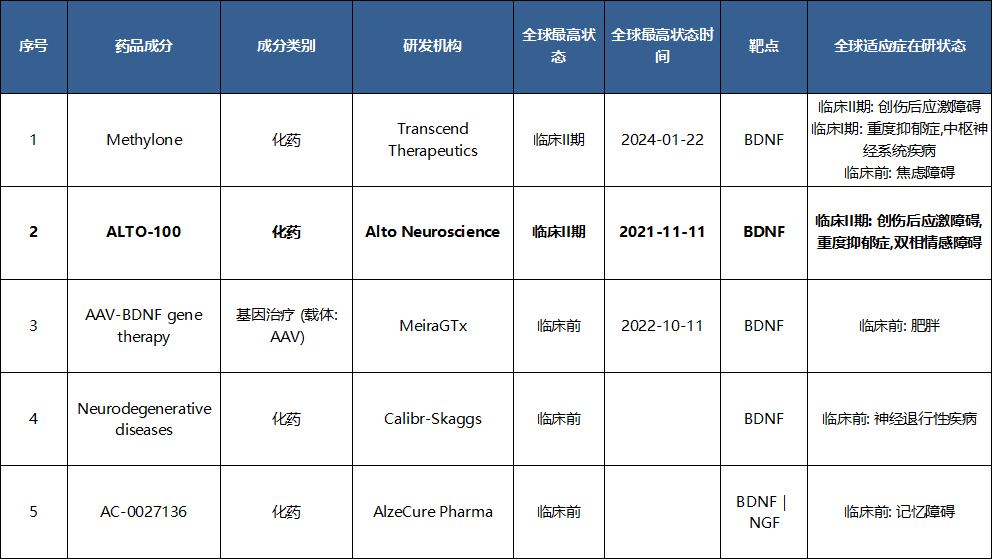
Global BDNF-Targeted Drugs in Development (Source: Insight Database)
In December 2023, Transcend Therapeutics presented positive results from its Phase 2 clinical trial, IMPACT-1, for TSND-201 (methylone), a neuroplastogen, used in the treatment of post-traumatic stress disorder (PTSD), at the annual meeting of the American College of Neuropsychopharmacology (ACNP). The results showed,More than 60% of patients showed improvement in their PTSD and depressive symptoms.
It can be seen that the preliminary clinical data of this novel target has shown some impressive results, and whether it can eventually become a drug is still worth looking forward to. After all, the road of pharmaceutical research and development has never been smooth sailing.
02
Urgently Need Clinical Data for Self-Validation
Alto Neuroscience, Inc. was founded in 2019 and is headquartered in Los Altos, California, USA. It was established by Amit Etkin, a psychiatrist from Stanford University, who has been obsessed with how to better define mental illnesses for decades. Frustrated by the lack of innovation in treating mental health conditions over the years, he began to question...Traditional diagnosis actually does not touch the core of what is happening in the patient's brain.
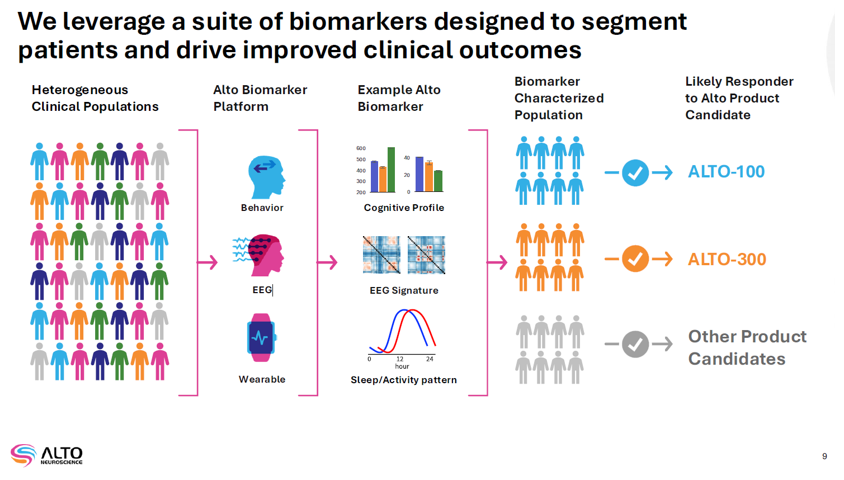
Based on more than 10 years of method and data accumulation, Alto Neuroscience has developedPrecision Psychiatry PlatformThroughAnalyze EEG activity, neurocognitive assessments, wearable data, and other methods to measureBrain Biomarkers, and then use these characteristics to identify and screen patients who show better clinical responses to the candidate therapeutic drugs.
However, analysts at William Blair pointed out,The failure of the ALTO-100 mid-stage trial "will undoubtedly deepen investors' skepticism about Alto Neuroscience's precision psychiatry approach.". In addition, although Alto has adopted an innovative approach, William Blair believes that this biotechnology company is facing one of the most formidable challenges: depression itself."While today's trial data has drawn more scrutiny to the biomarker stratification approach, historically placebo-controlled MDD studies have always been high-risk, and this time seems no different."
Nevertheless, Alto Neuroscience remains confident in its precision psychiatry approach.
Moreover, Alto Neuroscience's precision psychiatry platform has also shown positive signs in trials of other candidate drugs. In December last year, the company announced positive results from the Phase 2a study of ALTO-300 in MDD: After ALTO-300 administration, some patients identified through EEG biomarkers showed significant clinical improvement in depressive symptoms and higher remission rates. This further supports Alto Neuroscience's precision drug development approach and provides additional validation for its precision psychiatry platform.
Although ALTO-100 encountered setbacks in the MDD trial, interim data for other candidate drugs from Alto Neuroscience, such as ALTO-203 and ALTO-300, are expected to be released in 2025. Additionally, the Phase 2b study of ALTO-100 in patients with bipolar disorder (BD) during a depressive episode is still ongoing, with topline results anticipated in 2026.
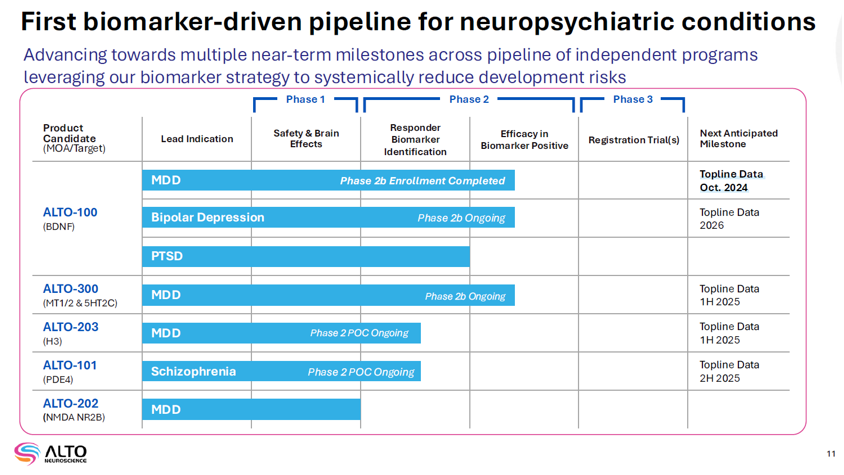
Milestone Progress of Alto's R&D Pipeline (Source: Company Official Website)
03
According to the latest statistical analysis data from the WHO in March 2023, approximately 280 million people worldwide suffer from depression (prevalence rate of 3.8%), about 5% of adults have depression, and it is projected that by 2030, depression will become the leading cause of global disease burden.
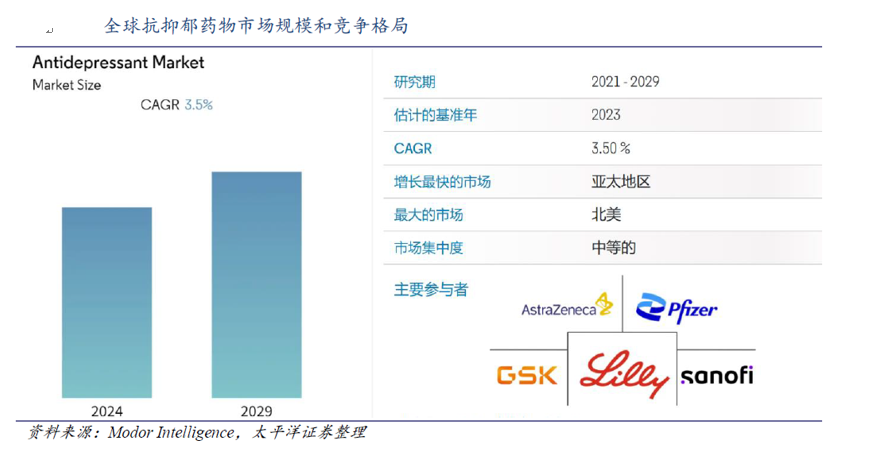
According to the depression market research report by Research and Markets, the global antidepressant market was estimated at $14.5 billion in 2022 and is projected to reach $17.6 billion by 2030, with a compound annual growth rate (CAGR) of 2.5% from 2022 to 2030. According to the depression market research report by Modor Intelligence, the CAGR is expected to reach 3.5% from 2024 to 2029, with the Asia-Pacific region experiencing the fastest growth in the antidepressant drug market.
The etiology of major depressive disorder is complex and may be related to various factors such as genetics and environment. A complete mechanism explaining the disease onset is still lacking. However, clinical research and relevant animal model studies have identified pathophysiological characteristics of the central nervous system and the primary stress response systems, including the hypothalamic-pituitary-adrenal (HPA) axis, autonomic nervous system, and immune system.
The main mechanism of existing drug treatments is to regulate neurotransmitter levels by affecting the synthesis, release, reuptake, or degradation processes of neurotransmitters, thereby alleviating the symptoms of depression.At present, the main effect of first-line antidepressant drugs is on monoamine neurotransmitters, which increase the concentration of neurotransmitters such as 5-HT, DA, and NE in the patient's brain, thereby alleviating depression.
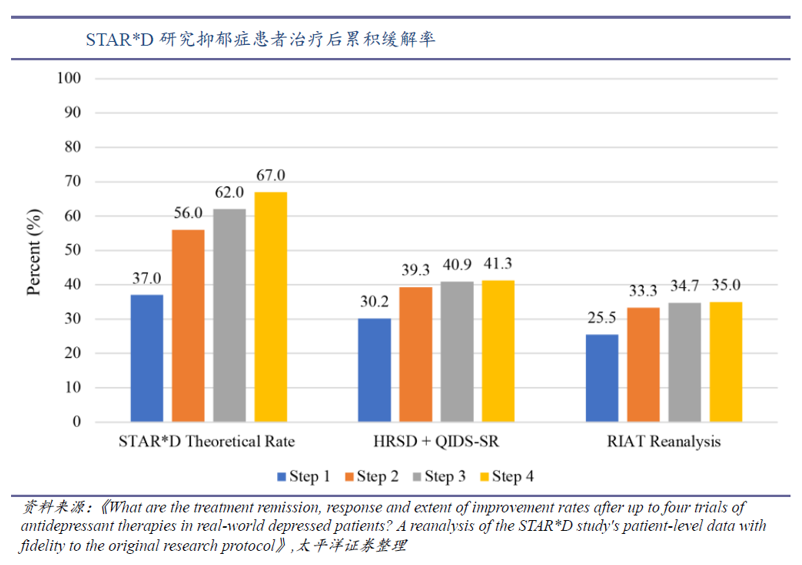
The STAR*D study, the largest and longest clinical treatment research on depression funded by the U.S. NIMH to date, indicates that for patients with depression who initially failed to respond to monotherapy with antidepressants, a sequential treatment approach yields theoretical cumulative remission rates of 37%, 56%, 62%, and 67% across four treatment steps. After comprehensively considering the potential biases in the STAR*D study, further analysis by researchers evaluating the outcomes revealed,The actual cumulative remission rate of sequential treatment for depression is much lower than 67%.
The first-line treatment drugs recommended by the guidelines, SSRIs and SNRIs, have relatively better efficacy, but these SSRIs and SNRIs class antidepressant drugsGenerally, it will start to take effect gradually 2-4 weeks after taking it.In addition, antidepressant treatment usually needs to last for more than half a year, but gastrointestinal adverse reactions are common with first-line antidepressants, including dry mouth, nausea, diarrhea, or constipation, etc. Headache, dizziness, sedation, insomnia, fatigue, and other adverse reactions may also occur. Long-term use at higher doses might lead to sexual dysfunction, resulting in low patient compliance with the treatment.
According to the data from PharmaCloud, there are currently 25 approved antidepressant drugs globally. The majority of these drugs target monoamine neurotransmitter transporters (10), followed by those targeting serotonin (5-HT) (8).
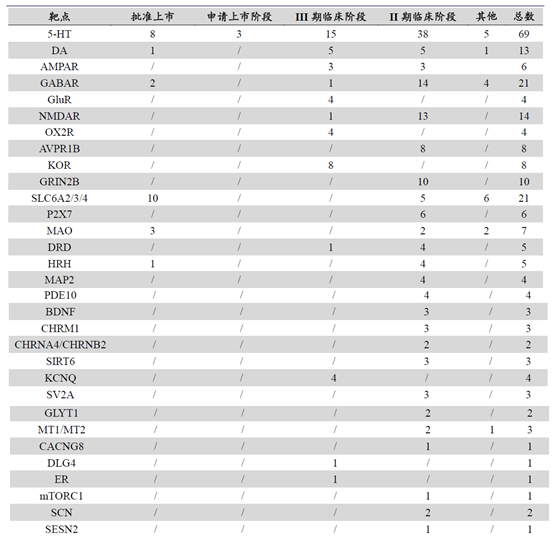
Among them, amino acid neurotransmitter drugs mainly include non-selective NMDA receptor antagonists, selective NR2B site NMDA receptor antagonists, allosteric modulators of NMDA receptors, allosteric modulators of metabotropic glutamate receptors and AMPA receptors, as well as drugs targeting GABA receptors, etc.As a research hotspot in the past two decades, amino acid neurotransmitter antidepressants have produced several blockbuster drugs worth billions of dollars.
1. Johnson & Johnson's Esketamine: Long-term sales peak expected to reach $50 billion
In 2000, a research team led by Professor John Krystal of Yale University (who co-founded Biohaven with two other professors in 2013) discovered that administering a low dose (0.5 mg/kg) of the anesthetic ketamine (Ketamine) to subjects could rapidly alleviate depressive symptoms, with the antidepressant effect lasting up to a week. This study, as a milestone event in the development of glutamate receptor-targeted antidepressants, greatly inspired researchers to investigate the molecular mechanisms behind Ketamine's rapid and long-lasting antidepressant effects.
On March 5, 2019, the U.S. FDA approved Esketamine (the right-handed isomer of Ketamine) nasal spray (brand name Spravato), the first new mechanism antidepressant in over 30 years, for use in combination with oral antidepressants to treat adults with treatment-resistant depression and those with depression accompanied by suicidal ideation or behavior.
Affected by the limitations of application scenarios, the sales growth of Esketamine was relatively slow after its launch, and it only started to grow rapidly in 2023, with global sales reaching $689 million, a year-on-year increase of 84.1%, far exceeding the growth rate of Johnson & Johnson's other blockbuster drug for the central nervous system, Methylphenidate, which had a year-on-year growth rate of 21.6%. The CEO of Johnson & Johnson stated at the JPM conference in 2024,Esketamine's sales peak in 2027 is expected to exceed analysts' expectations, potentially reaching up to $5 billion at its highest.
2. AXSM's Auvelity (Dextromethorphan and Bupropion): The first rapid-acting oral treatment approved for the treatment of depression.
Auvelity is a multi-target oral compound antidepressant developed by Axsome Therapeutics (AXSM). It non-competitively antagonizes NMDA receptors, activates Sigma-1 receptors, and competitively inhibits cytochrome P450 2D6 (CYP2D6). However, its specific antidepressant mechanism of action has not been fully elucidated.
In August 2022, based on its mechanism of action as an oral NMDA antagonist, rapid antidepressant effects, and relatively good safety profile, Auvelity was approved by the FDA for the treatment of major depressive disorder in adults. It became the first fast-acting oral treatment for depression to be approved in over 60 years, and prescription volumes increased rapidly after its market launch.
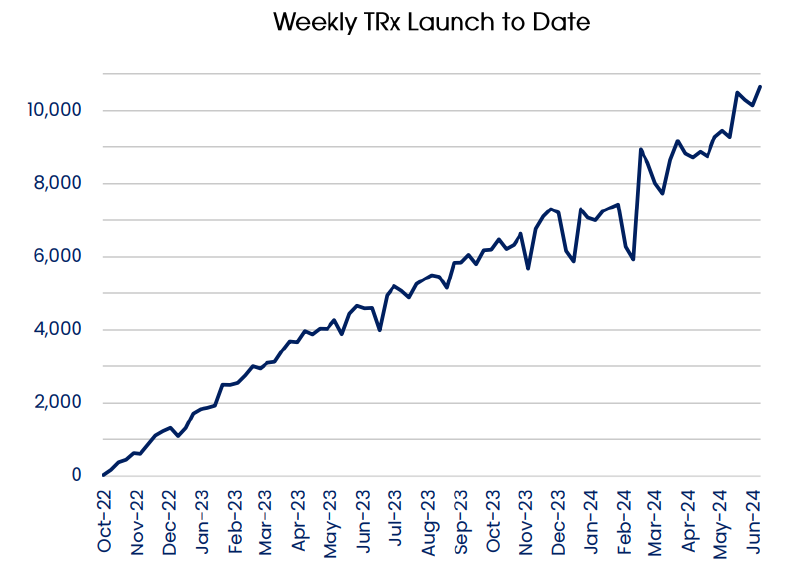
Auvelity Prescriptions (Source: Company Official Website)
3. ITCI's Lumateperone: Expected to Reach Sales Peak of $4.3 Billion, with Depression Peak Sales Projected at $1.3 Billion
Lumateperone is a multi-target antipsychotic drug developed by Intra-Cellular Therapies (ITCI). It partially agonizes dopamine D1 and D2 receptors, antagonizes 5-HT2A receptors, inhibits DA and 5-HT transporters, and promotes the activation of the NR2B subunit of NMDA receptors.
In December 2019, the U.S. FDA approved Lumateperone (42mg/day, brand name Caplyta) for the treatment of schizophrenia in adults. In December 2021, the U.S. FDA approved a new indication for Lumateperone: as monotherapy and as an adjunctive therapy with lithium or valproate (the broadest range), for depressive episodes in adult patients with bipolar I or II disorder. After the approval of the new indication, the total prescription volume (TRxs) increased rapidly. In 2023, Caplyta achieved sales of $462 million (YoY+86%), and the company's guidance for 2024 is $645-675 million.
According to the official website of Intra-Cellular Therapies, prescriptions for depression in the United States account for about 30% of the total antipsychotic prescriptions, with a CAGR of +26% over the past three years. The penetration rate of antipsychotics in patients with depression has reached 11%. If the indication for depression is approved, the market potential for Lumateperone could expand significantly, possibly reaching ten times that of its bipolar disorder indication.
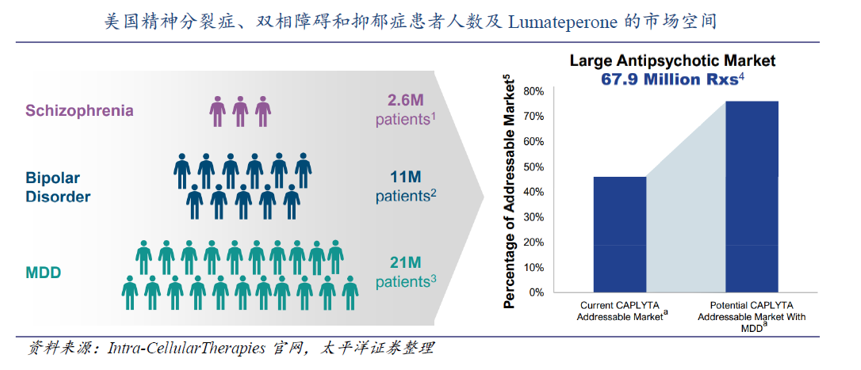 Given the positive Phase 2 and Phase 3 clinical data, analysts at RBC Capital Markets predict a 95% likelihood of Lumateperone gaining approval for the depression indication, while Mizuho forecasts that Lumateperone could achieve peak sales of $4.3 billion, with peak sales for depression expected to reach $1.3 billion.
References
1. Pacific Securities: New Mechanism Antidepressants Rapidly Improve Symptoms, Poised to Reshape Market Landscape


Disclaimer
1. All information provided by the "Drug Hunter Club" is for reference only and should not be used as a basis for any commercial transactions or medical services. If any deviation occurs from the independent use of the content of the "Drug Hunter Club," our company shall bear no responsibility, including but not limited to legal liability or compensation.
2. "Drug Hunter Club" is committed to providing reasonable, accurate, and complete information, but does not guarantee the reasonableness, accuracy, or completeness of the information, and assumes no responsibility for any loss or damage caused by unreasonable, inaccurate, or omitted information.
3. Some articles in the "Drug Hunter Club" are reproduced from the Internet with the purpose of conveying more information, but this does not imply endorsement of the views or confirmation of the authenticity of the content. If you have any questions about the content, please contact our company in a timely manner.
4. For issues not covered in this statement, please refer to relevant national laws and regulations. In case of any conflict between this statement and national laws and regulations, the latter shall prevail.


"Under Observation"Click once