HS-20093 (GSK5764227): A Novel B7-H3 Targeting ADC with Over 95% Disease Control Rate in Extensive-Stage Small Cell Lung Cancer, Granted Breakthrough Therapy Designation by Both U.S. FDA and China NMPA
Hansoh Pharma
Pharmaceutical Research, Production, and Sales


On October 24, 2024, according to the official website of the Center for Drug Evaluation (CDE) of China's National Medical Products Administration (NMPA), "HS-20093 for Injection," developed by Hansoh Pharma, is proposed to be included in the breakthrough therapy designation. It is intended for the treatment of patients with extensive-stage small cell lung cancer (ES-SCLC) whose disease has progressed after standard first-line treatment (platinum-based doublet chemotherapy combined with immunotherapy).
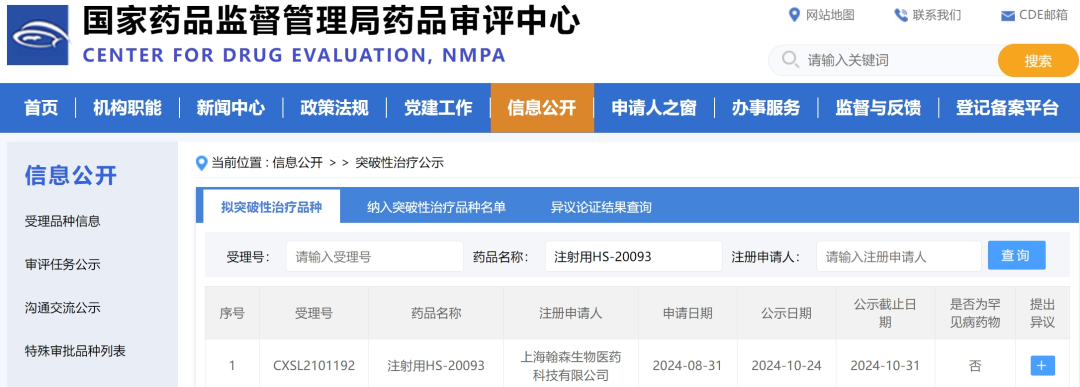
▲ Screenshot source: "NMPA"
HS-20093 (also known as GSK5764227) is a novel B7-H3-targeted antibody-drug conjugate (ADC), composed of a topoisomerase inhibitor (TOPOi) covalently linked to a fully humanized anti-B7-H3 monoclonal antibody payload, which can be used for the treatment of lung cancer, sarcoma, head and neck cancer, and other solid tumors.
As early as August 20, 2024, HS-20093 was granted Breakthrough Therapy Designation by the U.S. Food and Drug Administration (FDA) for the treatment of relapsed or refractory extensive-stage small cell lung cancer (ES-SCLC) with disease progression during or after platinum-based chemotherapy.
Small cell lung cancer accounts for approximately 15% of all lung cancers, with 70% of small cell lung cancer patients being in the extensive stage, meaning that the cancer has spread to one or both lungs and/or other parts of the body. Therefore, extensive-stage small cell lung cancer (ES-SCLC) is an aggressive and difficult-to-treat cancer with limited treatment options. The five-year survival rate is only about 3%, and most ES-SCLC patients will experience recurrence after initial treatment. Thus, there is an urgent need for new treatment methods. The emergence of HS-20093 brings new hope and options for small cell lung cancer patients, especially those with extensive-stage small cell lung cancer!
In the "First Phase 1 Clinical Study of HS-20093 in the Treatment of Extensive-Stage Small Cell Lung Cancer (ES-SCLC)," 53 evaluable patients with extensive-stage small cell lung cancer (ES-SCLC) who had previously received platinum-based standard treatment were enrolled. The enrolled patients were divided into two groups: the high-dose group (n=25, receiving HS-20093 at a dose of 10.0mg/kg) and the low-dose group (n=31, receiving HS-20093 at a dose of 8.0mg/kg). The results are as follows:
1、Disease Control Rate (DCR): The DCR of the patients were respectively80.6% (Low-dose Group) vs 95.5% (High-dose Group)。
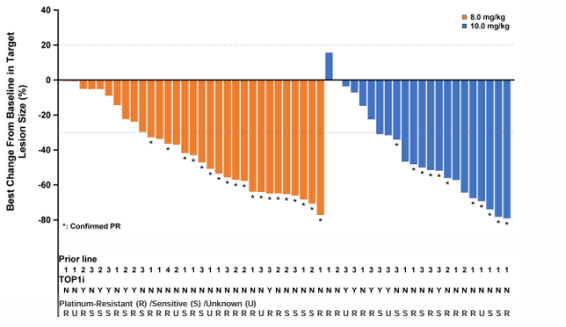
▲Source of the image“IASLC", owned by the original author. If we unintentionally infringe on intellectual property rights, please contact us for removal."
2、Objective Response Rate (ORR): The ORR of the patients were respectively61.3% (Low-Dose Group) vs 50.0% (High-Dose Group)。
3、Median Duration of Response (DOR): The DOR of the patients were respectively6.4 (low-dose group) vs 8.9 months (high-dose group)。
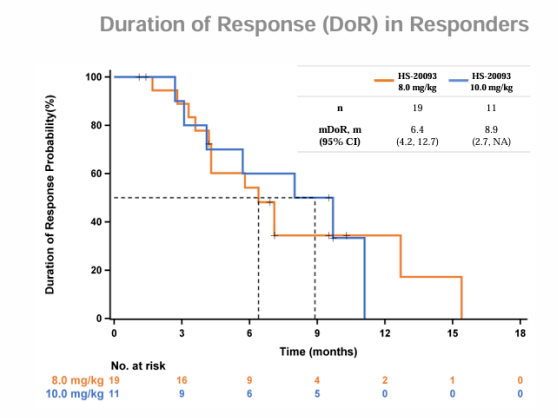
▲Source of the image“IASLC", owned by the original author. If we unintentionally infringe on intellectual property rights, please contact us for removal."
4、Median Progression-Free Survival (PFS): The PFS of the patients were respectively5.9 months (low-dose group) vs 7.3 months (high-dose group)。
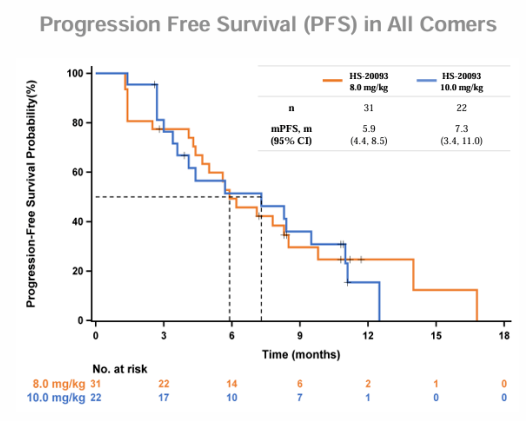
▲Source of the image“IASLC", owned by the original author. If we unintentionally infringe on intellectual property rights, please contact us for removal."
In addition to the aforementioned HS-20093 for injection, several new drugs for small cell lung cancer and multiple ADC drugs have recently been approved, aiding patients with lung cancer and other solid tumors in their fight against cancer!
Patients who are not satisfied with the current treatment can submit their treatment history, recent pathology, and imaging examination reports toGlobal Cancer Doctors Network Medical Department (4006667998), preliminary assessment of whether there is an opportunity to participate in clinical trials for new drugs, or to seek free medication opportunities through the Ark Project!
[1]Wang J,et al. Efficacy and safety of HS-20093 in extensive stage small cell lung cancer in a multicenter, phase 1 study (ARTEMIS-001). Presented at: 2024 IASLC World Conference on Lung Cancer; September 6-10, 2024; San Diego, CA. Abstract OA04.06.
https://cattendee.abstractsonline.com/meeting/20598/presentation/3215
[2]https://www.gsk.com/en-gb/media/press-releases/gsk-enters-exclusive-license-agreement-with-hansoh-for-hs-20093/
[3]https://www.onclive.com/view/hs-20093-generates-responses-in-pretreated-es-sclc
"Ark Gene Treasure Plan" is a gene "treasure hunt" initiative launched by Global Cancer Doctors Network in collaboration with Cancer-Free Home, authoritative gene testing institutions, international pharmaceutical companies, and renowned cancer centers. This plan aims to thoroughly explore the survival hopes indicated in each gene testing report, comprehensively interpret the gene testing reports for cancer patients, and match cancer patients with suitable newly approved drugs and ongoing clinical trials of investigational drugs on a global scale, providing patients with new survival opportunities as well as chances for free treatment with approved or unapproved new drugs!
Patients who wish to participate can send their genetic test reports and diagnostic reports electronically.Subsidiary or PhotographyPhotoSend to: doctor.huang@globecancer.com. Leave your contact information in the email, and the Medical Department will call you within 1 working day after receiving and analyzing the report; or call directly.Global Oncologist Network Medical Department (400-666-7998)Evaluation.

This article is original content from Global Oncologist Network. Reproduction is strictly prohibited without authorization.
Scan to Add Patient Group
Cancer News|New Technologies|New Drug Development|Leading Experts
Join the group to receive free anti-cancer resources