

Alto Neuroscience Faces Crisis as Lead Candidate Fails Phase IIb Trial Less Than a Year After IPO

Alto Neuroscience
Mental Health Treatment Drug Developer

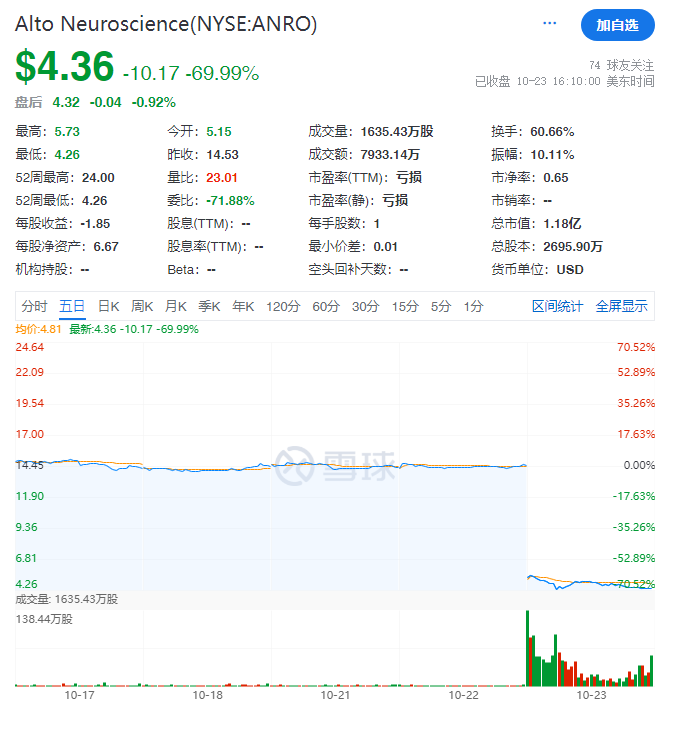
Recently, Alto Neuroscience, which highlights artificial intelligence as its selling point, may be facing this situation. Following the failure of the confirmatory clinical trial, the company's stock price plummeted by 69.99% at the close of trading. This is less than a year since the company's IPO in February this year.
The technical model of Alto Neuroscience is actually somewhat similar to a group of "pipeline salvage" companies that have emerged in recent years, which means they develop pipelines that others have failed in clinical trials. These "pipeline salvagers" often switch indications for clinical pipelines that have already failed. However, Alto Neuroscience is different. They believe that the failure of these "failed pipelines" is not necessarily due to the drug itself, but rather because the wrong patients were targeted.
By screening patients for specific biomarkers through Alto Neuroscience's unique artificial intelligence technology, the classification of patients can improve the success rate of clinical trials and bring failed pipelines "back to life."
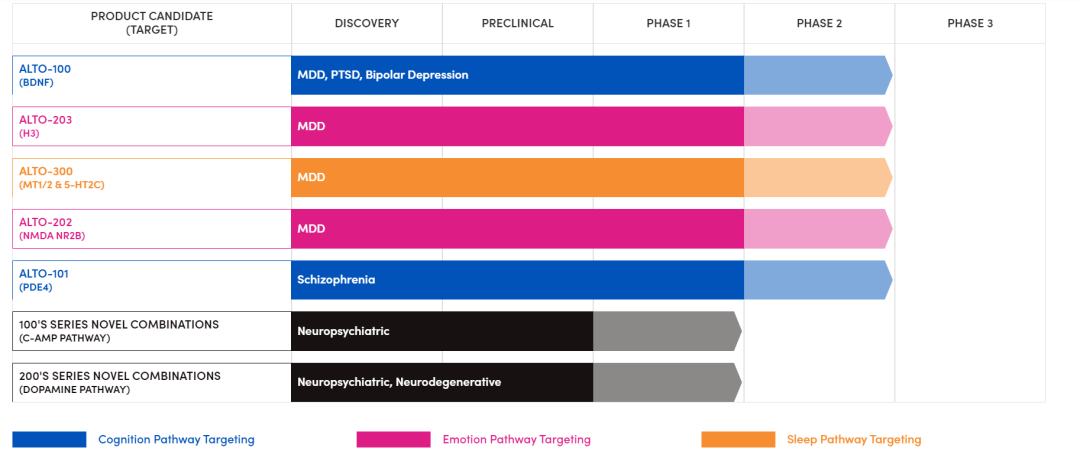
If Alto Neuroscience is correct, then the recently released core pipeline ALTO-100 Phase II clinical data for major depressive disorder should serve as evidence proving the effectiveness of the artificial intelligence platform. Even if statistical significance is not achieved, some level of improvement could still confirm the potential to "turn waste into treasure."
But this time it became a "deadly rope,"The reason is that the primary endpoint was not met in this clinical data, and in the key secondary analysis, the secondary endpoint was even inferior to the placebo.。Although clinical failures are very common in the treatment of mental illnesses like depression, this time Alto Neuroscience has suffered a complete defeat.
The core pipeline ALTO-100 involved in this accident was originally derived from Palisade Bio's pipeline NSI-189 and was secretly transferred to Alto Neuroscience in 2021. (Total deal value of $4.9 million, with a $500,000 upfront payment.)

Speaking of Palisade Bio, the company itself is a merger between Seneca Biopharma (formerly known as Neuralstem) and Leading BioSciences. During the time it was still called Neuralstem, the company acquired a patent license from Dow to develop what is now the predecessor of ALTO-100, NSI-189, with its indication being major depressive disorder. (According to the agreementAlto Needs to Pay Dow Patent Royalties)
However, it is worth criticizing that the actual mechanism of NSI-189 itself is not clear. Previously,It has been found to enhance hippocampal neuroplasticity and neurogenesis in multiple preclinical models., especially in a dose-dependent manner to increase the hippocampal volume of rodents. However, the mechanism by which NSI-189 achieves this effect is unclear and is speculated to be throughBrain-Derived Neurotrophic Factor (BDNF) is regulated.
Considering that the hippocampal volume shrinks and hippocampal neurons also die in patients with major depressive disorder, it has been applied to major depressive disorder.
However, although significant improvements in the hippocampus were observed in rodents previously, in human clinical trials, no notable impact on patients' hippocampus was detected. In this context, Neuralstem's NSI-189 Phase II clinical trial also failed in 2017 due to not reaching the clinical endpoint.
But the key is, no comparison, no harm.。
In 2017, NSI-189 showed statistically significant improvements across multiple secondary endpoints for depression and cognition. More detailed data analysis at the end of 2017 and the beginning of 2018 also demonstrated statistically significant improvements in patient-reported depression scale scores and cognitive enhancement with a daily dose of 40 mg.
In contrastALTO-100, although in the Phase IIa clinical trial released in 2023, it did show effects at the sixth week onSignificant improvement in MADRS scores in the biomarker-defined patient population (-15.5 vs. -10.5; p=0.0001), but by Phase IIb clinical trials, it showed its true colors, with secondary endpoints inferior to placebo.
What worries investors most is that in this processAlto Neuroscience's artificial intelligence platform may not have worked at all.The chain of suspicion would continue like this: All the pipelines Alto bought are failed pipelines, so similar to ALTO-100,The failed drug may still fail, and the artificial intelligence platform cannot change the outcome for a failing drug. The company will lose its future.
Fortunately, Alto Neuroscience has enough funds to last until 2027, and the clinical data of ALTO-300 and ALTO-203 to be released next year might be the key hope for this company to turn things around.
Reference Source:

Click "PharmSnap" below to follow more exciting content.
Disclaimer
The push rules of WeChat Official Accounts have changed again. If you don't tap"Views"Or not set to"Star Mark", we might just dissipate in the vast ocean of text~ Click here, don't miss out on the latest news from PharmaDJ!??