

BioMap Launches xTrimo V3, the World's Largest 210B-Parameter Multimodal Foundation Model for Life Sciences, Empowering Drug Discovery and Beyond

BioMap
Developer of Innovative Drug R&D Platform
In recent years, the craze for large models has expanded beyond natural language and image generation into more fields. Among them, large models in the life sciences have undoubtedly become a focal point of market attention due to their high technical barriers and significant application value. The scientific community and the industry hold high expectations for the empowerment of large models in areas such as drug discovery, biomanufacturing, and healthcare.
As a pioneer in the global life sciences foundational large model,BioMap Releases xTrimo V3, the New Generation of Life Science Foundation Model, at the 3rd China Bioinformatics Conference on October 27`, presenting a brand-new answer sheet for the industry.`
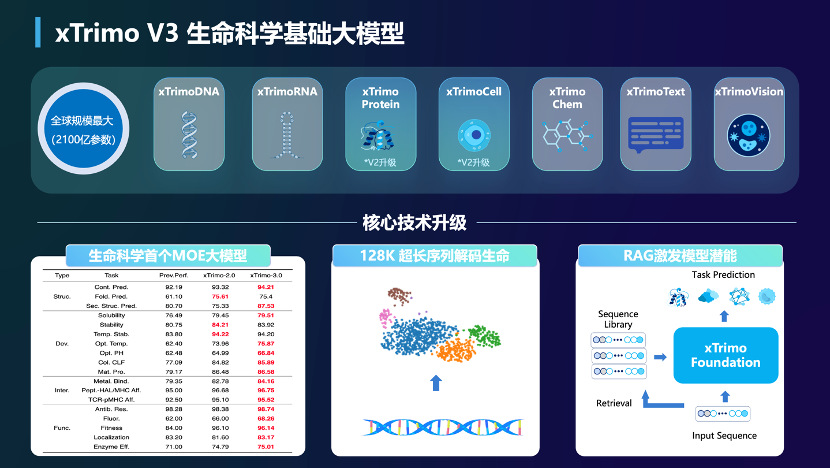
xTrimo V3, building on the breakthrough of the V2 large model with over 100 billion parameters and the understanding of protein language, further expands to 210 billion parameters, covering seven major mainstream modalities in life sciences such as proteins, DNA, and RNA., which can model a wider range of genomics, cellular, and systemic issues, bringing new capabilities to scenarios such as gene editing, target discovery, cell regulation, strain modification, and life science image analysis.
xTrimo V3 Prequel:
Four Years to Sharpen a Sword, the Sword's Success Brings a Chill
As the world's earliest platform company focused on foundational large models in life sciences, since its establishment in 2020, BioMap has been committed to achieving breakthroughs in this highly challenging technical platform. Foundational large models in life sciences are not simply vertical applications or "large models" of natural language models combined with biological texts. Instead, they involve developing a set of underlying technologies for foundational large models around highly complex sequence data such as amino acids and bases in life sciences. While conceptually similar to natural language foundational large models, these technologies are completely different, ranging from Transformer architectures to training frameworks, and more critically, to datasets and validation loops that are far more challenging and cutting-edge. Integrating with diverse specific tasks in life sciences, aligning and understanding complex omics data, deciphering the principles of life sciences, building foundational maps, and creating ultra-large-scale datasets over a hundred times larger than the existing data in the life sciences industry — these are the challenges faced by pioneers of foundational large models in life sciences over the past four years.
In 2022 and 2023, BioMap successively released xTrimo V1 and V2, achieving the world's first life science foundational large model with hundreds of billions of parameters.——A large protein model with hundreds of billions of parameters trained on massive protein sequence data, with more than 8 times the parameters of the second-largest model, surpassing the industry in dozens of tasks to achieve SOTA levels. It particularly supports critical issues such as protein structure prediction with unprecedented accuracy and performance, achieving numerous commercial and technical breakthroughs; A large single-cell model realized using massive single-cell omics data has preliminarily validated multi-dimensional, cross-modal technology, laying a solid foundation for cross-modal modeling of complex living organisms, and supporting more than ten tasks such as target discovery and cell classification to achieve SOTA results. Related work has been featured multiple times on the cover of Nature sub-journals and top academic conferences.
On the xTrimo basic large model platform, more than 200 task models have achieved SOTA evaluation levels.In drug development, it involves multiple fields such as general proteins, antibodies with various configurations, cell therapy, gene therapy, and diverse directions like target discovery, process optimization, synthetic biology, biomanufacturing, and life science tools. The contribution of fundamental large models does not lie in solving cutting-edge problems with a single technology or by one's own strength alone, but rather in facing diversified and data-scarce frontier issues, as well as existing models lacking generalization ability. It can utilize the knowledge embedded within hundreds of billions of parameters and trillions of data points to perform embedding empowerment, bringing high-dimensional information derived from the billions-of-years-old biological evolutionary tree to address challenging problems.
BioMap has built more than 200 AI models,Have successively contributed to the development of more than 20 cutting-edge antibodies and enzymes, enabled the discovery of over 10 innovative targets, all of which have been experimentally validated and advanced into subsequent stages such as preclinical development..AI model-driven high-throughput automation process, covering the complete chain from molecular generation, experimental validation, to closed-loop iteration, significantly improving the R&D efficiency of cooperative customers and shortening the R&D cycle.
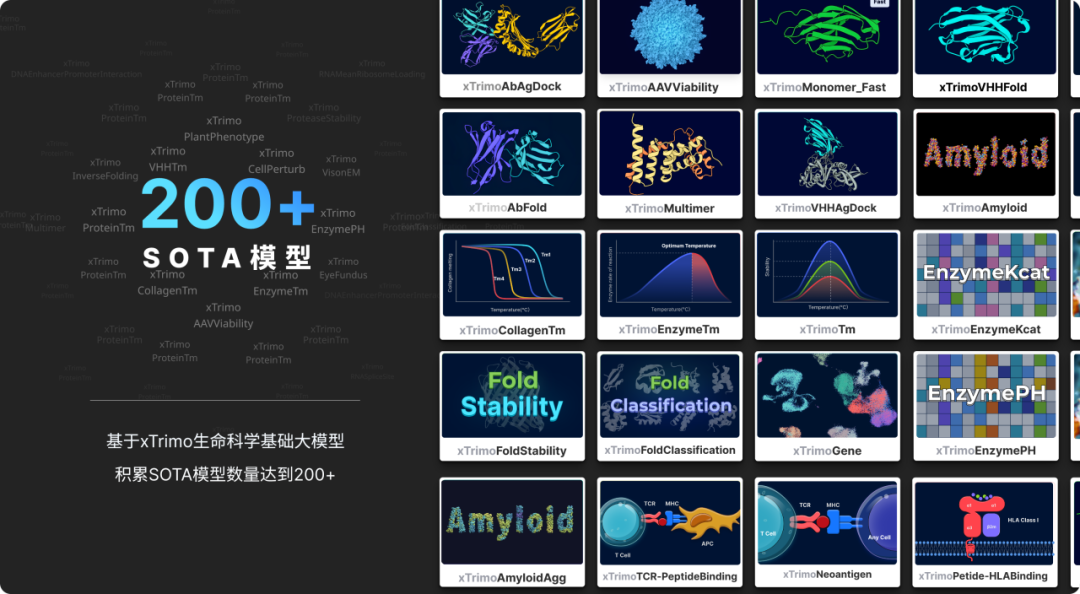
To date, BioMap has served more than 300 users globally, including multinational pharmaceutical companies, large CROs, star startups, and research institutions in and outside China, signing over 2 billion US dollars in total potential orders, achieving a series of breakthroughs together in the field of life sciences.
xTrimo V3:
Modal All-in-One, A Powerful Tool for Exploring New Questions in Life Sciences
The foundational large model xTrimo V3, released this time, covers seven mainstream modalities in life sciences, including DNA, RNA, proteins, cells, small molecules, biological vision, and biological knowledge text. It has also made significant enhancements in each original modality by relying on new data and a new architecture."This version has achieved full modality coverage in one step, thereby supporting the exploration needs of rapidly developing new fields and new problems in life sciences," said Zhang Xiaoming, CTO of BioMap. "Compared with the V2 platform, V3 not only consolidates the foundation previously laid in the field of proteins and continues the development in the cellular domain, but also expands into areas such as genomics, transcriptomics, complex cellular tasks, image analysis, and text analysis, supporting the entire AI modeling process from early molecular R&D to production scale-up and later experimental analysis."
xTrimo V3 Breaks Through 210 Billion Parameters, Maintaining Its Leading Position as the World's Largest Full-Modal Life Science Model.Especially in the field of large protein models, becomingThe World's First Large Life Science Model to Introduce the Advanced Expert Mixture-of-Experts (MoE) Architecture, with parameters reaching hundreds of billions in scale;DNA Large Model Sequence Length Surges to 128K, achieving ultra-long sequence decoding of life. These upgrades fully demonstrate BioMap's continuous innovation in the field of foundational large models in life sciences.
How to make the best use of foundational large models? Must only cutting-edge teams with expertise in both biology and AI benefit from the empowerment of large models? After applying a large model platform internally to achieve efficient modeling, BioMap has been continuously exploring stronger toolchains and productization capabilities.In March 2023, BioMap released the AIGP (AI Generated Protein) platform driven by xTrimo.This is acclaimed by the industry as"ChatGPT that can generate proteins", providing researchers in the life sciences field with a convenient interactive window. Even researchers without programming skills can utilize large models and dozens of protein-related task models, along with配套软硬件系统, to carry out innovative protein design research.
This time, the xTrimo V3 platform also released a model toolchain specifically designed for AI models in the life sciences.— Includes the Model Builder module for various data scenarios and user needs, the Model Hub module for model management and assembly, and the Model Booster module to accelerate model invocation and physical computing, among others.
“Build exclusive task models based on the xTrimo platform, combining the capabilities of large models with enterprises' private data and specific needs., quickly creating exclusive AI tools for enterprises is one of the key features of the V3 platform." Zhang Xiaoming introduced, "We have also integrated existing models with model customization capabilities, proposing solutions across various industries.Drug R&D Solutions, Biomanufacturing Solutions, and AI4LS Platform Solutions, through AI models and supporting services, help enterprises accelerate innovation, improve R&D efficiency, optimize processes, enabling companies to move faster from the lab to the market, directly experiencing the immense productivity of large models, and promoting the comprehensive intelligent development of the industry."