Johnson & Johnson's Impella ECP Enters China's Innovative Medical Device Fast Track as World’s Smallest Hemodynamic Support Heart Pump

Johnson & Johnson
Medical Device R&D and Manufacturer

Abiomed
Cardiac System Medical Device Developer


Source: Siyu Medtech
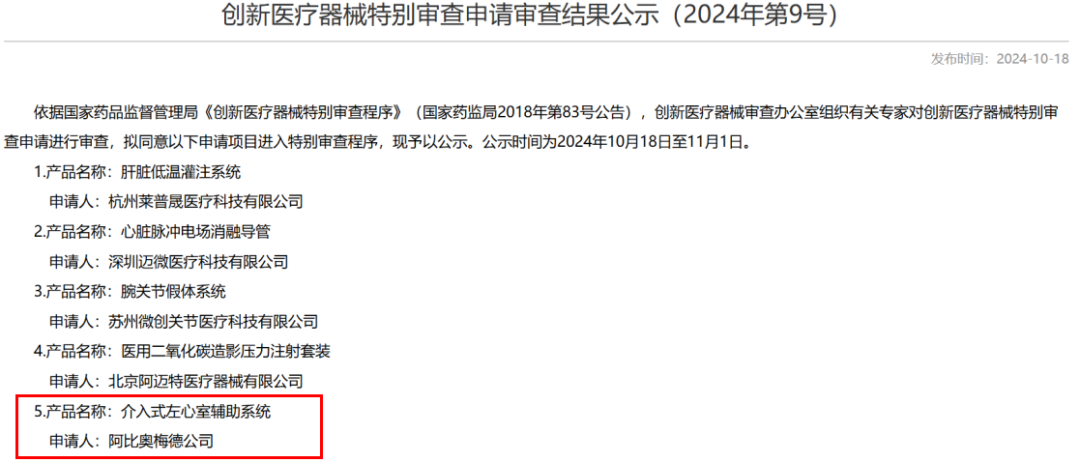
Recently, the NMPA announced the results of the special review application for innovative medical devices (2024 No. 9). Seven products have entered the innovation channel, including the interventional left ventricular assist system applied for by Abiomed.
Abiomed is a medical device company focused on developing percutaneous ventricular assist devices (pVADs). Its core product, the Impella series of heart pumps (not re-registered in China after 2017), holds a significant position in global cardiac care.
Impella is a mechanical circulatory support device that is inserted retrograde via the femoral artery to the level of the aortic valve. It is the only FDA-approved percutaneous ventricular assist device in the United States and the earliest commercially available percutaneous artificial heart, known as "the world's smallest artificial heart."
The product has been approved in the United States, the European Union, Japan, and other regions for cardiogenic shock, left ventricular unloading (in conjunction with ECOM), high-risk PCI treatment, ventricular tachycardia ablation, and right ventricular failure.
Imepella has multiple models: including Impella CP, Impella 2.5, Impella 5.0, Impella 5.5, and Impella RP. The first four models pump blood directly from the left ventricle in a retrograde manner through the aortic valve; Impella RP provides hemodynamic support to the right heart system by being inserted through the inferior vena cava into the pulmonary artery. These models mainly differ in terms of flow rate, implantation method, and the length and diameter of the device.
In November 2022, Johnson & Johnson (NYSE: JNJ) announced that it would acquire all shares of Abiomed at a price of $380 per share, with a total transaction value reaching $16.6 billion. Through this acquisition, Johnson & Johnson aims to further expand its market share in the cardiovascular treatment field and leverage Abiomed's technological advantages to enhance its product portfolio and market competitiveness. Abiomed will become part of Johnson & Johnson's medical technology business and continue to operate independently.
Following the completion of the acquisition, Abiomed announced that its latest (as of 2024.10.22) interventional cardiac pump, Impella ECP, has received FDA approval for pivotal clinical trials. Through technological innovation, Impella ECP achieves a smaller profile and higher flow rate. Johnson & Johnson also stated that it will further promote the global market expansion of Impella products, particularly in emerging markets such as China and Southeast Asia, to strengthen its market competitiveness.
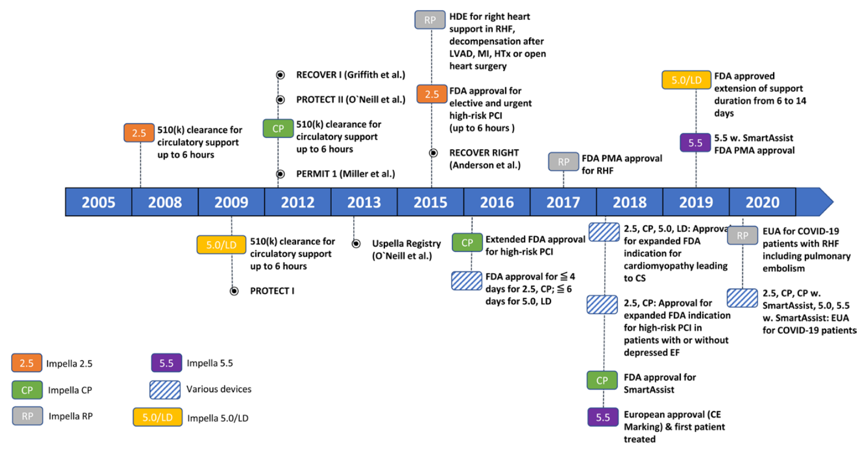
The Development History of Impella Series Products
Impella, based on the Archimedes screw pump principle, assists circulation by directly pumping oxygenated blood from the left ventricle into the ascending aorta through an internal micro axial flow pump. This creates a blood flow pathway between the left ventricle and the ascending aorta, helping to compensate for left ventricular dysfunction.
The core components of Impella include a micro axial flow pump (responsible for drawing in and propelling blood towards the ascending aorta), an impeller (involved in drawing in and propelling blood), a cannula (maintaining smooth blood flow), and a distal pigtail catheter (placed directly inside the left ventricle with a curved design to prevent direct contact with the ventricular wall during high-speed blood intake, avoiding damage).
The inflow tract of the catheter is located in the left ventricle, generally 3.5 cm below the aortic valve, while the outflow tract is situated in the ascending aorta. The pump is housed within the cannula, with a speed of up to 51,000 rpm, cardiac output ranging from 2.5-6 L/min (varies by product), a diameter of 9-21 Fr, and a maximum usage duration of 4-14 days.
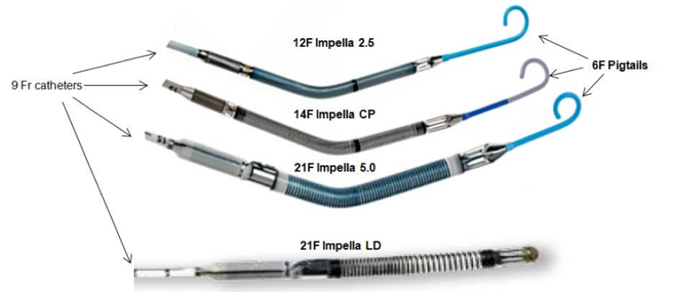
Impella Series Catheters
Impella 2.5: The earliest Impella device, implanted via femoral artery puncture, can provide a maximum blood flow of 2.5L/min and is used for patients requiring short-term (usually a few days) cardiac support in clinical settings.
Impella CP: Implanted via femoral artery puncture, it can provide a maximum blood flow of 3.5L/min and is suitable for patients requiring intermediate-term (up to 14 days) cardiac support.
Impella 5.0 and 5.5: Implanted through open-chest surgery or via the femoral route, providing maximum blood flow of 5.0L/min and 5.5L/min respectively, offering long-term (up to 14 days) cardiac support.
Impella RP: Used to provide right ventricular support, it is the only FDA-approved artificial heart assist device for acute right ventricular failure.
All Impella catheters are operated by the same external drive console, the portable Automated Impella Controller (AIC). The AIC generates the signals required to drive the motor of the Impella catheter and provides a user interface. The AIC also integrates a system to prevent blood from entering the drive motor of the Impella catheter, which uses a glucose heparin solution as the purge fluid.
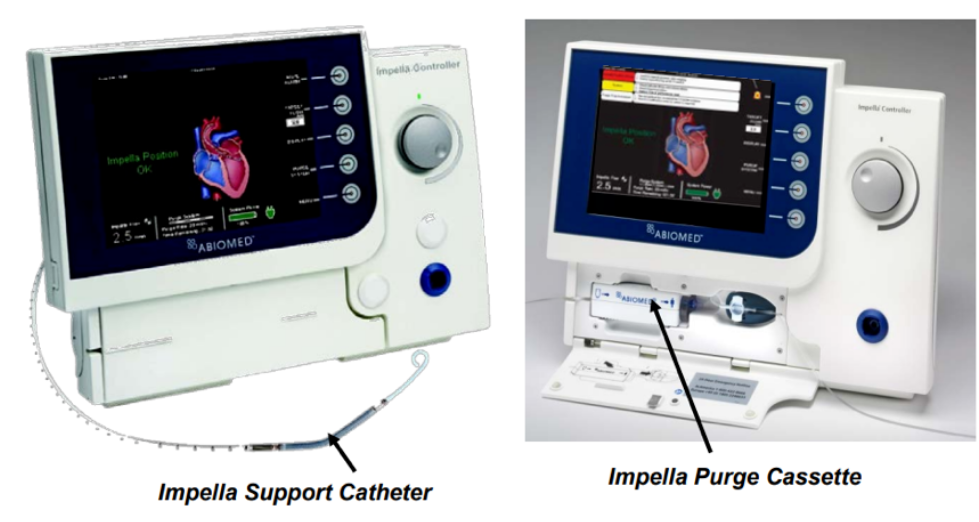
Impella Controller (AIC)
Despite the excellent performance of Impella in clinical applications, its built-in motor technology presents some challenges, such as a relatively large pump size and hemolysis caused by motor heating. To address these issues, Abiomed is developing the next generation of interventional cardiac pumps, such as the Impella ECP, which utilizes an external motor technology.
Impella ECP is the world's smallest hemodynamic support heart pump, with a diameter of only 9Fr (3mm). It features an external motor design and blade-folding technology, allowing the heart pump to expand to approximately 18Fr, providing a peak flow rate of up to 5L/min. It is currently in clinical trials for circulatory support during high-risk PCI procedures.
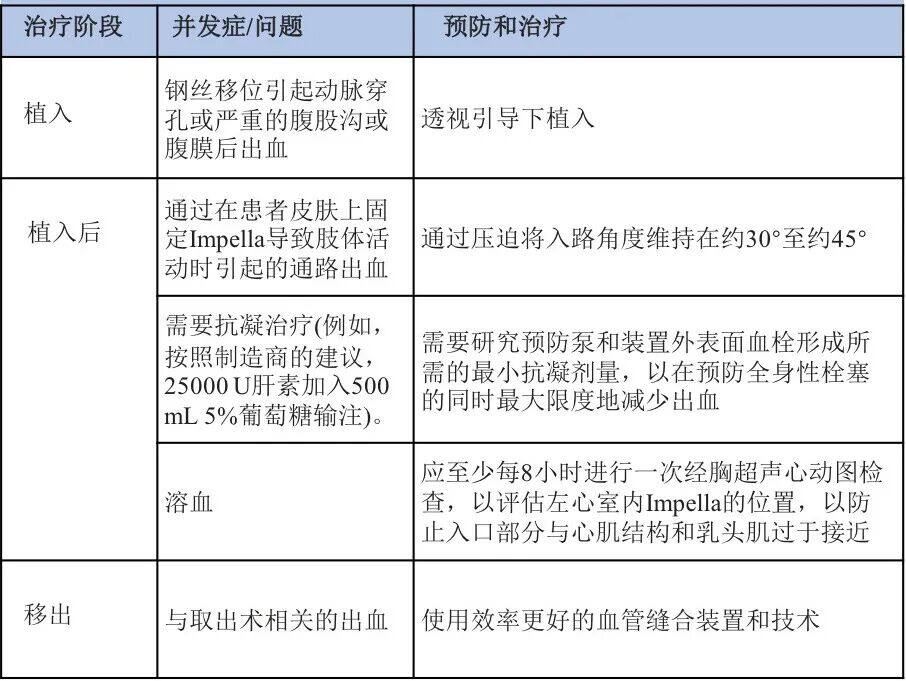
It should be noted that complications with Impella may occur during implantation, post-implantation, and removal. Different aspects need to be monitored at different stages for prevention and treatment.
China has a large population base, with approximately 26.6 million patients suffering from coronary artery disease in 2022. The percutaneous ventricular assist device (pVAD) provides short-term support to heart disease patients by aiding or replacing the heart's pumping function. Compared to long-term use of left ventricular assist devices (LVAD), pVAD is suitable for acute conditions and features simple operation and lower costs.
The clinical application goals and treatment durations of pVAD and LVAD are completely different. LVAD is mainly used for end-stage chronic heart failure patients, requiring long-term implantation to provide continuous cardiac support for patients awaiting heart transplantation, and sometimes even serving as a lifelong treatment solution. Therefore, the design of LVAD needs to have a high degree of durability.
In contrast, pVADs are designed as short-term use devices, typically employed in emergency situations such as providing intraoperative and postoperative cardiac support for high-risk percutaneous coronary intervention (PCI) patients and those with cardiogenic shock. Therefore, the design of pVADs emphasizes miniaturization, convenience, and minimal invasiveness. The cost of a pVAD is also lower, generally around 20,000 to 25,000 US dollars, whereas the average selling price of an LVAD is as high as 175,000 US dollars.
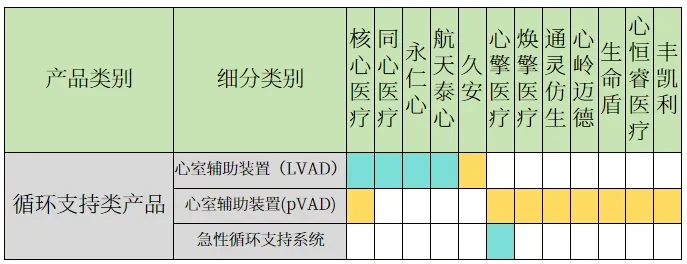
Currently, four LVADs based on different technological approaches have been approved in China, coming from Core Medical, Tongxin Medical, Eternal Heart Medical, and Aerospace Taisin. However, due to high technical barriers, there are currently no domestically produced products approved for marketing in the percutaneous ventricular assist device (pVAD) field. Domestic companies such as Tongling Biomimetics, XinCheng Medical, Fengkaili Medical, and Core Medical have all developed product portfolios. Moreover, XinCheng Medical and Fengkaili Medical have strategically positioned themselves against Abiomed's under-development extracorporeal electrode Impella ECP series.
In January and July 2023, Fengkai Li Medical and Core Medical's pVAD devices respectively passed the NMPA's special review process for innovative medical devices. In December 2023, Tongling Biomimetic's TeleHeart P50 clinical research was launched, successfully completing China's first pVAD surgery to treat a patient with cardiogenic shock.
In this field, domestic manufacturers have also formed a relatively comprehensive R&D pipeline对标 overseas products, which is of great value in filling the gap in the domestic market for pVAD products.
Abiomed was founded in 1981 and is headquartered in Massachusetts, USA. With the corporate mission of "repairing hearts and saving lives," the company is dedicated to the development of artificial hearts to assist or replace the pumping function of failing hearts. Its main product line is the Impella series. In 1987, Abiomed was listed on NASDAQ with the stock code ABMD and was later delisted after being acquired by Johnson & Johnson.
2015: The U.S. FDA approved Impella 2.5 for selective and emergency high-risk PCI.
2016: The entire series of Impella left heart pumps received FDA approval for cardiac recovery in cardiogenic shock; Impella 2.5 and Impella 5.0 heart pumps were approved in Japan; the U.S. FDA expanded the approval of Impella CP for high-risk PCI.
2017: FDA approves Impella RP for the treatment of right heart failure.
This article is reprinted, all views belong to the original author.Platform(Siyu Medtech), Medical Device BusinessThe comment remains neutral on all viewpoints in the article and is intended solely for sharing and exchange.
*Advertisement

▼More Book Recommendations▼