Lilly's Novel Reversible BTK Inhibitor Pirtobrutinib Approved in China for Relapsed/Refractory Mantle Cell Lymphoma

Eli Lilly
Global Pharmaceutical R&D and Production Company

On October 29, the NMPA website showed that Eli Lilly's Pirtobrutinib Tablets(Pirtobrutinib)Approved for marketing in China, used to treat patients who have previously received Bruton's tyrosine kinase(BTK)Recurrent or Refractory Mantle Cell Lymphoma Inhibitors(MCL)Adult Patients(JXHS2300110/111)。


Screenshot source: NMPA official website
Pirtobrutinib is an orally administered, highly selective, reversible BTK inhibitor. It interacts with water molecules near the ATP binding site and BTK residues through extensive hydrogen bonding, rather than binding to the C481 site.Show potential to overcome resistance to covalent BTKIs, inhibitory effects on both wild-type and C481 acquired resistance mutant BTK。
Pirtobrutinib was initially developed by Redx Pharma and acquired by Loxo Oncology in July 2017. In January 2019, Eli Lilly and Company acquired Loxo Oncology for $8 billion, bringing pirtobrutinib into its portfolio. In March 2022, Innovent Biologics secured the priority negotiation rights for the commercialization of pirtobrutinib in China with an upfront payment of $45 million.
Currently, Pirtobrutinib has been approved for two indications in the United States:
Previously received at least two lines of systemic therapy, including BTK inhibitors, for relapsed/refractory disease.Sexual Mantle Cell Lymphoma(MCL)(2023.01); Adults who have previously received at least two lines of treatment, including BTK inhibitors and BCL-2 inhibitors.Chronic Lymphocytic Leukemia or Small Lymphocytic Lymphoma(CLL/SLL)(2023.12)。
It is worth mentioning that,Pirtobrutinib is the first reversible BTK inhibitor approved by the FDA, and also the first BTK inhibitor approved for the treatment of MCL patients who have developed resistance to covalent BTK inhibitors.
The FDA approval of pirtobrutinib for the MCL indication was based on positive results from the Phase I/II clinical study BRUIN. This was an open-label, multi-center, single-arm trial conducted in 120 MCL patients who had previously received at least one line of therapy involving a BTK covalent inhibitor.The overall response rate for patients treated with pirtobrutinib was 50%., among which 13% and 38% of patients achieved complete remission and partial remission, respectively.The median duration of response was 8.3 months.。
At the 2023 ASH Annual Meeting, Eli Lilly and Company presented the results of pirtobrutinib in patients previously treated with covalent BTK inhibitors.Phase Ⅱ Study Results of MCL Patients in China。Main Analysis Group of the Study (PAS,N=28)Included are patients with non-blastic MCL confirmed by the center, who have received prior covalent BTK inhibitor treatment, and the data shows:
IRC AssessmentORR was 71.4%, with 4 patients achieving complete remission(CR), 16 patients achieved partial remission (PR)。
As of the data cutoff date, the median DOR assessed by the IRC has not been reached, and the 6-month DOR rate was 66.02%. IRC-assessedmPFS was 9.43 months, and mOS was 15.47 months.。
TherapyThe EAS (N=35) also showed similar efficacy results, as assessed by the IRC.ORR was 62.9%, and the 6-month DOR rate was 64.45%.。
BTK is considered a potential target for the treatment of autoimmune diseases and B-cell malignancies. According to the Insight database,Previously, 4 BTK inhibitors had been approved in China.(Including 2 imported and 2 domestically produced))。
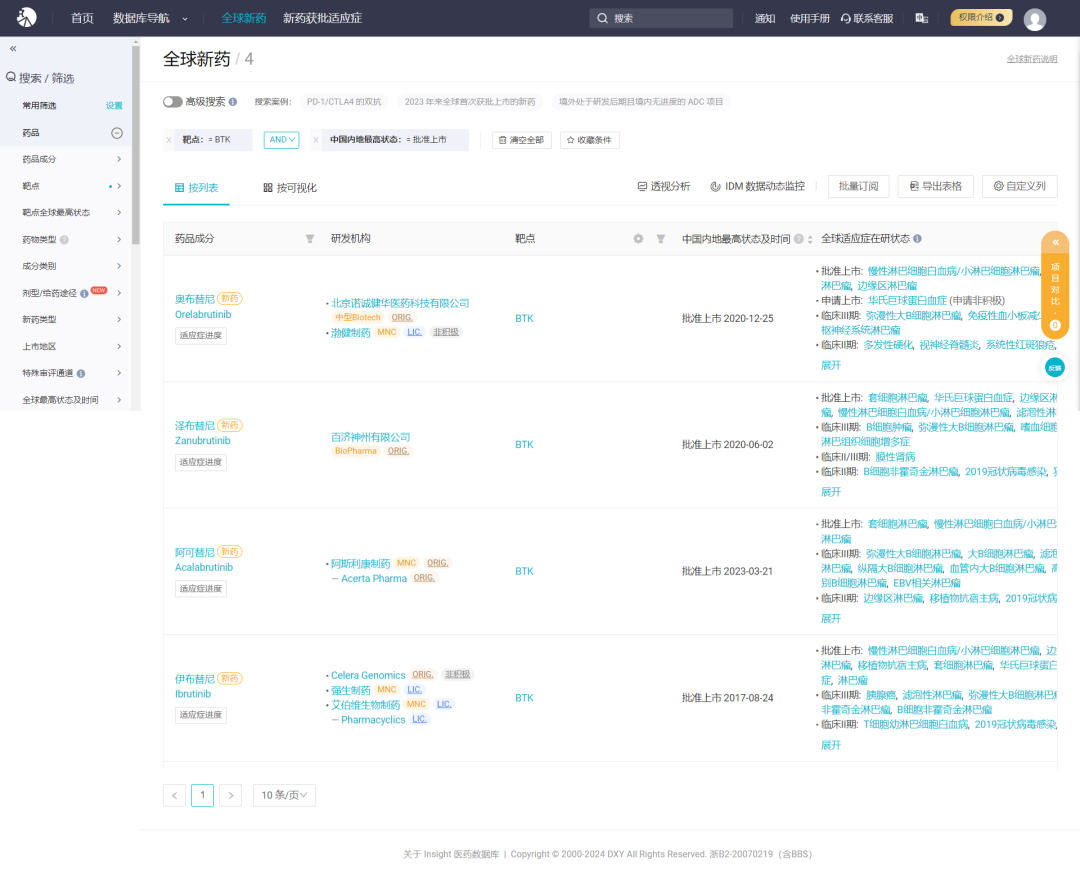
Screenshot source: Insight database
All four of the aforementioned compounds bind to cysteine 481 in the ATP-binding pocket of BTK through irreversible covalent bonding. Long-term use of covalent BTK inhibitors can lead to drug resistance caused by mutations at the BTK binding site (C481) or activating mutations in the downstream BTK substrate PLCγ2.PieceTobutinib can precisely overcome the drug resistance issue caused by C481 binding site mutations.。
Market Performance:
IbrutinibWith its first-mover advantage, sales peaked in 2021 at approximately $9.777 billion, but began to decline in 2022 following the approval and launch of second-generation BTK inhibitors. Additionally, with the patent expiration, generic versions of Ibrutinib have emerged, and Simcere Pharmaceutical in China obtained the first generic production approval in 2022. ZanubrutinibFollowing its market launch, sales have been increasing year by year, reaching 9.138 billion yuan (approximately 1.297 billion US dollars) in global sales in 2023, making it the first innovative drug in China to surpass 1 billion US dollars in annual sales. OrelabrutinibIs the third BTK inhibitor to be listed in China, with sales of 570 million yuan and 670 million yuan in 2022 and 2023, respectively. AcalabrutinibIs AstraZeneca's ace product in the BTK inhibitor field, with rapid sales growth in recent years, reaching 2.514 billion US dollars in 2023.
In addition, according to the Insight database, there are several BTK inhibitors under development in China, with Tolebrutinib and Rilzabrutinib in Phase III clinical trials, and Elsubrutinib and CT-1530 in Phase II clinical trials.
Unlike the marketed BTK inhibitors, the BTK inhibitors under development are also being developed for the treatment of multiple sclerosis and other autoimmune diseases. Moreover, the BTK inhibitors under development include not only small molecule drugs but also PROTAC.