

Lilly Announces Phase 3b TRAILBLAZER-ALZ 6 Success with Modified Donanemab Dosing, Significantly Reducing ARIA-E Risk in Early Alzheimer’s Patients

Eli Lilly
Global Pharmaceutical R&D and Production Company
▎WuXiEdited by Kant Content Team
Today, Eli Lilly and Company announced that the TRAILBLAZER-ALZ 6 Phase 3b clinical study has met its primary endpoint. At 24 weeks, adult patients with early symptoms of Alzheimer's disease (AD) who received the adjusted Kisunla (donanemab) dosing regimenThe risk of developing edema/exudate-related amyloid-related imaging abnormalities (ARIA-E) compared to the standardToMedicineThe plan significantly reduced compared to the previous one, and after adjustmentToMedicineThe regimen was comparable to the standard regimen in terms of reducing patients' amyloid plaques and plasma P-tau217.Eli Lilly plans to submit this data to global regulatory authorities in hopes of updatingdonanemabThe label.

TRAILBLAZER-ALZ 6It is a multicenter, randomized, double-blind3bPhase study, aimed at examining differentdonanemabToMedicinePlan for Early SymptomsADPatient'sARIA-EIncidence and impact on amyloid clearance, including patients with mild cognitive impairment (MCI) and patients in the mild dementia stage.The primary endpoint of the study is24Appeared at the same timeARIA-EThe proportion of subjects.
Analysis shows,After AdjustmentToMedicineThe incidence of ARIA-E in the trial patients was 14%, compared to those receiving the standardToMedicineThe incidence rate of ARIA-E in the trial patients was 24%, adjusted.ToMedicineThe regimen reduced the relative risk of ARIA-E by 41%.In apolipoprotein E (APOE4) In homozygous patients, namely carriers of known genetic risk factors for Alzheimer's disease, adjustmentToMedicineThe reduction in ARIA-E achieved by the regimen was the greatest.Among them, 19% of patients developed ARIA-E, while the standardToMedicineThe incidence rate of the regimen was 57%, with a 67% reduction in relative risk.
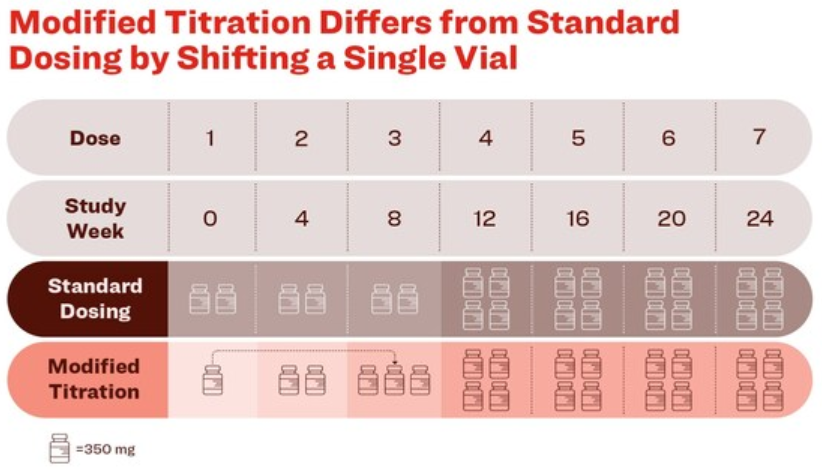
▲ Adjusted to Meet StandardsdonanemabDrug AdministrationScheme Comparison (Image Source: Reference [1])
In addition, accept adjustmentsToMedicineReduction of Amyloid Plaques and Plasma P-tau217 in Trial Patients Compared to StandardToMedicineThe patients in the program are similar. At 24 weeks, based on amyloid proteinPositron Emission Tomography (PET)Scan analysis,After adjustment in the trialToMedicineThe amyloid plaque levels in patients on the regimen decreased by an average of 67% compared to baseline, while the standardToMedicineThe patients in the treatment group had a 69% reduction.
TRAILBLAZER-ALZThe Phase 6 study is still ongoing, with data expected to be released early next year regarding the potential reduction of ARIA-E at week 52 in patients with early symptomatic AD. In addition to the improvement in the incidence of ARIA-E, the safety profiles of the groups were comparable, and no new safety signals were identified.

Donanemab is a monoclonal antibody targeting β-amyloid protein., it canSpecifically binds to the amyloid subtype named N3pG.By targeting this subtype, donanemab is able to specifically bind to amyloid plaques in the brain, thereby promoting the clearance of amyloid plaques. This therapy received U.S. approval in July this year.FDA Approval,For the treatment of adult AD patients with early symptoms。According to the press release, once a monthdonanemabIt is the first amyloid plaque-targeting therapy with evidence showing that treatment can be stopped after the clearance of amyloid plaques, thus expected to reduce treatment costs and decrease the number of infusions.

▲To learn more about the application of cutting-edge technologies in the biopharmaceutical industry, please long-press and scan the QR code above to access "WuXi Live Studio" and watch live discussions and exciting replays on related topics.
References:
[1] Modified Titration of Donanemab Demonstrated Reduction of ARIA-E in Early Symptomatic Alzheimer's Disease Patients in Phase 3b study. Retrieved October 29, 2024 from https://investor.lilly.com/news-releases/news-release-details/modified-titration-donanemab-demonstrated-reduction-aria-e-early
Disclaimer: The content team of WuXi AppTec focuses on introducing the research progress in global biopharmaceuticals and health. This article is for information exchange only, and the views expressed in the article do not represent the position of WuXi AppTec, nor does it imply that WuXi AppTec supports or opposes these views. This article is not a recommendation for treatment plans. For guidance on treatment options, please visit a正规 hospital.
Copyright Statement: This article is from the content team of WuXi AppTec. Individuals are welcome to share it on their social media circles, but unauthorized reproduction by media or institutions in any form to other platforms is prohibited. For authorization to reproduce, please reply with "reprint" on the WeChat Official Account of "WuXi AppTec" to obtain reprint guidelines.


Share,PointLike,In View, Focusing on Global Biomedical Health Innovation