

Medtronic's Pioneering ADAPT-PD Clinical Trial Methodology Published, Setting New Standards in Parkinson’s Disease Research

Medtronic
Medical Device Manufacturer
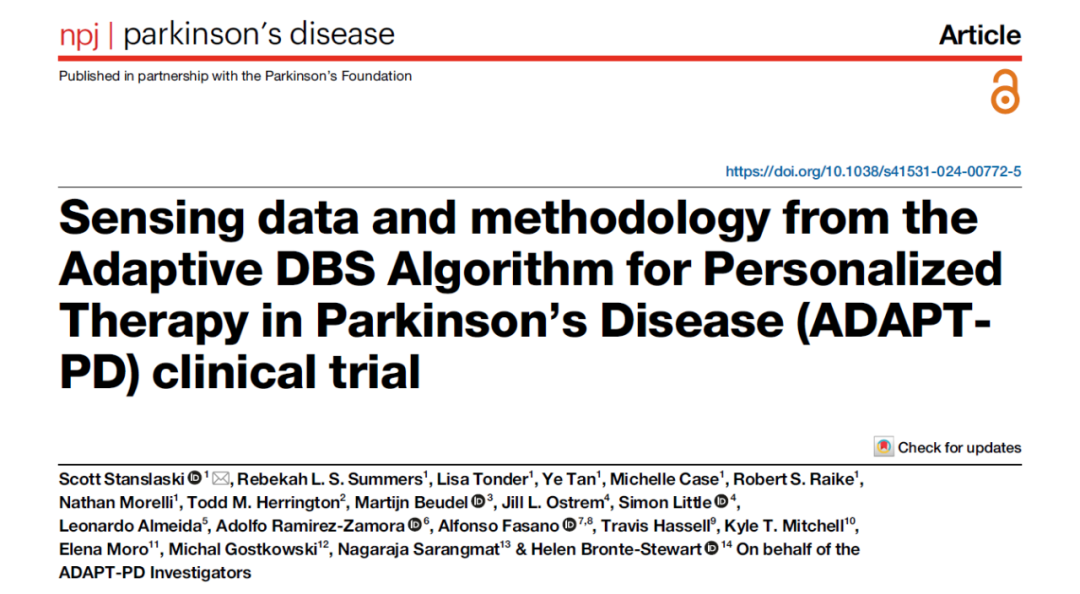
Initiated by the well-known medical technology company MedtronicThe World's First Clinical Study on Personalized Treatment of Parkinson's Disease with Adaptive Deep Brain Stimulation (aDBS)(The ADAPT-PD study, for short) is proceeding smoothly, with the article unveiling the methodology of this significant studySensing data and methodology from the Adaptive DBS Algorithm for Personalized Therapy in Parkinson’s DiseaseRecently published in the authoritative journal npj Parkinson's Disease!
The groundbreaking achievements at this stage are mainly reflected in the following four aspects:
01
For the first time, the adaptive deep brain stimulation (aDBS) algorithm was defined through real-world long-term use in a large clinical cohort.
02
Pioneering the establishment of methods for setting up aDBS and programming steps in different modes;
03
The effect of combining directional stimulation and aDBS in the treatment of Parkinson's disease will be determined for the first time;
04
Further validation shows that patients have high LFP signals in both medicated and unmedicated states, regardless of PD phenotype, with bilateral signals being more common. The detection rate of LFP signals is sufficient to support aDBS algorithms and configure aDBS.
With the application of cutting-edge technologies such as artificial intelligence and brain-computer interfaces in the fields of medical technology and neuroscience, aDBS is undoubtedly the inevitable path for the further innovation and development of traditional deep brain stimulation. The ADAPT-PD study, initiated by Medtronic, is currently the largest-scale and longest-running RCT study on aDBS treatment for Parkinson's disease conducted in a "home environment" worldwide.We believe that with the release of more clinical data in the future, it will further support and validate the clinical advantages and developmental potential of aDBS therapy, advancing the process of intelligent, precise, and personalized treatment in deep brain stimulation. This will make it possible for adaptive stimulation to be truly applied in clinical practice, leading Parkinson's disease treatment into a new "adaptive" era!
Breakthrough traditional DBS limitations,
aDBS Becomes the Key to Breaking the Stalemate


Deep Brain Stimulation (DBS), commonly known as a brain pacemaker, involves electrodes implanted in the brain that emit electrical pulses to stimulate specific nuclei deep in the brain, thereby improving patients' symptoms and quality of life. It has been approved for the treatment ofParkinson's disease, dystonia, essential tremor, and epilepsyThis therapy has been clinically applied globally for over 35 years and in China for more than 25 years, benefiting more than 250,000 patients worldwide.
However, traditional deep brain stimulation (DBS) requires clinicians to manually adjust the programming based on the patient's complaints and symptom presentation in order to optimize the therapeutic effect. Its stimulation parameters cannot be adjusted in real time according to the patient’s condition, thus limiting the immediacy and stability of the treatment. The introduction of adaptive DBS (aDBS) has become the key to overcoming these limitations.aDBS refers to the brain pacemaker sensing brain signals while providing electrical stimulation, and automatically adjusting to the appropriate stimulation intensity based on changes in the patient's brain state, achieving closed-loop stimulation, thereby offering precise, stable, and long-term effective symptom control for patients.. This breakthrough innovation upgrades the treatment of brain pacemakers from "manual driving" to "autonomous driving," bringing more prospects and hope to the research and diagnosis of Parkinson's disease and other brain disorders.

Medtronic Launches Percept™ Series, Leading the aDBS Brain Modulation Field


For many years, Medtronic has been dedicated to exploring and researching the development path of aDBS.The Percept™ series,重磅 launched by Medtronic, is the first and only deep brain stimulation system featuring brain sensing, directional stimulation, and advanced programming capabilities. Its powerful functionality provides reliable data support for the research and application of aDBS, strengthens the foundation of adaptive stimulation technology, and establishes Medtronic's leadership in the aDBS field as well as the broader neuromodulation sector.
The Percept™ series of products utilize the proprietary BrainSense™ patented technology, which can simultaneously sense specific brain electrical signals related to disease symptoms while delivering electrical stimulation therapy to the patient's brain. These signals are then analyzed using intelligent algorithms, providing objective data for doctors to develop treatment strategies and enabling personalized precision treatment for patients.Currently, the new generation of Medtronic's intelligent Percept™ PC brain pacemaker and the SenSight™ directional electrode system with brain sensing capabilities have officially entered clinical application in major hospitals across China, benefiting patients in China.。
The ADAPT-PD study is based on BrainSense™ technology to further validate and explore aDBS.At the same time, Medtronic has submitted an application for FDA approval of the aDBS technology, and the final results of the ADAPT-PD trial are also expected to provide crucial evidence to support and accelerate the global implementation of aDBS.

AsThe Inventor and Leader of Brain PacemakersMedtronic has always been committed to leading technological innovation and breakthroughs, continuously bringing more advanced products and better treatment experiences to patients worldwide. The ADAPT-PD study is an important step forward in Medtronic's development of aDBS therapy, showcasing its deep understanding and mastery of the therapy. From concept to technology, from research to clinical application, every step counts. We believe that in the near future, Medtronic’s aDBS therapy will be truly applied in clinical practice, ushering in the "adaptive" era of deep brain stimulation, benefiting patients around the world!
Statement: The intellectual property rights of the content published by Neuromedical Exchange, Neurointerventional Information, Neuromedical Consultation, and AiBrain, which are under the Brain Medical Alliance, belong to the Brain Medical Alliance, the organizers, and the original authors or other relevant right holders. Without permission, reproduction, excerpting, copying, cropping, recording, etc., are prohibited. Even with authorized use, the source must be cited. Forwarding and sharing are welcome.
For submission/conference release, please contact 400-888-2526 ext. 3


Share

Favorite

Like

Click to view