

Race to the Finish Line in B7-H3 ADC Development: Hansoh, YLBio, Innovent and Dozens of Companies Accelerate Amid High Stakes
Hansoh Pharma
Pharmaceutical Research, Production, and Sales
The research enthusiasm for B7-H3 ADC remains high, presenting undoubtedly both opportunities and challenges for many enterprises inside and outside China.
Recently, the official website of the Center for Drug Evaluation (CDE) of the China National Medical Products Administration (NMPA) announced that HS-20093 for injection is proposed to be included in the breakthrough therapy designation. The proposed indication is: extensive-stage small cell lung cancer (ES-SCLC) that has progressed after standard first-line treatment (platinum doublet chemotherapy combined with immunotherapy). Public information shows that HS-20093 is a B7-H3-targeted antibody-drug conjugate (ADC) developed by Hansoh Pharma.

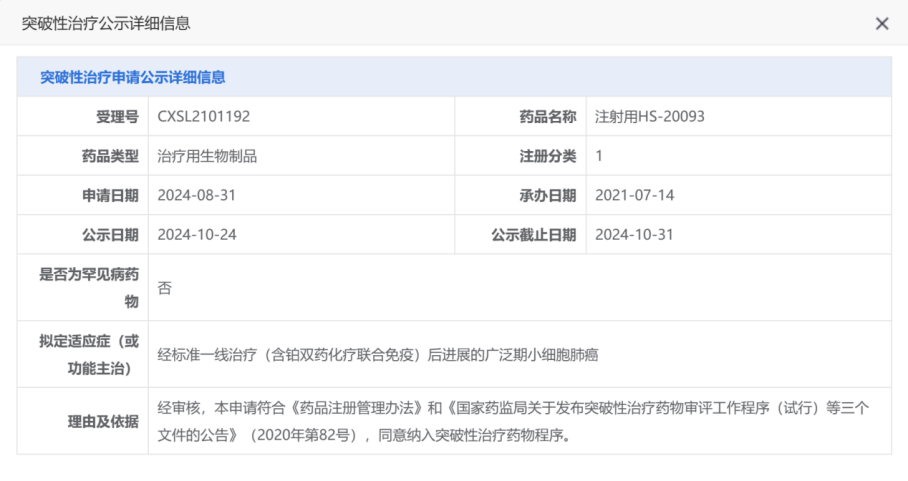
Notably, the Breakthrough Therapy designation aims to expedite the development and review of new drugs for serious or life-threatening diseases. Prior to this proposed inclusion in the CDE's "Breakthrough Therapy Designation," HS-20093 also received the "Breakthrough Therapy Designation" (BTD) from the U.S. FDA.
Industry insiders believe that a "new drug" in the research and development stage receiving a breakthrough therapy designation indicates the drug's high clinical value and promising future market demand. As a highly anticipated target in the industry, the development of ADC drugs targeting B7-H3 has become a significant focus in this niche field. A large number of companies, including Hansoh Pharma and Yilian Biotechnology, have already embarked on a new wave of R&D competition based on this approach.

R&D Process Fully Accelerated
Can Lung Cancer Treatment Take the Lead?
Lung cancer is one of the most common cancers globally, with approximately 15% being small cell lung cancer (SCLC). Among patients with small cell lung cancer, 70% are in the extensive-stage (ES), meaning the cancer has spread to one or both lungs or other parts of the body. Extensive-stage small cell lung cancer (ES-SCLC) is an aggressive and difficult-to-treat cancer. Most ES-SCLC patients experience recurrence after initial treatment, and their survival period is short, creating an urgent clinical need for new treatment options. B7-H3-targeted ADC drugs are currently under research as a promising tool for treating ES-SCLC.
B7-H3 (also known as CD276) is a type I transmembrane glycoprotein and a member of the B7 family. Studies have found that B7-H3 is overexpressed in various tumor tissues, including non-small cell lung cancer, pancreatic cancer, and primary liver cancer. Its excessive expression in tumor tissues is often associated with poor patient prognosis, shorter overall survival, and progression-free survival. In lung cancer, particularly small cell lung cancer, about 65% of patients exhibit high B7-H3 expression, which correlates with an adverse prognosis, making B7-H3 a promising therapeutic target.
According to the information disclosed by Hansoh Pharma, HS-20093 is a novel B7-H3-targeted ADC composed of a fully humanized B7-H3 monoclonal antibody covalently linked to a topoisomerase inhibitor (TOPOi) payload. Public data shows that more than ten clinical studies on HS-20093 are currently underway, including two Phase III clinical trials for recurrent small cell lung cancer and limited-stage small cell lung cancer, as well as multiple Phase I and Phase II clinical trials for the treatment of lung cancer, sarcoma, head and neck cancer, and other solid tumors.
Previously, the successful "going global" of HS-20093 has already attracted significant industry attention. In December 2023, Hansoh Pharma entered into an exclusive licensing agreement worth over $1.7 billion with GlaxoSmithKline (GSK), granting GSK global exclusive rights (excluding Greater China) to develop, manufacture, and commercialize HS-20093. In August this year, GSK announced that HS-20093 received Breakthrough Therapy Designation from the FDA for the treatment of patients with relapsed or refractory ES-SCLC who progress during or after platinum-based chemotherapy. This FDA Breakthrough Therapy Designation was supported by data from the Phase I ARTEMIS-001 first-in-human clinical trial.

It is reported that ARTEMIS-001 (NCT05276609) is an open-label, multi-center, dose-escalation and expansion Phase I clinical trial aimed at studying the safety and efficacy of HS-20093 in treating advanced solid tumors. The trial targets adult subjects with locally advanced or metastatic solid tumors and includes a dose-escalation phase (Phase Ia) and a dose-expansion phase (Phase Ib). At this year's WCLC, updated data from the Phase I dose-expansion study of the ES-SCLC cohort was presented, with a total of 56 ES-SCLC patients enrolled. All patients had previously received platinum plus etoposide treatment; 73.2% had undergone immunotherapy, and 23.2% had been treated with a TOPO1 inhibitor.
In terms of efficacy, among 53 patients, the ORR was 61.3%, the DCR was 80.6%, the mDOR was 6.4 months, the mPFS was 5.9 months, and the mOS was 9.8 months in the 8.0 mpk dose group. In the 10.0 mpk dose group, the ORR was 50.0%, the DCR was 95.5%, the mDOR was 8.9 months, the mPFS was 7.3 months, and the mOS has not yet been reached. In patients who had received IO and platinum-based therapy but not TOPO1i, the ORRs in the two dose groups were 75.0% and 66.7%, respectively, both significantly higher than the overall population. No correlation was observed between B7-H3 expression levels and ORR, but a trend toward prolonged mPFS was noted in patients with B7-H3 IHC expression (≥1%).

In addition to the field of lung cancer, HS-20093 has also achieved positive results in a Phase 2 study (ARTEMIS-002 study) for recurrent or refractory bone and soft tissue sarcoma, which was orally presented at the American Society of Clinical Oncology (ASCO) Annual Meeting in June this year. The data from the ARTEMIS-002 study showed that HS-20093 demonstrated strong anti-tumor activity in patients with recurrent or refractory bone and soft tissue sarcoma who had received extensive prior treatment, outperforming historical data of current standard treatments, with good safety and tolerability. This provides robust clinical evidence for the continued development of HS-20093 in bone and soft tissue sarcoma.
Currently, Hansoh Pharma has a rich pipeline in the fields of anti-tumor, anti-infective, metabolic, and autoimmune disease drugs. The HS-20093 injection is one of Hansoh's research products in the anti-tumor field. In addition, Hansoh Pharma’s ongoing projects in common malignant tumor areas include Class 1 new drugs such as the HS-20106 injection, HS-10516 capsules, HS-10382 tablets, HS-20089 for injection, HS-20124 for injection, and HS-10504 tablets. Among them, HS-20089 is an ADC product targeting B7-H4, which demonstrated inhibition of B7-H4-expressing tumor cell growth both in vitro and in vivo during preclinical studies. Hansoh Pharma's ADC products have significant overseas potential, and with the advancement of global clinical trials and regulatory approvals, they are expected to secure a position in the global market.

B7-H3-Targeted ADCs Rise to the Challenge
Fierce Competition: Who Will Cross the Finish Line?
The R&D progress targeting B7-H3 has been fraught with challenges, as numerous clinical trial failures have sparked significant controversy within the industry regarding drug development for this target. Issues such as clinical safety have posed severe challenges to the advancement of B7-H3 ADC research. Key obstacles for pharmaceutical companies include further enhancing drug efficacy and safety, optimizing drug administration methods and dosages, and reducing drug resistance. These hurdles make the development of ADC drugs both a challenge and a highly anticipated opportunity in this specialized field.
Previously, there were reports that patient deaths in clinical trials and the subsequent halting of studies related to the B7-H3 target have added obstacles to the development of this target. In 2019, the U.S. FDA suspended the Phase I trial of MGD009, a CD3/B7H3 bispecific antibody targeting B7H3-positive solid tumors, due to liver-related adverse events. In 2022, the Phase II clinical trial of enoblituzumab (MGA271), a B7H3-targeting monoclonal antibody developed by I-Mab/MacroGenics for squamous cell carcinoma of the head and neck, was also halted following patient deaths.
The current R&D landscape in the B7-H3 ADC field presents a different situation compared to previous landscapes in other fields. Despite setbacks along the R&D journey, companies in and outside of China continue to tirelessly work towards overcoming this "tough challenge." According to incomplete data statistics, there are currently over 30 B7-H3 ADC drugs in development globally, with approximately 14 of them having entered the clinical research stage.
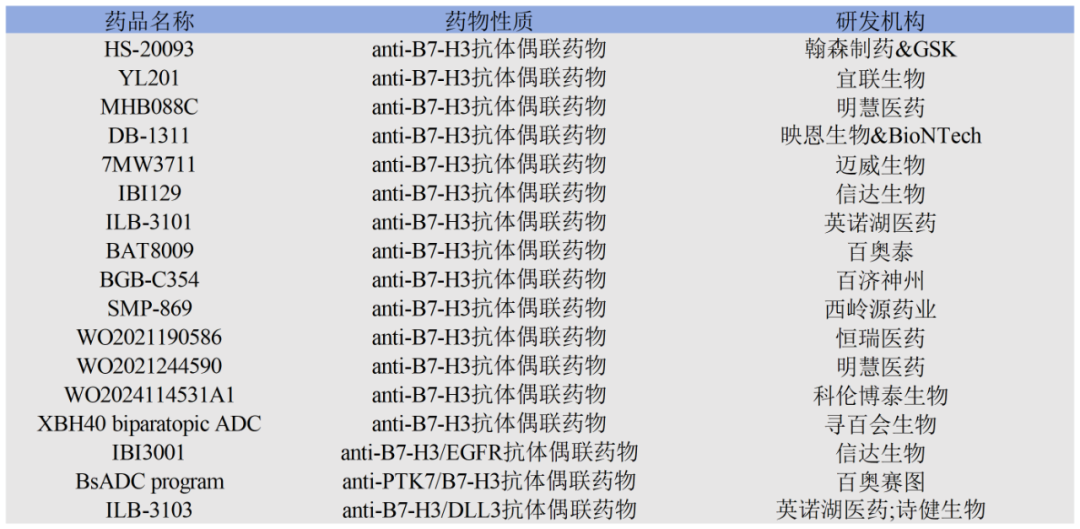
In terms of the development of B7-H3 ADC in China, apart from Hansoh Pharma, domestic pharmaceutical companies such as Yilian Biotech and Innovent Biologics have also made arrangements in ADC targeting B7-H3. Yilian Biotech's injectable YL201, disclosed on the CDE’s official website during the same period, has also been proposed to be included as a breakthrough therapy product. Recently, Innovent Biologics' EGFR/B7H3-targeted ADC drug IBI3001 received CDE approval for clinical trials for the treatment of solid tumors.
In July this year, Biocytogen and IDEAYA Biosciences reached an option and license agreement on the B7H3/PTK7 bispecific antibody-drug conjugate (BsADC) program. According to the terms of the agreement, the nomination of a development candidate for the B7H3/PTK7 topoisomerase inhibitor payload BsADC program is planned for completion in the second half of 2024. This means that both parties are actively advancing the R&D work of the project and are expected to make further progress in the near future.
During the same period, Shijian Biotech and Innolake Pharmaceuticals reached an exclusive global licensing collaboration for the application of Shijian Biotech’s novel ADC technology platform EZWi-Fit® in Innolake's development of ADC products targeting specific antigens. Meanwhile, ILB-3103, a first-in-class bispecific ADC product designed from scratch by Innolake using Shijian Biotech’s EZWi-Fit® technology platform, has successfully completed the efficacy validation of its PCC (preclinical candidate product). This product simultaneously targets two highly promising tumor-associated antigens, DLL-3 and B7H3.
In April 2023, DualityBio and BioNTech entered into an exclusive license and collaboration agreement for two ADC pipelines, DB-1303 and DB-1311, with DB-1311 being a B7-H3-targeted antibody-drug conjugate. Under the terms of the agreement, DualityBio will receive an upfront payment totaling $170 million and is eligible to receive development, regulatory, and commercial milestone payments exceeding $1.5 billion in total, along with single-digit to double-digit percentage royalties on future potential net sales.
Industry analysis points out that, despite some setbacks in the B7-H3 ADC field, it does not affect the strong momentum of more and more companies in China and abroad increasing their R&D investment in this area. The broad development prospects are inseparable from the innovation and efforts of enterprises. With continuous technological advancements and in-depth clinical trials, more B7-H3 ADC drugs will be successfully approved and launched in the future, laying a solid foundation for cancer treatment and bringing more hope to patients.
Editor: Shuwen



www.yyjjb.com.cn
Insight into Industry Trends

Pharmaceutical Economy Herald
Academic Official Account
Focus on the Frontier of Oncology Academia

Terminal Official Account