

HighLife Announces Positive Two-Year Follow-Up Data from TSMVR Feasibility Study, Paving the Way for Potential Global First Approval of a Transseptal Mitral Valve Replacement System

HighLife
Companies Focusing on Transcatheter Mitral Valve Replacement (TMVR)
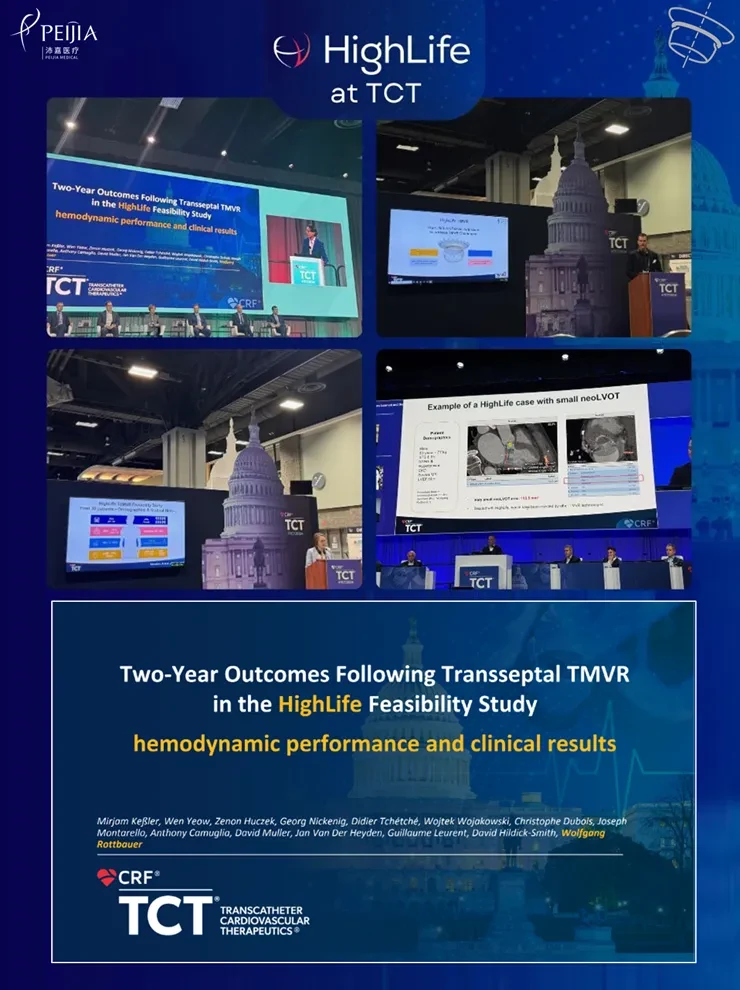
Currently, this clinical trial has been approved in 6 countries, with 34 centers initiated. The average age of the first 30 patients was 75.6 years, about 90% had secondary mitral regurgitation, all patients had MR≥3+, and they also had other comorbidities, with poor baseline conditions. From the clinical results, HighLife TSMVR achieved a 90% technical success rate, and at 2 years, the patients...All-cause mortality37%, with 5 cases of life-threatening bleeding. No residual MR≥2+ occurred, no LVOT obstruction, no valve-related thrombosis, no residual paravalvular leak closure, and no hemolysis events occurred. All patients continued to maintain reduced regurgitation (MR≤1+) at the 1-year follow-up, with nearly 80% of patients remaining in NYHA class I/II at 1 year. The study results indicate that for high-risk surgical patients with moderate-to-severe and severe mitral regurgitation, HighLife achieved excellent technical success, reaching favorable primary safety and efficacy endpoints. The 2-year follow-up results confirm the safety, effectiveness, and durability of mitral regurgitation elimination with HighLife.
At the same time, from the Tucson Medical Center in the United StatesProfessor Thomas E. WaggonerShared the speech "Addressing Anatomical Challenges to Transcatheter Mitral Valve Replacements: HighLife TMVR System," starting from the four major challenges in mitral valve replacement device design—Large annular, MAC (Mitral Annular Calcification), LVOT Obstruction (Left Ventricular Outflow Tract Obstruction), and DMR (Degenerative Mitral Regurgitation)—explaining the ingenious design and adaptability of the HighLife device.
Challenge 1-Large Annular:
The HighLife device can adapt to annuli ranging from 30-53mm, effectively addressing large annular anatomy.
Challenge 2-MAC:
The framework design of HighLife and the concept of valve in ring can be applied to the prominent anatomy caused by MAC.
Challenge 3-LVOT Obstruction:
HighLife's hollow mesh design can further reduce the risk of LVOT obstruction.
Challenge 4-DMR:
HighLife can be used for both primary and secondary mitral regurgitation.
SubsequentlyProfessor Thomas E. WaggonerThrough four challenging cases, a total of 12 patients (3 with large annulus, 2 with MAC, 2 with small Neo-LVOT, and 5 with DMR), it was confirmed that HighLife still demonstrated excellent clinical outcomes in complex anatomies and is suitable for all-terrain complex cases. HighLife technology is a truly "One-valve-fits-all" TMVR product.
HighLife TSMVR
"Valve-in-Ring" Design Concept
HighLife TSMVR System Addresses Unmet Clinical Needs and Enhances Patient Screening Success Rates. The HighLife multicenter registry study launched in Europe demonstrates that over 120 patients across more than 30 centers globally have achieved better clinical outcomes using the HighLife TSMVR system. The U.S. FDA IDE has been approved, and the Pivotal study will commence across multiple regions, including the United States, Europe, and the Asia-Pacific. Meanwhile, the Peijia HighLife China Multicenter Clinical Study was initiated in November 2022, with successful implantations already performed at various centers across China. The longest patient follow-up has exceeded two years, further verifying the procedure's safety and efficacy. This innovative technique has placed China and the international community at the forefront of evidence-based exploration. With additional clinical studies underway, the development of HighLife TSMVR technology is expected to accelerate, benefiting more patients with mitral valve disease.
Peijia Medical was founded in 2012, with its headquarters located in Suzhou, Jiangsu, China. It was listed on the Hong Kong Stock Exchange in May 2020 (Stock Code: 9996.HK). The company upholds the philosophy of "Striving for Excellence, Respecting Life," always prioritizing life and safety, focusing on technology, adhering to innovation, and doing its utmost to promote health. The company positions itself with a strategic layout of "Innovation as the Foundation, Treating Heart and Brain Simultaneously," specializing in the innovation, research and development, and production of high-end medical devices in the fields of structural heart disease and cerebrovascular intervention. Its product range covers aortic valves, mitral valves, tricuspid valves, and surgical accessories, as well as cerebrovascular intervention products for hemorrhagic, ischemic, and access categories, establishing a relatively comprehensive portfolio and solutions in the field of structural heart disease and cerebrovascular intervention in China.
Peijia Medical has been granted an exclusive license by its partner, French company HighLife SAS, for the TMVR patented product. Peijia Medical has the right to manufacture, develop, and sell the TMVR product in Greater China. Both companies have cross-implementation licenses for product upgrades and improvements, encouraging close cooperation, focusing on innovation, and sharing results.
HighLife SAS, headquartered in Paris, France, with an office in Irvine, California, is a pre-commercial stage company dedicated to developing a novel transcatheter replacement system for treating mitral regurgitation. The TSMVR technology developed by HighLife adopts the Valve-in-Ring concept, with both the ring and valve implanted percutaneously. Clinical trials are currently being conducted on three continents.