

CIIE Day One: Overseas Bestsellers Poised for China Market Entry

Medtronic
Chronic Disease Medical Device and Therapy Developer

Johnson & Johnson
Healthcare Product Manufacturers, Health Service Providers
Bausch+Lomb
Eye Health Product Provider

Abbott
Diagnostic and pharmaceutical product manufacturers

GSK
Pharmaceutical R&D Manufacturer

Pfizer
Pharmaceutical R&D Developer

Novo Nordisk
Insulin Developer and Manufacturer

Roche
Oncology Drug Research, Development, and Manufacturing

Boston Scientific
Medical Device Manufacturer

BD
Medical Device R&D Manufacturer, Distributor

GE Healthcare
Digital Solution Provider
On the first day of the CIIE, the National Exhibition and Convention Center (Shanghai) was crowded with people.
It is reported that approximately 300 Fortune Global 500 companies and leading enterprises in various industries participated in the CIIE. Among them, global pharmaceutical and medical device giants showcased a series of innovative technology products, including global firsts, world premieres, Asian debuts, and China exclusives.
At the CIIE venue, we noticed that the "spillover effect" has become a high-frequency term among multinational giants. For instance, Boston Scientific highlighted that since its first participation, 21 products have accelerated regulatory approval thanks to the spillover effect of the CIIE, successfully transforming exhibits into commercial products. Medtronic, having attended the CIIE for six consecutive years, has leveraged this spillover effect to turn more than 10 innovative products and therapies from exhibits into commercial successes. Meanwhile, GE Healthcare has utilized the spillover effect of the CIIE to deploy PET/MR systems to end-users, promoting product implementation…
Perhaps due to the significant influence of the CIIE, an increasing number of multinational pharmaceutical and medical device giants have begun participating, such as global ophthalmology leader Bausch+Lomb and IVD company Asur, both attending the CIIE for the first time this year. Meanwhile, these imported brands have also brought more groundbreaking products, including global firsts and world innovations.
7T MRI, whole-body spatiotemporal sensing PET/CT, fully intelligent orthopedic robotic-assisted surgical systems, research-grade MRI… There is no doubt that these products labeled as global debuts or China’s first exhibits have garnered more attention at the CIIE.
However, apart from these first-release products, there are also some products at the CIIE that have been best-sellers overseas and are about to enter the Chinese market, which are worth market attention. After all, these products are highly likely to leverage the spillover effects of the CIIE to accelerate their approval process, becoming "CIIE babies," thereby impacting the existing market landscape.
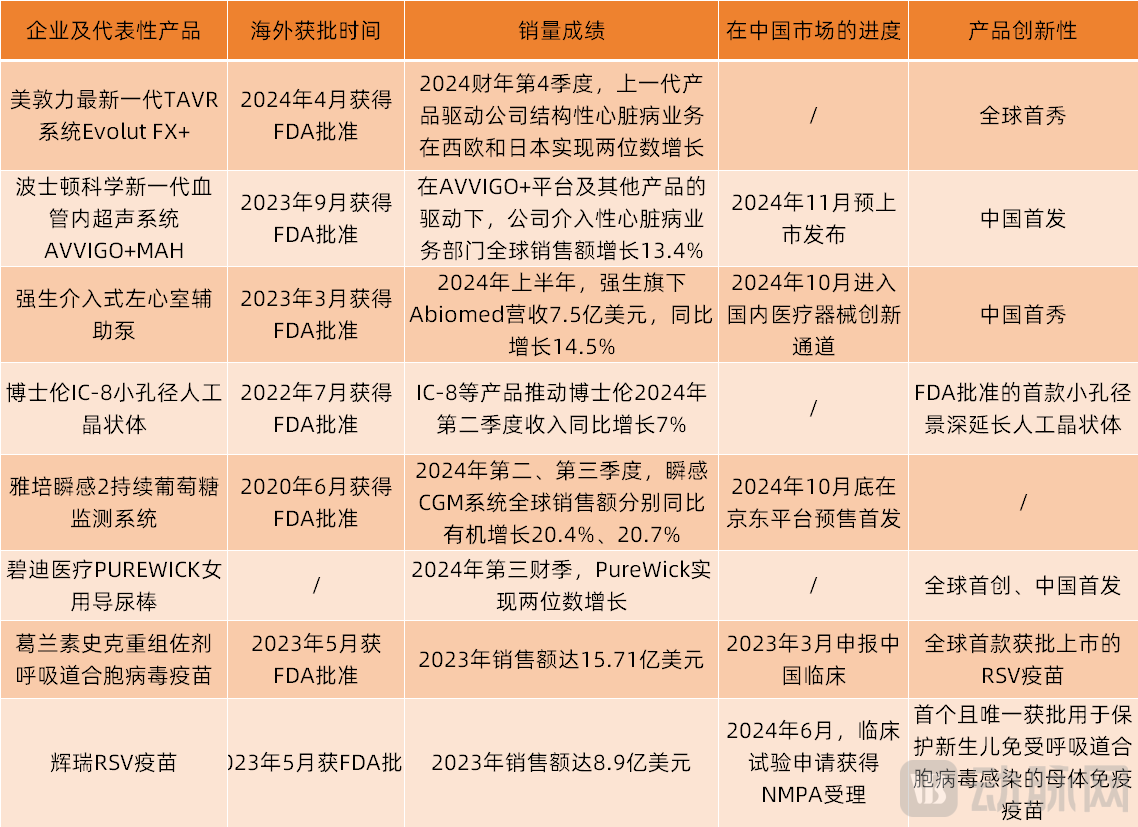
For example, Medtronic introduced the latest generation of the Transcatheter Aortic Valve Replacement (TAVR) system, Evolut FX+. This marks the first public unveiling of Evolut FX+ globally. According to Medtronic's Q4 financial report for the fiscal year 2024: due toContinuous Adoption of the Evolut FX Transcatheter Aortic Valve Replacement (TAVR) SystemThe company's structural heart disease business has achieved success in Western Europe and Japan.Double-digit growth。
It is reported that Evolut FX+ is an upgraded version of Evolut FX, which received FDA approval in April 2024. It is suitable for symptomatic severe aortic stenosis patients across all risk categories (extreme, high, moderate, and low). Compared to the previous generation, the biggest highlight of Evolut FX+ is its resolution of the coronary access issue.
In clinical practice, commissural alignment refers to aligning the commissures of an artificial valve with those of the native valve during aortic valve replacement. Clinical studies have shown that commissural alignment in TAVR procedures directly impacts coronary access, valve hemodynamics, and the durability of the artificial valve.
Before the launch of Evolut FX+, the previous generation product, Evolut FX, assisted doctors in confirming commissural alignment during TAVR procedures with the help of three radiopaque markers. However, due to variations in patients' anatomical structures, commissural alignment cannot always perfectly avoid the coronary ostium, potentially obstructing coronary access. In response to this, Medtronic designed Evolut FX+ based on clinical needs.
Compared with the previous generation, the Evolut FX+ retains the three radiopaque markers and adopts a large window design for the valve. The opening size is four times that of the previous Evolut series products. As a result, the Evolut FX+ provides more space for catheter maneuverability, facilitating access to coronary arteries with different patient anatomical structures and addressing coronary access issues.
For example, Johnson & Johnson unveiled the Impella CP with SmartAssist, a groundbreaking innovation in heart failure treatment and an interventional left ventricular assist pump, for its debut in China.
It is reported that the Impella series of products were innovatively launched by Abiomed, a leader in the artificial heart field. In 2022, Johnson & Johnson acquired Abiomed for $16.6 billion.
Driven by Johnson & Johnson, the Impella product, which was already a best-seller overseas, has gained even more momentum. In the first half of 2024, Abiomed achieved a revenue of $750 million.An increase of 14.5% year-over-yearJohnson & Johnson has already pushed for the Impella product to enter China's medical device innovation channel by October 2024. Its display at the CIIE will leverage the spillover effects of the event to accelerate product approval.
The Impella CP with SmartAssist, making its debut in China this time, is different from other products. The Impella heart pump equipped with the SmartAssist platform can display pump information metrics and device location in real time on the automatic controller. Currently, only the Impella CP and 5.5 under Johnson & Johnson are equipped with the SmartAssist technology platform.
It is reported that the SmartAssist platform mainly adds an optical positioning sensor and a micro axial motor to the standard Impella product. The optical positioning sensor can detect aortic pressure, while the micro axial motor can sense blood flow/volume between the aorta and the left ventricle. Based on the relationship between intravascular and intraventricular pressures, the SmartAssist system transmits the data collected by the sensors into an algorithm, which calculates the position of the Impella pump for adjustment. This allows the new Impella product to achieve precise positioning without angiography.
In addition, the SmartAssist technology platform also enables Impella to measure and calculate hemodynamic parameters in real time, such as left ventricular end-diastolic pressure, mean arterial pressure, and cardiac output.
Besides Medtronic and Johnson & Johnson, many other multinational device giants have brought their overseas blockbuster products. For instance, Bausch+Lomb introduced its IC-8 small-aperture intraocular lens that has been a hit overseas; Abbott launched the FreeStyle Libre 2 continuous glucose monitoring system, which has been a best-seller for many years, and this product had its pre-sale debut on JD.com on October 31st…
Not only medical device giants, but pharmaceutical companies have also brought overseas blockbuster products into China. For instance, both Pfizer and GSK have introduced their RSV vaccines. Among them, GSK's recombinant adjuvanted Respiratory Syncytial Virus (RSV) vaccine is the world's first approved RSV vaccine to hit the market and the first in China to receive clinical approval. Pfizer’s RSV vaccine is currently the first and only maternal immunization vaccine approved to protect newborns from Respiratory Syncytial Virus infection.
According to statistics, approximately 64 million people worldwide are infected with RSV (Respiratory Syncytial Virus) each year, leading to about 160,000 deaths. Driven by strong market demand, the sales of RSV vaccines from two major pharmaceutical companies have surged. According to the financial reports of GSK and Pfizer, GSK's RSV vaccine generated $1.571 billion in sales in 2023, while Pfizer's RSV vaccine reached $890 million in sales for the same year. With both products being showcased at the China International Import Expo (CIIE), they are expected to leverage the spillover effects of the CIIE to accelerate regulatory approvals and promote product implementation.
In addition, Novo Nordisk also showcased its oral semaglutide in China for the first time. According to financial reports, in 2023, Novo Nordisk's oral tablet Rybelsus, used for lowering blood sugar, achieved sales of approximately $2.719 billion, representing a year-on-year increase of 66%. On January 26, 2024, Novo Nordisk’s semaglutide tablet, NovoRin®, was approved for marketing by the National Medical Products Administration (NMPA) for the treatment of type 2 diabetes. This is the first orally-administered GLP-1 receptor agonist approved for marketing in China.
In the past, semaglutide was mainly available to patients in the form of injections. This product requires refrigerated storage, and patients need to inject once a week. Oral semaglutide, on the other hand, does not require refrigeration, making transportation more convenient and patient use much easier, as it only needs to be taken orally once a day. In terms of efficacy, there is no significant difference between the two. Clinical studies have shown that the glycated hemoglobin (HbA1c) target achievement rate for newly diagnosed type 2 diabetes patients in China using semaglutide tablets as monotherapy reached up to 92.3%. Based on these various advantages, oral semaglutide may replace injectable semaglutide and become the mainstream.
In the past, multinational pharmaceutical and medical device companies did not pay sufficient attention to the Chinese market, and many innovative products would only enter China long after they were approved overseas.
But at present, China has become the second-largest medical device market globally, and changes in the Chinese market can quickly be reflected in their financial reports. As the Chinese market develops, multinational pharmaceutical and device giants are paying increasing attention to it. One manifestation of this is that these multinational corporations are simultaneously registering their innovative products in both China and the United States.
At this year's CIIE, many giant companies have brought these innovative products that have been simultaneously filed for approval in both China and the U.S.
For example, Roche, one of the largest exhibitors in the medical device and healthcare exhibition area, has brought more than 30 products and innovative solutions that are already on the market or will soon be launched in China.
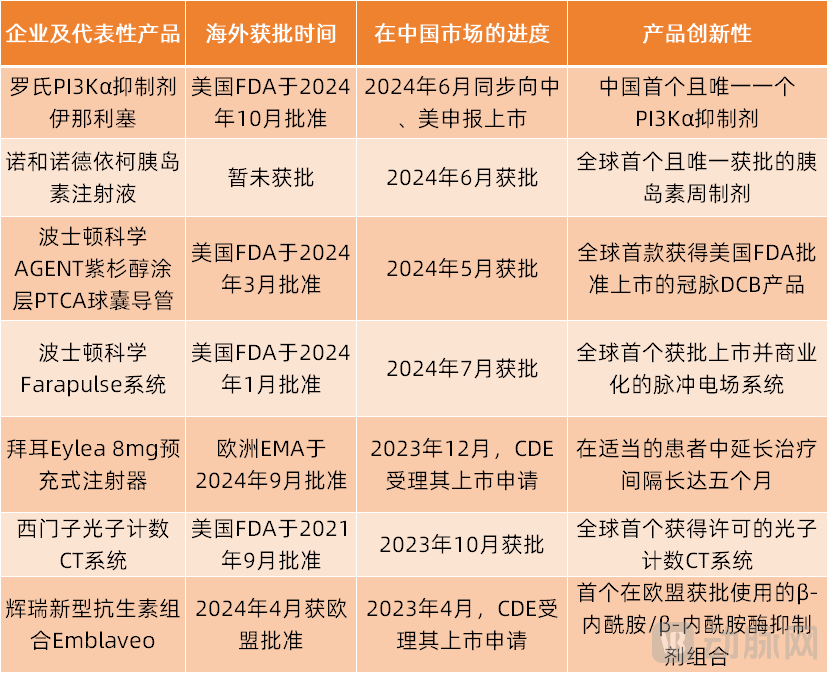
Among the exhibits, Roche's重磅 product, Inavolisib, is the first and only PI3Kα inhibitor in China. The product was simultaneously submitted for marketing approval in both China and the U.S. in June 2024. In October 2024, the U.S. FDA approved Inavolisib in combination with Palbociclib and Fulvestrant for the treatment of adult patients with HR-positive, HER2-negative locally advanced or metastatic breast cancer who have developed resistance to endocrine therapy during or after adjuvant endocrine therapy and harbor PIK3CA mutations.
It is understood that PI3K is one of the most frequently activated signaling pathways in human cancers, mediating nearly 50% of malignant tumor occurrences. Inavolisib is a phosphatidylinositol 3-kinase (PI3K) inhibitor, primarily exhibiting inhibitory activity against PI3Kα.
In vitro, inavolisib induces degradation of the mutant PI3K catalytic α subunit p110α, inhibits phosphorylation of the downstream target AKT, reduces cell proliferation, and induces apoptosis in PIK3CA-mutant cancer cell lines. In vivo, inavolisib decreases tumor growth in PIK3CA-mutant, estrogen receptor-positive, breast cancer xenograft models.
Compared with the use of each treatment alone or dual therapy, the combination of Inavolisib, Palbociclib, and Fulvestrant increased tumor growth inhibition.
To date, only Novartis and Roche's selective PI3Kα inhibitors have been approved for marketing globally. Other PI3Kα inhibitor products are still in the research and development stage. Roche's exhibition of Inavolisib at this year's CIIE is expected to leverage the spillover effects of the event to accelerate its approval and market launch.
In addition, Novo Nordisk's NovoPeak® Icodec insulin injection was the first product to simultaneously complete clinical trials in China, the EU, and the US, and to file new drug marketing applications in these regions. The product was approved for marketing in June 2024.
It is reported that Novo Nordisk's latest once-weekly basal insulin, Icodec insulin injection (brand name: NovoCycle®), is used for the treatment of adult type 2 diabetes. With innovative molecular design and structural modifications, the action duration of Icodec insulin injection has been significantly extended, balancing efficacy and safety. Requiring only one injection per week, it effectively improves patient compliance with insulin therapy.
As the world's first and only approved weekly insulin regimen, Insulin Icodec Injection demonstrates excellent clinical data: it helps more patients with type 2 diabetes achieve the treatment goal of HbA1c < 7% without increasing the risk of hypoglycemia compared to daily insulin regimens.
In the medical device field, Boston Scientific's AGENT Paclitaxel-Coated PTCA Balloon Catheter received FDA approval in March 2024 and obtained NMPA approval in China in May 2024. This product is used for the treatment of in-stent restenosis in coronary arteries. In-stent restenosis refers to a condition where the diameter of the originally implanted stent becomes narrowed by more than 50%.
In addition, Boston Scientific's pulsed field ablation product, the Farapulse system, received FDA approval in the United States in January 2024 and NMPA approval in China in July 2024, significantly reducing the time gap for cutting-edge innovative products to serve Chinese patients.
Another example of multinational pharmaceutical and medical device giants valuing the Chinese market is their customization of product development to meet the specific needs of China. Such products are on display at this year's CIIE.
For example, BD Medical launched the world’s first 3CG PICC, a traceable and locatable peripherally inserted central catheter that debuted in China. Complementing this, BD tailored the "Vascular Access Maintenance Record Mini-Program" specifically for Chinese patients. Together, these two solutions greatly assist patients in easily understanding and successfully completing regular postoperative chemotherapy maintenance.
For instance, GE Healthcare has previously customized several medical imaging products specifically for the Chinese market. Take the Brivo CT 325/315 series as an example, which is a cost-effective CT solution developed and produced locally by GE Healthcare in response to the needs of the Chinese market.
Meeting the demands of China's primary healthcare market, the Brivo CT 325/315 series ensures low maintenance costs, high reliability, and high image quality through multiple innovative technologies. Additionally, the product enhances functionalities related to stroke and tumor detection to address specific needs in China, while also meeting routine diagnostic requirements. Furthermore, its industrial design significantly reduces the footprint and simplifies installation site requirements.
GE Healthcare once stated: "In China, GE's primary focus is on meeting the actual needs of local customers by providing customized products and services that are developed specifically for the Chinese market, rather than simply bringing products that have been applied in other markets to Chinese customers."
Local production in China, accelerating benefits for Chinese patients, is also one of the important strategies for multinational pharmaceutical companies. On October 15, 2024, Roche's star influenza drug, Baloxavir Marboxil Tablets (Xofluza), began localized production in Shanghai, China. This means that the production supply chain for Baloxavir Marboxil will be effectively shortened.
Baloxavir marboxil is the world's first single-dose oral influenza treatment, which was approved for the first time in China in 2021. Eight months later, it was included in the National Medical Insurance Drug List, and in March 2023, it was again approved for pediatric indications. In December of the same year, Baloxavir marboxil dry suspension was also approved in China and officially launched in August this year, providing a better treatment option for flu patients who have difficulty swallowing tablets and those with low body weight.
In addition to tailoring products for the Chinese market, the deep involvement of Chinese teams is also an important reflection of multinational giants' emphasis on the Chinese market.
The new-generation intravascular ultrasound system AVVIGO+MAH, which Boston Scientific showcased at the CIIE, is a representative product deeply participated in by the Chinese team.
According to the introduction, the main application scenario of the AVVIGO+ intravascular ultrasound system is in percutaneous coronary intervention (PCI) surgeries, providing doctors with rapid, intuitive, and accurate assessment of vascular lesions.
In PCI procedures, doctors need to determine key information such as the degree of coronary artery stenosis, lesion location, and nature to select the most appropriate treatment plan. Against the backdrop of stent procurement, a significant increase in PCI procedures, and the growing popularity of precision treatment, the market's demand for precise vascular information is greater, with the frequency of examinations for projects such as IVUS, OCT, and FFR rapidly increasing.
The AVVIGO+ Intravascular Ultrasound System, as the first IVUS system to apply artificial intelligence for automatic lesion assessment, can automate several key steps for precise measurement of diseased vessels, reducing imaging time and thus decreasing procedure time.
Compared with other diagnostic systems on the market that only have either intravascular ultrasound (IVUS) or FFR functionality, AVVIGO+ provides two functions: intravascular ultrasound (IVUS) and physiological index assessment, which are used for intraluminal imaging and physiological evaluation during PCI procedures, respectively. AVVIGO+ also integrates FFR and DFR measurements, helping clinicians optimize the workflow for complex intravascular imaging and functional assessments, improving the PCI treatment process and enhancing patients' long-term outcomes.
It is worth mentioning that the intravascular ultrasound system AVVIGO+ was deeply involved in the research and development by the Boston Scientific China team, and its core V4 image acquisition host is entirely produced in China. Meanwhile, the product has achieved localized production by leveraging the Medical Device Registrant System, and the locally produced products will supply the global market.
According to the Q3 financial report released by Boston Scientific, the intravascular ultrasound system AVVIGO+ achieved large-scale global implementation in October 2024, one year after receiving FDA approval in September 2023. The application of the intravascular ultrasound system AVVIGO+ drove a 13.4% increase in global sales for the company’s interventional cardiology therapy business division.
Overseas blockbuster products, products registered simultaneously in China and the U.S., products specifically designed for the Chinese market, and products with deep involvement from Chinese R&D teams… Each of these cases reflects the growing importance multinational giants are placing on the Chinese market.
In addition to these product-related initiatives, multinational giants are also taking measures such as collaborating with local companies and establishing R&D and production centers in China to better expand their presence in the Chinese market. These efforts are also one of the key focuses of the CIIE. Subsequently, VCBeat will provide an in-depth analysis of this content—stay tuned.