

Novo Nordisk Secures Global Exclusive License to Ascendis’ TransCon Platform in $285M Deal Targeting Metabolic and Cardiovascular Diseases
Ascendis Pharma
Disease Treatment Drug Developer
Novo Nordisk
Insulin Developer and Manufacturer
Copenhagen, Denmark, Local Time November 4, 2024 – Ascendis Pharma A/S (NASDAQ: ASND, hereinafter referred to as Ascendis) announced that it has granted Novo Nordisk a global exclusive license for the TransCon technology platform to develop, manufacture, and commercialize Novo Nordisk's proprietary products in metabolic diseases, including obesity and type 2 diabetes, and granted it an exclusive license for its products in cardiovascular diseases.
According to the agreement, Ascendis will be eligible to receive upfront, development, and regulatory milestone payments of up to $285 million. In addition, the company will also be eligible for sales-based milestone payments and tiered royalties on global net sales. For each additional metabolic or cardiovascular disease candidate product, Ascendis will be eligible to receive development and regulatory milestone payments of up to $77.5 million, as well as sales-based milestone payments and tiered royalties on global net sales. Under the collaboration, Ascendis will conduct early-stage development of TransCon candidate products. Novo Nordisk will be responsible for these early development costs as well as clinical development, regulatory affairs, commercial manufacturing, and commercialization.
The agreement includes provisions for certain TransCon technology-based products to be identified and improved in metabolic diseases to maintain exclusivity in this field, as well as additional terms targeting cardiovascular diseases. Under the terms of the agreement, Novo Nordisk also obtains exclusive rights to expand any resulting metabolic disease products into other therapeutic areas. The main project of this collaboration is a once-monthly GLP-1 receptor agonist candidate, which will initially target obesity and type 2 diabetes.
TransCon Technology Platform, Customized "Transient Conjugation"
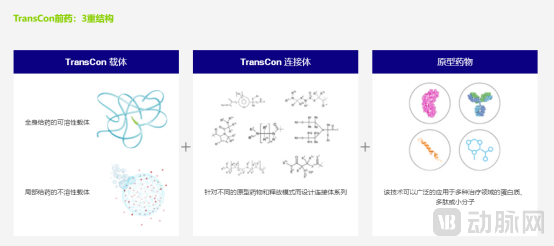
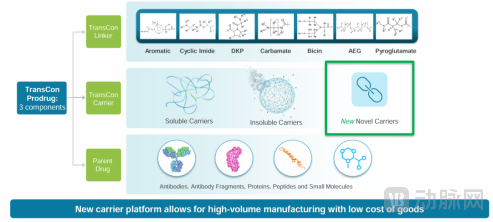
Ascendis' core asset at present is precisely the TransCon technology platform. TransCon stands for "Transient Conjugation." A TransCon molecule consists of three parts: the unmodified parent drug, the inert carrier molecule (TransCon Carriers) that protects the parent drug, and the linker structure (TransCon Linkers) that temporarily connects the two. When these three parts are combined, the carrier molecule allows the parent drug to exist in an inactive state and prevents it from being cleared by the human body. Once injected into the body, under physiological conditions of pH and body temperature, the active, unmodified parent drug is released in a controlled manner. Since the parent drug remains unmodified, its original mechanism of action can be preserved.
The key technical barrier here lies in the fact that traditional prodrugs need to be converted by enzymatic or non-enzymatic processes in the body to release the active drug for efficacy. However, the conversion rate varies significantly between different patients and even among different tissues within the same patient, making it impossible to predict the conversion rate of prodrugs in the body.
TransCon carriers are divided into systemic carriers and local carriers, which are typically PEG or some natural or synthetic polymers. The carriers of the company's three candidate drugs, TransCon hGH, TransCon PTH, and TransCon CNP, are all PEG-based. Local carriers enable the drug to be released at a high concentration locally, thereby increasing the therapeutic window of the drug.
Overall, the TransCon technology platform is a platform that can design and customize Linkers connected to different parent drugs, transforming them into long-acting formulations that can be administered once a week, once a month, or even once every six months.
Positive clinical progress, candidate products yet to be commercialized
In 2018, Ascendis Pharma, Vivo Capital, and Sofinnova Ventures decided to establish VISEN Pharmaceuticals in Shanghai. The former contributed products as equity, while Vivo Capital and Sofinnova Ventures provided financial support and granted full rights for the research, development, and commercialization of three endocrine candidate products. The company holds 50% of the shares, with the remaining shares held by Vivo Capital and Sofinnova Ventures.
According to the exclusive license agreement reached between ViSen Pharmaceuticals and Ascendis Pharma, the company is able to develop, manufacture, and commercialize candidate drugs in the endocrine field such as lonapegsomatropin, navepegritide, and palopegteriparatide in relevant regions.
Among them, Lonapegsomatropin is a once-weekly long-acting growth hormone replacement therapy used to treat pediatric growth hormone deficiency (PGHD, a common form of short stature in patients under 18 caused by insufficient growth hormone). Lonapegsomatropin has completed the Phase 3 pivotal trial in China. Data showed that after 52 weeks of treatment in Chinese children with growth hormone deficiency, the annualized height velocity (AHV) reached 10.66 cm, which was statistically significantly superior to the daily growth hormone preparation in the control group (AHV=9.75 cm).
In addition, the BLA for Lonapegsomatropin was submitted on January 18, 2024, and subsequently accepted by the National Medical Products Administration on March 7, 2024, marking the upcoming commercialization journey of VISEN Pharmaceuticals' first new drug.
In the growth hormone market, which has a potential value of over tens of billions, there haven't been any innovative long-acting products launched in the domestic market for nearly a decade. Moreover, TransCon hGH (Lonapegsomatropin) has proven through its Phase 3 clinical trial results that it is, to date, the only long-acting growth hormone superior to daily growth hormone formulations. Notably, in the global race for long-acting growth hormones, 12 companies have previously failed in the development of this indication. Ascendis Pharma's long-acting growth hormone, Lonapegsomatropin, has the potential to become the first-line preferred treatment for children with GHD.
At the same time, the other two core products have also achieved positive clinical results respectively.
Navicorelin, a long-acting prodrug of C-type natriuretic peptide, is used to treat achondroplasia (a type of short-limbed dwarfism that can lead to severe skeletal complications and comorbidities). Navicorelin has completed the double-blind phase of a Phase 2 clinical trial for the treatment of achondroplasia in China, and the last visit of the last patient in the open-label phase of this trial was completed in April 2024.
Paroparatide is a once-daily parathyroid hormone replacement therapy used to treat chronic hypoparathyroidism (a syndrome of calcium and phosphorus metabolism disorders caused by reduced secretion or functional defects of parathyroid hormone). Paroparatide is currently under development in a Phase 3 pivotal trial in China; its double-blind phase was completed in January 2023, and an NDA submission to the National Medical Products Administration is expected in the first half of 2025.
VitalSpring Pharma Recently Submits IPO Prospectus to HKEX, Aiming for Listing on the Main Board of Hong Kong. Notably, this marks another attempt following three previously lapsed submissions on November 17, 2022, August 16, 2023, and March 21, 2024. According to the prospectus, although Ascendis has exclusively licensed all intellectual property rights related to the company’s investigational drug candidates, VitalSpring Pharma has still invested over RMB 230 million in R&D over the past two years starting from 2022.
Racing Ahead in the Billion-Dollar Market
Positive clinical information based on the TransCon technology platform has also caught the attention of Novo Nordisk.
In the field of long-acting growth hormones, four long-acting growth hormone products have been approved for marketing globally. Apart from Jin Sai Pharmaceutical's Jin Sai Zeng, the rest are products from overseas pharmaceutical companies: Novo Nordisk's Sogroya, Ascendis Pharma's Skytrofa, and Pfizer's Ngenla. Among them, Sogroya is the first long-acting growth hormone formulation approved by the U.S. FDA for treating children aged 2.5 years and above with growth disorders due to insufficient endogenous growth hormone secretion, as well as for replacement therapy in adults with growth hormone deficiency. It has already been approved for marketing in multiple countries and regions.
According to the strategic layout disclosed in Novo Nordisk's 2024 half-year report, rare diseases are also one of its four pillars. However, the company’s core products still focus on diabetes and obesity drugs. The latest guidelines released by the American Diabetes Association (ADA) and the European Association for the Study of Diabetes (EASD) in 2023 have listed GLP-1 as a first-line treatment for type 2 diabetes. Novo Nordisk's 2023 annual report shows that the overall sales revenue of the GLP-1 drug semaglutide reached 145.811 billion Danish kroner, approximately 21.2 billion US dollars. Notably, the sales revenue of semaglutide for weight loss surged by 406%, reaching 31.343 billion Danish kroner, approximately 4.6 billion US dollars.
The development of GLP-1 has also undergone a process from short-acting to long-acting and then to ultra-long-acting.
Currently, the common issues faced by peptide and protein macromolecule drugs include limitations in drug delivery methods, potential immunogenicity, and poor cell membrane permeability. The biggest challenge for GLP-1 agonists lies in their extremely short half-life. The half-life of GLP-1 secreted by the human body is only 1-2 minutes, and once secreted into the bloodstream, it is easily and rapidly degraded by dipeptidyl peptidase-4 (DPP-4), losing its insulin secretion-promoting activity. Therefore, continuously updating long-acting mechanisms (injection, oral) to extend the half-life has become a key technical difficulty that needs to be addressed in GLP-1 agonist development and an internal driving force for product iteration.
However, MNCs focusing on oral mechanisms have not had smooth sailing. In December 2023, Pfizer abandoned its second-generation oral GLP-1RA drug, Danuglipron, due to a high frequency of observed adverse reactions. In June 2023, Pfizer decided to halt the further development of the GLP-1 small molecule Lotiglipron, primarily because its safety faced significant challenges. In Phase II clinical trials, elevated transaminase levels (indicative of liver damage) were observed in enrolled subjects, likely due to the metabolism of small-molecule GLP-1 drugs being predominantly processed by related protein activity within the liver, thus increasing the burden on the liver.
As Novo Nordisk, which has prioritized seizing an absolute advantage in the revolutionary treatment of Type 2 diabetes, it clearly would not miss the opportunity to further address the pain points of long-acting mechanisms.