Medtronic Secures FDA Approval for Affera Mapping and Ablation System and CE Mark for Evolut FX+ TAVR System

Medtronic
Medical Device Manufacturer


Source: Heart Future
Recently, Medtronic (NYSE: MDT) announced that its Affera mapping and ablation system has received FDA approval for marketing in the United States. This includes the Sphere-9™ catheter and Affera™ Prism-1 mapping software. The system integrates three functions: three-dimensional mapping (HD), radiofrequency ablation (RF), and pulsed field ablation (PFA). It is used to treat persistent atrial fibrillation and tricuspid isthmus-dependent atrial flutter. Previously, it received CE mark approval in March 2023.
In addition, its Evolut FX+ Transcatheter Aortic Valve Replacement (TAVR) System has also received CE Mark approval for the treatment of symptomatic severe aortic stenosis (AS). This system had previously received FDA approval in March 2024. The Evolut FX+ features an opening size four times larger than the previous Evolut TAVR systems to facilitate access to coronary arteries with varying anatomical structures.
Notably, prior to acquiring Affera for $1 billion in 2022, Medtronic did not have its own mapping system. The recent approval of the Affera system strengthens Medtronic’s position to compete with the other three major players in the electrophysiology field (Boston Scientific, Johnson & Johnson, and Abbott). Medtronic has also become the first company globally to offer two FDA-approved PFA systems for treating atrial fibrillation. Medtronic's PulseSelect PFA system received FDA approval in December 2023.
Medtronic will also launch the Sphere-360 for single-shot pulmonary vein ablation in the future, capable of adjusting the electrode shape according to the patient's physiological structure, thereby conforming to various pulmonary vein anatomical structures. It integrates seamlessly with the Affera mapping and ablation system, achieving minimal to zero fluoroscopy.
Medtronic's existing PFA products include the self-developed PulSelect and the Affera mapping and ablation system acquired from Affera.
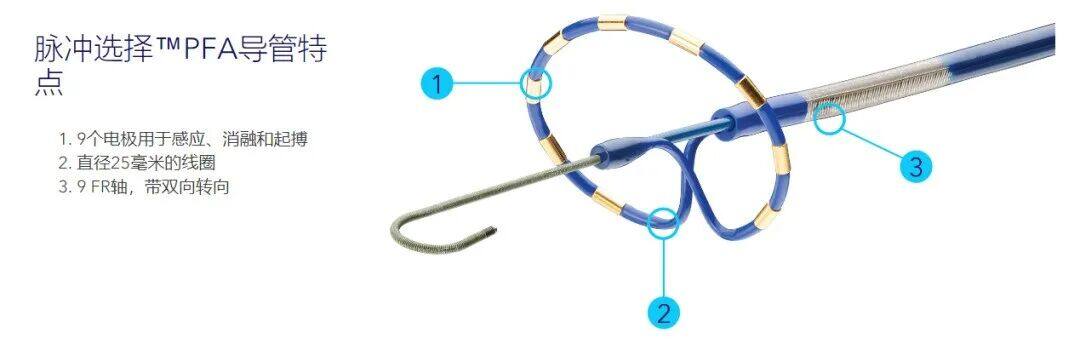
PulSelect delivers bipolar, biphasic pulse electric fields through a circular multi-electrode array catheter and has received FDA and CE approval. However, its circular design has some shortcomings in terms of pulmonary vein conformity, single circular size (25mm), and large sheath size (10Fr), which also puts Medtronic at a disadvantage in its competition with Boston Scientific and Johnson & Johnson.
Affera™ is an integrated, dual-energy pulsed field (PF) and radiofrequency (RF) ablation system with high-density mapping capabilities, designed for cardiac electrophysiology ablation procedures. The system includes a mapping/ablation catheter (Sphere-9), an energy generator (capable of delivering PFA and RF), and a three-dimensional mapping software (Prism-1).
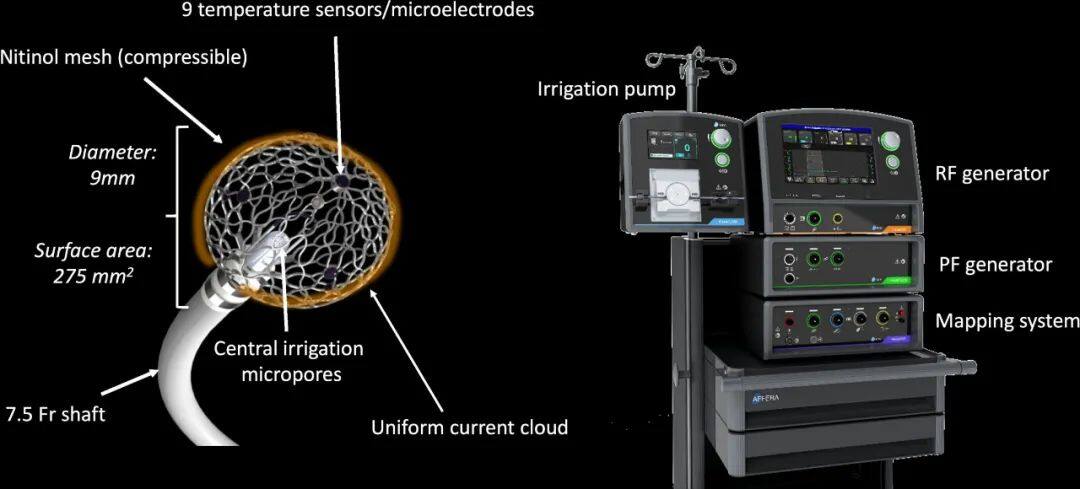
Sphere-9 is a novel 7.5F multi-segment grid-like spherical catheter that can be used in conjunction with other Medtronic products, serving as a complement to the company’s existing PFA product line.
The Sphere-9 lattice ablation catheter, used in conjunction with the HexaGen™ ablation generator and saline infusion pump, combines both radiofrequency ablation and pulsed field ablation. This dual-generator design allows for switching between radiofrequency energy and pulsed field energy without the need to reposition the catheter or connections, meeting ablation needs for various anatomical locations.
Sphere-9 is equipped with inflatable conductive lattice electrodes. The catheter is inserted into the sheath in a folded form, and once inside the heart, the lattice expands into a spherical structure with a diameter of 9mm. The lattice contains 9 micro-electrodes/temperature sensors (0.7mm in diameter) evenly distributed across its surface. The effective ablation area is 10 times that of traditional radiofrequency ablation catheters, completing one ablation in 4-5 seconds, with radiofrequency ablation lesion width exceeding 19mm and electropulse ablation lesion width exceeding 17mm.
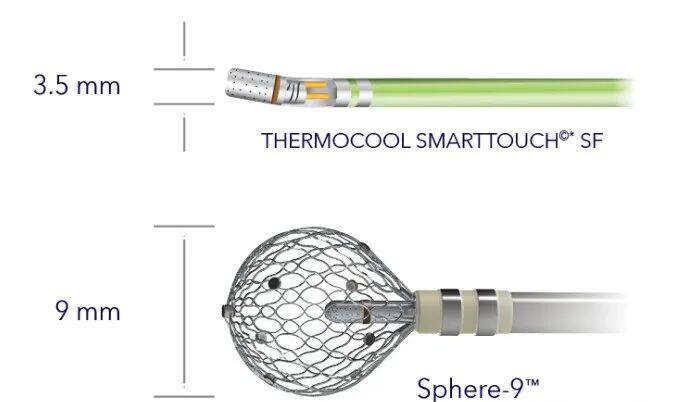
▲ Johnson & Johnson THERMOCOL SMARTTOUCH SF Dual-Energy Catheter and Medtronic Sphere-9 Lattice Ablation Catheter
Advantages of Affera™ are as follows:
Dual-mode RF/Pulsed Field Ablation: Allows intraoperative mode switching without the need to move the catheter or connection lines, meeting ablation needs for different anatomical sites.
Lattice Tip Design: The lattice tip design of Sphere-9 (with 9 microelectrodes) enables point-by-point ablation and can also be flexibly used in different anatomical locations, such as linear lesions.
Higher Safety and Efficacy: On one hand, it selectively affects myocardial cells without damaging the surrounding blood vessels and nerves, and without causing injury to the esophagus or phrenic nerve; on the other hand, it achieves 100% linear block during the acute phase, with the lesion still showing continuous transmurality 35 days post-operation.
Uniform and Efficient Delivery of Electrical Pulse Energy: A unique lattice tip design with a larger effective surface area can deliver higher current to tissues at a lower current density, increasing the safe and effective window for ablation. It has advantages when used in special areas such as ventricular muscle.
IDE Clinical Research Data:
The control group was the Johnson & Johnson dual-energy ablation catheter THERMOCOOL SMARTTOUCH SF with the CARTO mapping system (radiofrequency and pulse ablation).
The primary safety endpoint rate was 1.4% (1% in the control group). No safety events were reported, including pulmonary vein stenosis, esophageal events, or pericardial tamponade, demonstrating positive safety.
The Sphere-9 group demonstrated 73.8% freedom from atrial fibrillation (AF), while the control group observed only 65.8%.
Patients treated with the Sphere-9 catheter observed fewer recurrences of atrial arrhythmias throughout the 12-month follow-up period after 100% acute isolation of pulmonary veins and linear lesions.
Sphere-9 group saves more than 25 minutes per surgery.
Medtronic also announced that an early feasibility study of the Affera mapping and ablation system will be conducted. The study aims to evaluate the effectiveness of the Sphere-9 catheter in treating patients with persistent ventricular tachycardia (VT). The study will primarily focus on the incidence of device- or procedure-related serious adverse events following the ablation procedure, as well as the acute effectiveness of ablating the target VT, with plans to follow up with patients for six months.
Medtronic's New Generation TAVR – Evolut FX+ is suitable for symptomatic severe aortic stenosis patients across all risk categories (extreme, high, moderate, and low). It is an upgrade based on Medtronic's 4th generation TAVR – Evolut FX, with the key highlight being the resolution of coronary access issues.
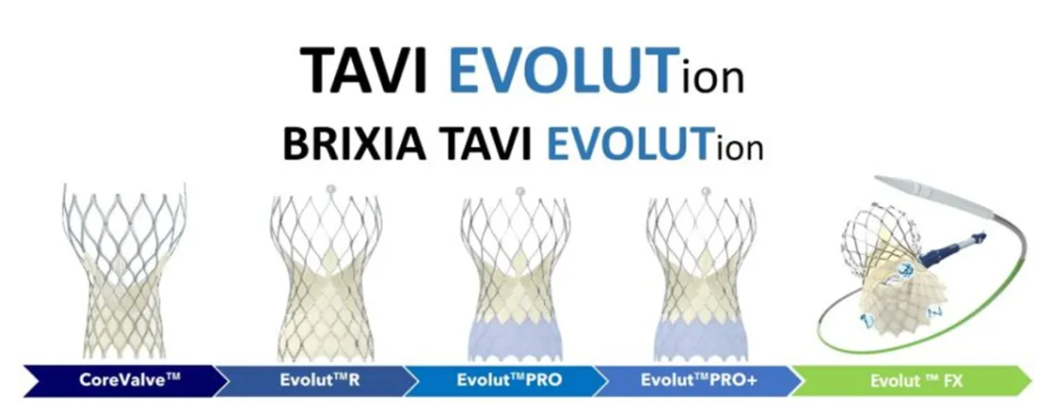
Evolut FX+ provides a larger coronary access window while retaining the three radiopaque markers of Evolut FX. This opening size is four times that of the previous Evolut series. Evolut FX+ is designed this way to offer more space for catheter maneuverability, facilitating access to the coronary arteries of patients with different anatomical structures.
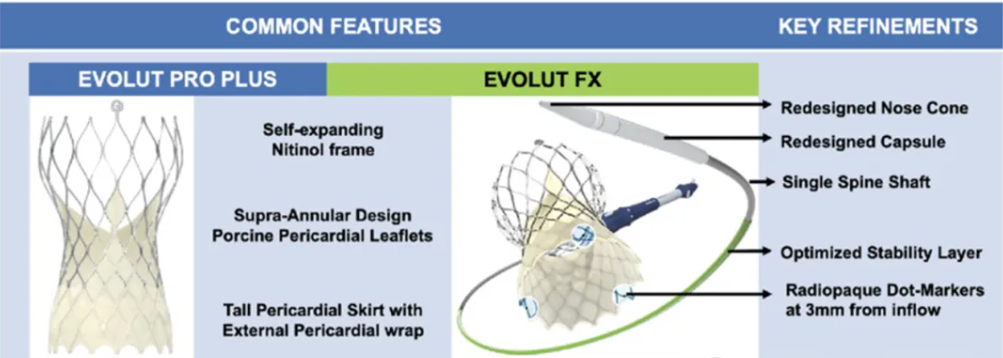
▲Comparison of the Two Systems
In a randomized controlled clinical study comparing transcatheter aortic valve replacement (TAVR) with surgical aortic valve replacement (SAVR, the industry gold standard), a total of 1,414 patients attempted implantation (730 TAVR; 684 SAVR). The results showed that, compared to SAVR, Evolut TAVR achieved favorable outcomes in the primary endpoint of all-cause mortality or disabling stroke over four years. At the four-year mark, the risk of death or disabling stroke was relatively reduced by 26% in the TAVR group, while the SAVR group had a rate of 14.1%.
But overall, combined with the research of other scholars, the advantages of TAVR technology compared to traditional SAVR technology are not very obvious. At the same time, innovation in TAVR product technology is becoming increasingly difficult, with both Medtronic and Edwards making minor adjustments to their respective TAVR products. For example, Edwards' SAPIEN series launched the Sapien 3 Ultra Resilia TAVR in 2022, which upgraded the bovine pericardial tissue (dry valve) and skirt compared to the previous generation. Meanwhile, Medtronic's Evolut FX+ focused on upgrading the delivery system and imaging markers.
Medtronic also announced the head-to-head clinical study between its Evolut platform and Edwards Sapien platform at the ACC2024 conference in April 2024. The Evolut platform achieved non-inferiority in the primary endpoint of clinical outcomes (Evolut 9.4% vs. SAPIEN 10.6%, p<0.001). The Evolut TAVR demonstrated superiority in the primary endpoint of valve performance and bioprosthetic valve dysfunction within one year (Evolut 9.4% vs. SAPIEN 41.6%, p<0.001).
Although the TAVR market competition is becoming increasingly fierce, shifting from initially growing together to a head-on confrontation, the positive results of this study, combined with the previous positive outcomes of the head-to-head clinical study with SAVR, have given Medtronic the upper hand in market promotion and publicity, laying the groundwork for further market share expansion.
Medtronic (NYSE: MDT), founded in 1949 and headquartered in Minneapolis, Minnesota, USA, is a global leading medical technology company with over 95,000 employees.
Revenue was $7.9 billion (approximately 56.32 billion RMB), and adjusted revenue was $80 Billion , Reported growth of 2.8%, organic growth of 5.3% ; GAAP net income was USD 1.042 billion, GAAP diluted earnings per share (EPS) was USD 0.80; non-GAAP diluted earnings per share was USD 1.23.
This article is a reprint, all opinions belong to the original author.FlatPlatform (HeartFuture), Medical DevicesBusiness ReviewDisclaimer: All opinions in the article are neutral and are shared for communication purposes only.



If you find the content rewarding, welcomeStar Marker、Like、Forward!
Your support is our greatest motivation