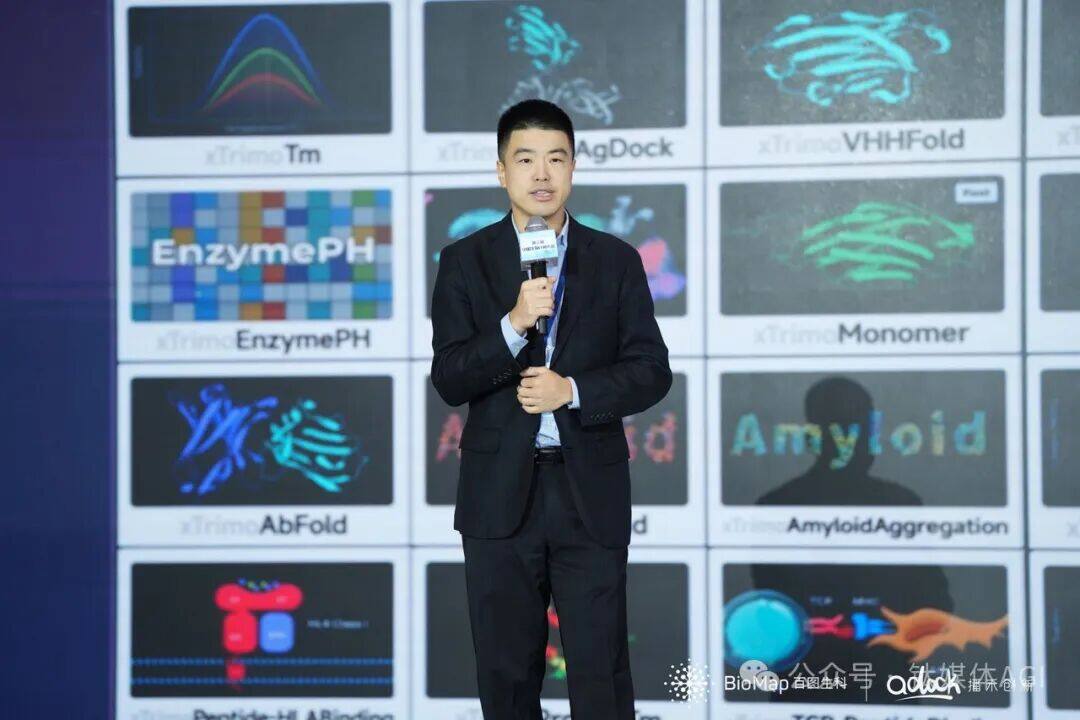
BioMap Co-Founder and CEO, Liu Wei2024 Nobel Prize in Chemistry Awarded to Demis Hassabis and John M. Jumper of Google DeepMind for AI Large Model Achieving Protein Structure Prediction, Sparking a Surge in China's AI for Science Frontier Technology Track.In late October, at the 3rd China Bio-Computing Conference,BioMap, co-founded by Robin Li, releases xTrimo V3, a new large foundational model for life sciences with 210 billion parameters, making it the world's largest AI foundational model in the life sciences field. It covers seven major mainstream modalities in life sciences, including proteins, DNA, and RNA. In the protein domain, it achieves the world’s first MoE (Mixture of Experts) architecture; DNA sequence length surpasses 128K, providing enhanced accuracy for genomics, genetic disease prediction, and precision medicine.To date, BioMap has built over 200 task models that have achieved SOTA evaluation levels, successively assisted in the development of more than 20 cutting-edge antibodies and enzymes, realized the discovery of over 10 innovative targets and target combinations, and expanded into broader fields such as biomanufacturing, agrochemicals, and green environmental protection.After the meeting,BioMap Co-founder and CEO Liu Wei told Titanium Media App and others, "BioMap is positioned to become a world-leading AI model provider in the life sciences." By accelerating its commercialization based on its large AI model platform foundation and application scenarios for a wide range of specific and cutting-edge life science issues today, the company aims to lead research and development by 3-5 years, creating an AI platform that delivers greater social and economic value to the industry.
AI Technology Solves the Dilemma of Low ROI in New Drug Development

New drug development is one of the most risky, complex, and time-consuming technical research fields in human development.According to statistics from the British journal *Nature*,The research and development cost of a new drug is approximately $2.6 billion, takes about 10 years, and has a success rate of less than one-tenth.Between 2000 and 2015, nearly 86% of candidate drugs failed to reach the target endpoint.For pharmaceutical developers and CRO research teams, the drug discovery process is extremely lengthy, complex, and costly. Therefore, AI-based drug development has the potential to significantly reduce the time and cost required for drug discovery, increase the success rate of drug development, and help identify new treatment methods.Before the wave of generative AI, most new drug research and development utilized CADD (Computer-Aided Drug Design) as one of the methods for drug discovery. This approach uses computers as an operational medium to simulate molecular structures and behaviors through atomic (quantum) scale models, thereby simulating various physical and chemical properties of molecular systems. However, with the increasing difficulty of drug research and development and more complex pathological issues, CADD cannot comprehensively calculate the pathways to obtain drugs; it only generates part of the ideas for drug molecular structures. Therefore, using AI to design drugs (AIDD) has become a new academic trend.After years of practice, AI technology can indeed identify potential drug targets and design molecules that interact with these targets, as well as analyze large amounts of data to identify potential drug targets, thereby reducing the time and cost invested in drug discovery and development.According to estimates by the McKinsey Global Institute in 2024, generative AI could create $60 billion to $110 billion in economic value annually for pharmaceutical and medical technology companies.BioMap, founded in 2020, is a life science AI large model company with disruptive technology. It was initiated by Robin Li, the founder and CEO of Baidu, who also serves as the chairman. Liu Wei, the former vice president of Baidu Group and CEO of Baidu Ventures (BV), serves as the co-founder and CEO of BioMap. The core team includes Per Greisen, the former global vice president of Novo Nordisk and president of BioMap Inc, as well as Deng Yongfu, the former global vice president of SAP and president of BioMap.As of now, BioMap has more than 200 employees and has established research and development centers in Silicon Valley, Beijing, Suzhou, and Hong Kong.In terms of financing, BioMap has currently secured over 200 million US dollars (approximately 1.425 billion yuan) in venture capital.Among the investments, in July 2021, BioMap completed an A-round financing of over 100 million US dollars, with participation from GGV Capital, Baidu, and others, while founder Robin Li continued to increase his investment. In June this year, Hong Kong Investment Management Limited (HKIM), holding an initial fund of 62 billion Hong Kong dollars, announced it would lead the investment in BioMap's new round of financing.Commercial LevelBioMap has served more than 300 users globally, achieving total customer orders exceeding $2 billion (approximately 14.251 billion yuan)., contributing to numerous breakthrough achievements in the fields of AI-driven novel protein design, AI target discovery, and AI enzyme design. Among these is the highly anticipated collaboration order between Sanofi and BioMap, with a total transaction value of 1 billion US dollars.In October this year, BioMap announced the intensification of its commercial efforts in China, officially launching ecosystem development for the Chinese market to bring intelligent solutions to more Chinese customers—based on the xTrimo foundational large model platform and the Model Builder toolchain, providing drug research and development solutions, biomanufacturing solutions, AI4LS platform solutions, and more. At the same time, BioMap will further expand its ecosystem partnership system, including upstream and downstream industrial chains such as hardware, software, infrastructure, value-added services, and industry ecosystems.BioMap revealed,Through in-depth cooperation with top global pharmaceutical companies and research institutions, BioMap has set an industry benchmark in the fields of drug development and precision medicine.For example, the collaboration with global top pharmaceutical giants has validated how BioMap's AI model can help pharmaceutical companies infer 70% of potential outcomes with only 5% of experimental data."In response to the demands of global leading customers for the advancement of AI models, our products must go beyond conventional improvements and deliver breakthrough value that leads the industry — this is precisely what sets us apart from other companies in the market."Regarding the Chinese market, BioMap believes that China has great potential in the fields of synthetic biology and biomanufacturing, with a market size far exceeding that of the United States. Although the U.S. demonstrates strong capabilities in laboratory research and development, it falls short in application scenarios and industrial manufacturing capacity, whereas China boasts numerous corporate giants, as well as small and medium-sized enterprises and research institutions exploring cutting-edge innovations. BioMap's core advantage lies in its ability to provide corresponding innovative services and solutions tailored to customers of varying scales and needs.BioMap President Deng Yongfu emphasized to the Titanium Media App, "In the current environment, many traditional pharmaceutical companies are also seeking new transformations, which are brewing new growth and changes. This is a very important factor worth the company's investment. At the same time, the biomanufacturing industry has fertile ground for development in China, and many customers are very welcoming of this new technological change."
Exploration of Platform Enterprises: From EDA to Foundation Models in Life Sciences

BioMap believes that, standing at the forefront of the intersection of life sciences and AI,By leveraging its AI large model platform, it empowers life science companies to accelerate scientific research and innovation, just as EDA (Electronic Design Automation) tools function in the semiconductor industry.。In fact, the core of EDA lies in relying on backend technology to optimize design processes and improve efficiency, empowering chip companies to design and produce chips more efficiently, but it does not directly manufacture chips. BioMap's large model platform builds task models through multimodal data and cross-domain knowledge, applying them to real business scenarios of life science enterprises.HelpItsAccelerate the entire process from research to product,Rather than directly producing end products. Moreover, generative AI technology has enabled BioMap's large model platform to achieve remarkable results in core life science fields such as protein structure prediction and target discovery. This not only enhances R&D efficiency but also helps companies address complex problems that traditional research struggles to solve, driving more enterprises and research institutions to accelerate into the AI for Science (AI4S) track.Liu Wei believes that generative AI technology can bring about a paradigm shift in the life sciences field.Protein structure prediction will also become a "key battleground." As Bill Gates said, AI is "the first technology without limits," and in the next five years, AI will completely transform human life and health.BioMap believes that, with its large model platform, it is attempting to influence multiple fields of life science. Whether it is the research and development of macromolecular drugs, gene editing, target discovery and development for cell and gene therapies in biomedicine, or the design and research of cutting-edge products such as artificial biomaterials, biofuels, and bioenzyme catalysts in the field of biomanufacturing.Etc.Despite the broad application prospects of AI, the computational challenges it faces cannot be ignored. Particularly against the backdrop of "excess low-end computing power and scarce high-end computing power," AI computing power has become a major cost bottleneck.Sequoia Capital once predicted that there is a huge gap between the return on investment in AI infrastructure and actual revenue, with the total revenue demand for AI companies expected to reach $600 billion. The uniqueness of the life sciences industry lies in the fact that, despite the high cost of AI computing power, the returns brought by AI technology are undoubtedly enormous for pharmaceutical companies with annual research and development investments reaching trillions of dollars. Through AI technology, complex scientific research problems can be broken down into verifiable solutions, thereby helping companies achieve significant breakthroughs in cutting-edge drug discovery and disease treatment. Although no single company can solve all problems with just one technology, the application of AI is gradually cracking complex life science challenges, ultimately leading to more precise drugs and life science solutions. Companies that embrace AI early on will reap substantial rewards in the future."In the future, different populations, different countries, including many patients with rare diseases, will be able to benefit from the new R&D paradigm driven by AI in biopharmaceuticals, biomanufacturing and other industries. Currently, annual R&D investment in the life sciences field is as high as several trillion US dollars, but it mainly focuses on solving a few major issues. Therefore, if AI can increase R&D efficiency by 100 times, there will be more precise drugs and life science product lines produced, which will greatly promote our health and well-being," Liu Wei told TMT Post.