Huihe Medical Showcases Innovative C-Wave® and K-Clip® Systems at TCT 2024 in Washington

H&H Healthcare
R&D and Producer of Interventional Medical Devices for Heart Disease
From October 27 to 30, 2024, the 36th Annual Transcatheter Cardiovascular Therapeutics (TCT 2024) conference grandly opened in Washington, D.C., USA. Gathering top experts in the international cardiovascular field and presenting the latest advancements in global clinical research, the event facilitated discussions on cutting-edge medical technologies worldwide.
During the conference, China's top experts brought two major products from HuiHe Healthcare.C-Wave®Coronary Shock Wave System,K-Clip®Transcatheter Tricuspid Annuloplasty System Debuts at TCT 2024.
Nanjing First HospitalProfessor Zhang JunjieC-Wave, with independent intellectual property rights from HuiHe Healthcare, was released for the first time on an international top-tier stage.®Clinical research results of the coronary artery shock wave system show that its surgical success rate and adverse event rate have significant advantages over similar products.
Professor Zhang Junjie's Presentation Topic: Intravascular Imaging and Angiography-Guided Intravascular Lithotripsy for the Treatment of Coronary Artery Calcified Lesions, and C-Wave®Coronary Shockwave Registration Clinical Study Data Report.
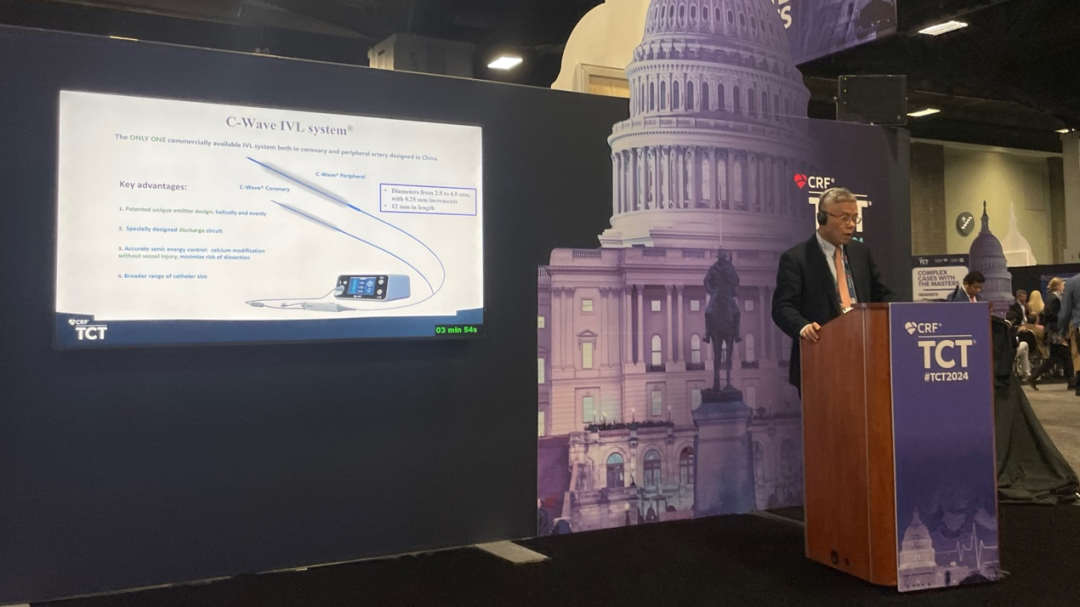
Professor Zhang Junjie's TCT Presentation at the Venue
At the same time, the team of Academician Ge Junbo from Zhongshan Hospital Affiliated to Fudan UniversityProfessor Zhang Xiaochun, Professor Wu Yongjian's team from Beijing Fuwai HospitalProfessor Wang Moyang`, following K-Clip`®Following the announcement of the 180-day follow-up results of the TriStar study at TCT 2023, the one-year follow-up results of the TriStar study were subsequently reported.
TriStar Study 1-Year Follow-Up Shows K-Clip®The system can continuously and significantly reduce the severity of tricuspid regurgitation, improve cardiac function, and enhance health conditions. The release of these two research achievements has attracted widespread attention in the industry, vividly showcasing the wisdom of Chinese healthcare workers.
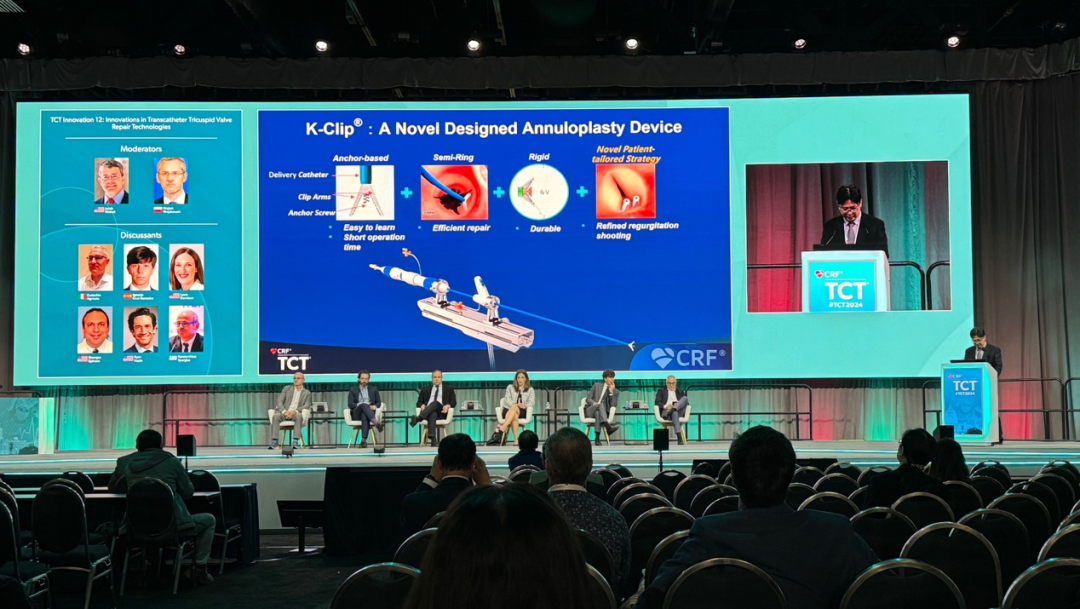
Professor Wang Moyang from Professor Wu Yongjian's Team Delivers a Speech at the Conference
【Venue Report】: HuiHe Healthcare C-wave®Coronary Shockwave
Professor Zhang Junjie introduced to overseas experts in his speech that the safety and effectiveness of shock wave technology (IVL) in coronary clinical applications have been confirmed in multiple clinical trials, but intravascular imaging (IVI) technology has not been widely used when performing IVL in patients with moderate to severe calcification.C-wave®The highlight of the coronary shock wave study is: comparing IVL under IVI guidance with IVL under coronary angiography guidance in terms of DES implantation outcomes.
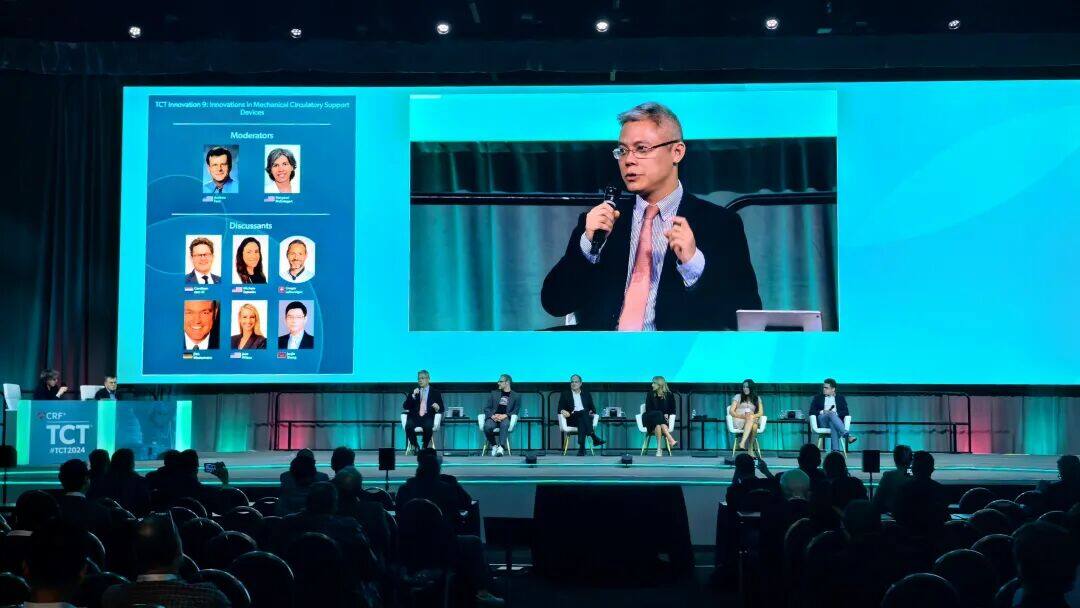
Study Design
C-wave®The pre-market clinical trial of the coronary artery involved 10 well-known cardiovascular interventional centers, as a prospective, multi-center, single-group objective performance criterion (OPC) clinical trial. The inclusion criteria for subjects were age ≥18 years, with primary coronary artery disease suitable for PCI (including stable or unstable angina and asymptomatic myocardial ischemia). Patients with moderate to severe calcified stenotic lesions in the coronary arteries, with a reference vessel diameter of 2.5-4.0mm and target lesion length of 5-40mm. The primary endpoint was procedural success rate, defined as residual stenosis of the target lesion less than 50% immediately after IVL pre-treatment and DES implantation, without in-hospital MACE occurrence. Additionally, a comparison between the IVI group and the angiography group was conducted, with the exploratory endpoint being immediate postoperative lumen gain. Secondary endpoints included residual stenosis rate of the target lesion after IVL pre-treatment, major adverse cardiac events (MACE) rate, major adverse cardio-cerebrovascular events (MACCE) rate, and stent thrombosis.
Research Results
The trial enrolled a total of 201 patients (97 in the IVI group and 104 in the angiography group), with an average age of 68.20 ± 8.85 years; male patients accounted for 63.7%; the average number of catheters used was 1.1 ± 0.4; the surgical success rate was 97.4%; the incidence of in-hospital MACE events was 2.6%, and 100% of patients had residual stenosis of the target lesion <50%. The 30-day follow-up results showed no MACE events and no stent thrombosis. QCA sensitivity analysis after IVL pretreatment showed a minimal lumen diameter of 2.52 ± 0.39 mm in the IVI group and 2.37 ± 0.47 mm in the angiography group, P = 0.014; immediate lumen gain was 1.55 ± 0.40 mm in the IVI group and 1.40 ± 0.51 mm in the angiography group, P = 0.023. Both groups showed statistically significant differences in lumen gain.
Research Conclusion
This study demonstrated the new generation of shock wave system C-Wave®Efficacy and Safety in the Treatment of Moderate to Severe Calcified Coronary Artery Lesions.Compared with similar products, the surgical success rate is higher and the incidence of MACE events is lower.Moreover, the use of IVL treatment under IVI guidance showed significant improvement in immediate lumen gain compared to angiography guidance alone. Under the guidance of IVI, the timing for using IVL and the efficacy post-treatment can be accurately determined, which is beneficial for better management of severe calcified lesions, thereby improving patient prognosis.
【Venue Report】: HuiHe Healthcare K-Clip®Transcatheter Tricuspid Annuloplasty System
Professor Zhang Xiaochun:K-Clip®Transcatheter Tricuspid Annuloplasty is a technology with China's independent intellectual property rights and global multi-country applications.TRISTAR Study Aims to Evaluate the Use of K-Clip®The effectiveness and safety of the transcatheter tricuspid annuloplasty system for treating patients with severe or higher FTR. This TCT reports its 1-year follow-up results.
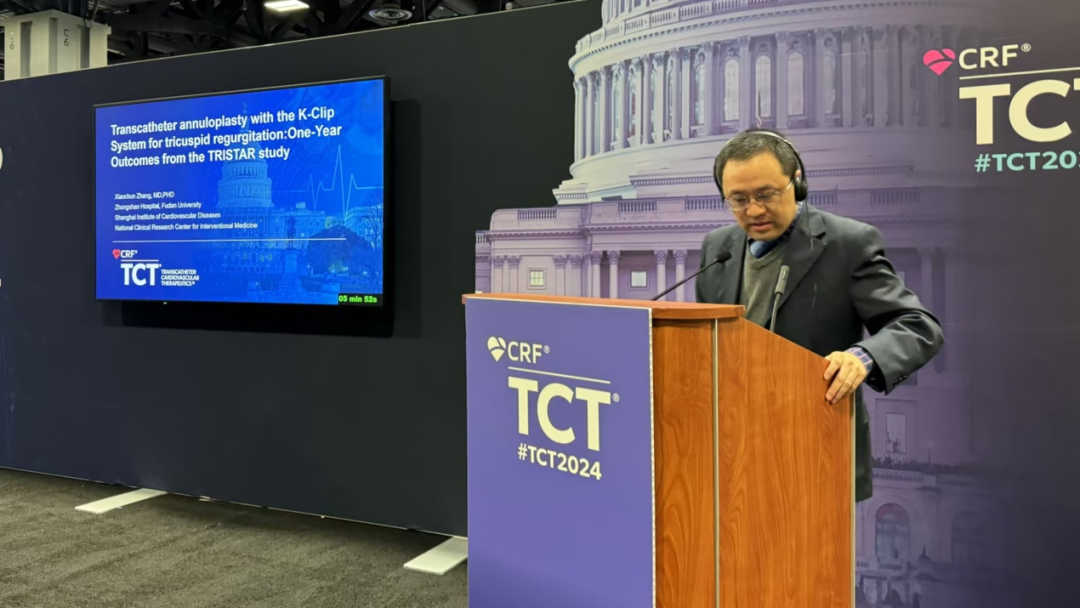
Professor Zhang Xiaochun's On-site Report
Professor Wang Moyang from Professor Wu Yongjian's Team: The TriStar Study Demonstrates K-Clip®Effectiveness and Safety of Transcatheter Tricuspid Annuloplasty System for Treating Severe and Above FTR.Significantly and sustainably reduces the severity of TR. At the 1-year follow-up, significant improvements in right heart remodeling, cardiac function, and health status were observed.
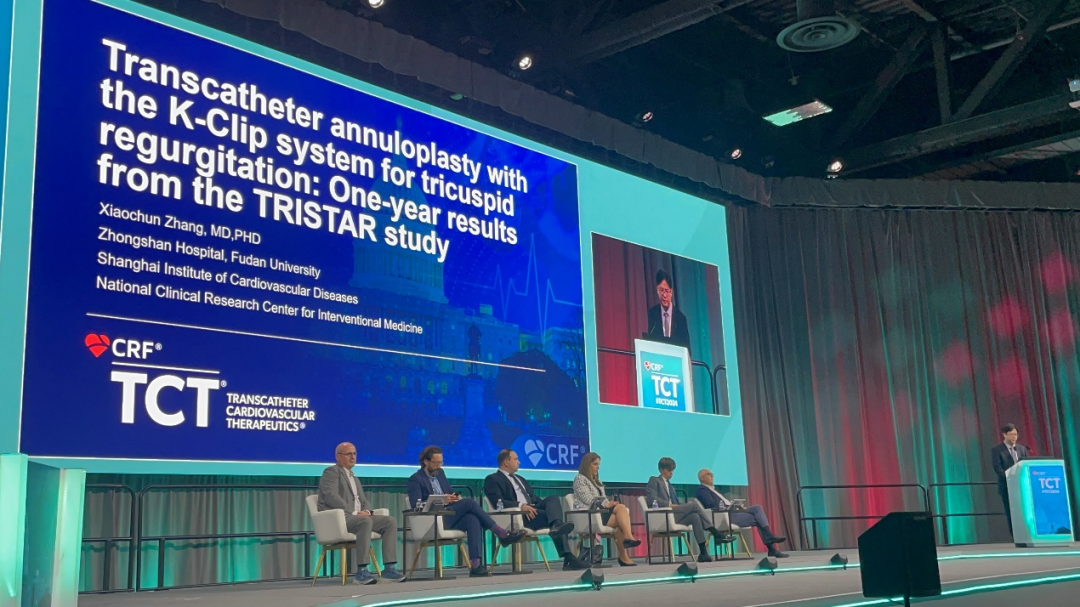
Study Design
The TriStar study, involving 11 renowned valve centers, is a prospective, single-arm, multicenter clinical trial. The inclusion criteria for participants are age ≥60 years, severe or greater secondary tricuspid regurgitation (TR≥4+), high surgical risk, left ventricular ejection fraction (LVEF) ≥30%, and no improvement in symptoms after receiving optimal medical therapy for tricuspid regurgitation for ≥30 days. The primary effectiveness endpoint is a reduction of at least two grades in TR severity at one year post-procedure, while the primary safety endpoint is all-cause mortality at one year post-procedure. Other secondary endpoints include device implantation success rate, echocardiographic parameter results, improvement rate in NYHA functional class, six-minute walk test (6MWD) results, KCCQ score, and the incidence of adverse events (AE) / serious adverse events (SAE).
Research Results
The trial enrolled a total of 96 patients, with an average age of 72.53 ± 4.5 years, and 62.5% were female. The average EuroScore II was 10.35 ± 6.80%, and the mean LVEF was 61.71 ± 6.69%. Atrial fibrillation history was present in 83.33% of the patients. During the procedure, the success rate of device implantation was 97.91%, with an average fluoroscopy time of 23.84 ± 8.17 minutes and an average number of clips used per patient being 1.49. Specifically, 51 patients (54%) received one clip, 40 patients (43%) received two clips, and three patients (3%) received three clips. Regarding the primary efficacy endpoint, at the one-year follow-up post-surgery, TR was reduced to moderate or less in 80% of patients, with 86.52% experiencing at least a two-grade reduction in TR severity, and 95.29% showing at least a one-grade reduction. For secondary endpoints, echocardiographic evaluations at 7 days, 30 days, 6 months, and 1 year post-procedure showed that both the effective regurgitant orifice area (EROA) and regurgitant volume (RVol) across the tricuspid valve significantly decreased from baseline (all P < 0.01), while the lateral and anteroposterior diameters of the tricuspid annulus also significantly reduced from baseline (all P < 0.001). Clinically, significant and sustained improvements were observed at 30 days, 6 months, and 1 year after the surgery. In terms of safety endpoints, the all-cause mortality rate at one year was only 5.21%, and the overall MACCE event rate at one year was 9.38%, with no occurrences of myocardial infarction or reintervention events.
Research Conclusion
TriStar Study Demonstrates K-Clip®Effectiveness and Safety of Transcatheter Tricuspid Annuloplasty System for the Treatment of Severe and Above FTR.Can significantly and continuously reduce the severity of TR. At the 1-year follow-up, significant improvements in right heart remodeling, cardiac function, and health status were observed.。K-Clip®The transcatheter tricuspid annuloplasty system is suitable for severe FTR patients with annular dilation as the main characteristic.The Preferred Treatment Option. Meanwhile, in patients with severe right heart dysfunction, K-Clip®The transcatheter tricuspid annuloplasty system can serve as a "bridging treatment" for TEER or TTVR procedures, preventing the occurrence of acute right heart failure.
· END ·