

GE Healthcare Launches 'ManualGPT'—a ChatGPT-like Large Language Model for Medical Devices

GE Healthcare
Digital Solution Provider
From the clinic to the cloud, large AI models are rapidly penetrating the healthcare field.
The "2023 AI Large Model Industry Research Report in Healthcare" shows that, as of October 2023, the cumulative number of publicly disclosed large models in China has reached 238, among which nearly 50 are in healthcare, covering multiple fields such as patient consultation, physician assistance, drug research and development, and health education.
"This is a huge opportunity," said Huang Feng, Chief Digital Officer of GE Healthcare China, in an interview with several media outlets, including Times Finance. By the end of 2022, a series of large language models appeared, sparking a wave of development in large AI models. According to estimates by Large Model House, the global market size for large AI models is expected to reach $21 billion by 2023 and $109.5 billion by 2028.
During the 7th CIIE, GE Healthcare unveiled its first large language model product, "Ji Yi Da" (ManualGPT), making its global debut. When users encounter equipment usage issues, they can ask the model questions through various methods such as voice, text, or images. It provides quick, precise, and comprehensive answers in text, voice, images, or videos—akin to a ChatGPT for medical devices—helping clinicians quickly get up to speed and promoting efficient operation of medical equipment.
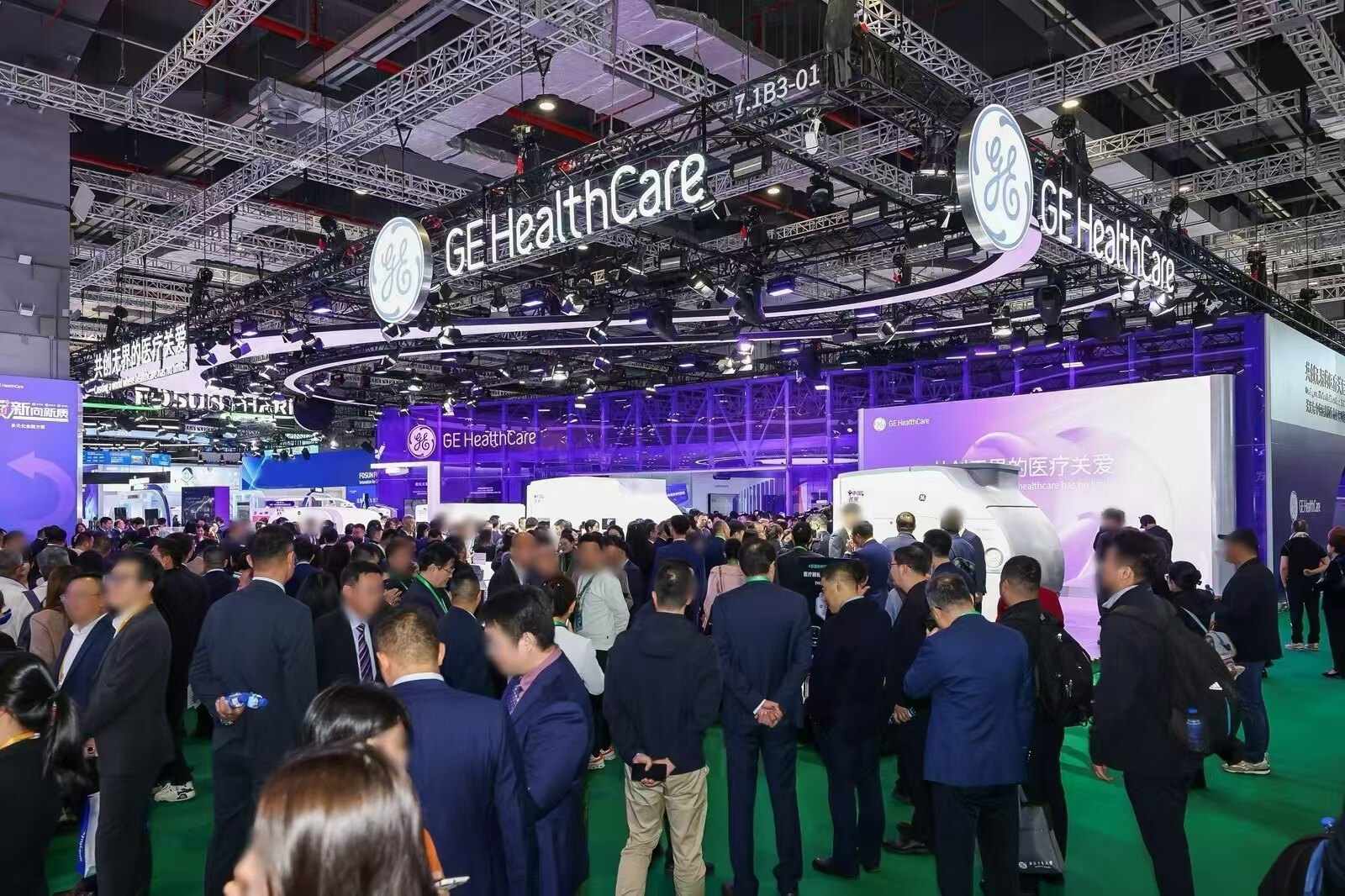 During the 7th CIIE, GE Healthcare unveiled its first large language model product, "Jiyida" (ManualGPT), making its global debut. Image Source: GE Healthcare
Now the application of large AI models in radiology is becoming increasingly common, and radiologists have also indicated that by importing radiological data into large AI models, they are able to reduce the time spent reviewing images.
Moreover, "SkillEase" plays a more refined role in the medical field. When a new device enters a hospital or issues arise during the use of medical equipment, clinical workers need to learn how to operate the device or resolve problems with it. Huang Feng told several media outlets, including Times Finance, that "during the use of medical equipment, device engineers are needed to assist doctors in solving problems, but they may not always be on standby. 'SkillEase' takes on the role of a device engineer, standing by 24/7, ready to provide intelligent, personalized, and comprehensive guidance to users anytime, anywhere, shortening the user's learning curve."
Clinical practitioners are most concerned about accuracy when applying AI. A radiologist told Times Finance that, generally speaking, in terms of writing reports, AI large models are mostly accurate in assisting radiologists to read images. However, if the image quality is poor, the accuracy decreases. Therefore, doctors still need to hold the last line of defense and complete the reading and writing of reports themselves.
Huang Feng explained the accuracy and convenience of this application from the perspective of medical equipment learning. He told Times Finance, "Since it is integrated into a mini-program, this product is very convenient to use. At the same time, this product has a high accuracy rate. During the internal testing process, we found that its accuracy rate reached 92%. It also has intelligent and personalized features, helping medical workers save time." Currently, 'Jiyida' already supports multiple CT, MRI, and ultrasound devices under GE Healthcare.
Players from various fields have successively increased their investments in the large medical model sector. Currently, some products related to large medical models have been applied in multiple hospitals and medical institutions. According to Huang Feng, "Ji Yi Da" is still in the internal testing phase and has not yet been put into use in hospitals. However, he believes that the market scale for this product will be very large, and they will equip every piece of factory-out equipment with "Ji Yi Da." Following the emergence of various medical AI large models, "Ji Yi Da" will transform the working model of medical imaging professionals and turn medical devices into truly intelligent equipment.
Despite the fact that AI technology can bring more convenience to the use of medical devices, it still faces many challenges. Huang Feng told Times Finance, "The biggest problem any artificial intelligence algorithm encounters is definitely data. For us, all our data comes from within GE Healthcare, and this does not involve any patient or user-related information. Since this AI large model pertains to the practical application stage of the equipment, we have little connection with users. The data and experience belong to GE Healthcare as well as the APP teachers and application teachers, with clear and compliant data sources. Aside from data, as a first-release product, we face more challenges from compliance requirements both at the national level and within the company. Large language models must comply with national regulations, and every department will pay attention to this aspect, resulting in a longer approval process."
In recent years, GE Healthcare has been continuously increasing its investment in the AI field. According to GE Healthcare, globally, apart from their own research and development, they are also collaborating with Nvidia or continuously acquiring AI companies, including MIM Software and Intelligent Ultrasound. Currently, GE Healthcare has received FDA approval for 80 artificial intelligence medical devices.
The content on this website (including but not limited to text, images, and audio/video), except for reprints, is copyrighted by Time Online. Without written agreement authorization, reproduction, linking, reposting, or use in other ways is prohibited. Those who violate the above statement will be held legally responsible by this website. For reprinting by other media, websites, or individuals, please contact Mr. Ding of this website: news@time-weekly.com