

Xingyao Kunze's Hepatitis B siRNA Therapy HT-101 Achieves HBsAg Loss with Just Two Doses, Marking a Breakthrough Toward Functional Cure

Hepa Thera
Innovative Drug Developer in the Field of Hepatology

November 10, 2024
eMedClub News
On November 8, Hepa Thera announced further positive news regarding the clinical trial of its siRNA new drug, HT-101. The latest 48-week follow-up data revealed the drug's significant effect in reducing hepatitis B surface antigen (HBsAg) levels, particularly its remarkable performance under low-dose administration.

Trial data show,Most participants in the HT-101 dosing group who were involved in the extended follow-up maintained a significant reduction in HBsAg at 48 weeks.。Particularly noteworthy is that in the 400mg dose group, one subject who received onlyAfter two doses, HBsAg levels continued to decline and were undetectable at 48 weeks,Achieved the clearance of HBsAg。
Currently, the most important drugs in the first-line clinical treatment of chronic hepatitis B are nucleoside analogs, such as Lamivudine, Entecavir, Adefovir, Telbivudine, and Tenofovir Alafenamide. The mechanism of action of this class of drugs is to integrate into the viral DNA via the hepatitis B virus (HBV) reverse transcriptase, causing termination of DNA chain replication, thereby reducing HBV DNA. Although nucleoside analogs can effectively control the condition, they...Once the medication is stopped, the virus may rebound, it cannot clear the virus, and it needs to be taken daily, resulting in poor patient compliance.
The ultimate treatment goal for hepatitis B is to achieve functional cure or even complete cure, but currently, there are no clinical treatments that have reached this goal. There is still a significant unmet clinical need for achieving functional cure of hepatitis B.The emergence of RNA interference (RNAi) technology has provided a new approach for achievingFunctional CureShowing great potential.

2025 (3rd) Biopharmaceutical Innovation Industry Conference
Pre-registration Opened



According to the introduction, HT-101 injection isThe First Chinese-Produced Anti-HBV siRNA to Enter Clinical Stage(small interfering RNA), an innovative GalNAc-conjugated siRNA drug. HT-101 inhibits the formation of hepatitis B virus particles by interfering with the mRNA of the hepatitis B virus, disrupting its function as a post-transcriptional translation template, and preventing the synthesis of related viral proteins, for the treatment of chronic hepatitis B virus infection.
In September 2022, the Investigational New Drug (IND) application for HT-101 to treat chronic hepatitis B virus infection (CHB) was approved by the Center for Drug Evaluation (CDE) of the National Medical Products Administration (NMPA).
In February 2023, Hepa Thera announced the recent completion ofPre-A Round Financing of 100 Million YuanThis round of investors includes Anji Kequan Fund, Suzhou Taihao Venture Capital, and existing shareholder Fosun Pharma's New Drug Innovation Fund. The financing will be used to advance the clinical development of Hepa Thera's two product pipelines, HT-101 (siRNA) and HT-102 (S antigen neutralizing antibody), as well as the early-stage development of several other self-developed products. HT-102 is a neutralizing antibody targeting HBsAg, with its first proposed indication being chronic hepatitis B (CHB), which is expected to achieve better therapeutic effects when used in combination with HT-101.

In May 2023, HT-101 completed the first patient dosing at Beijing Friendship Hospital, Capital Medical University.
In February this year, the clinical trial application for HT-101 was approved by the FDA, allowing the direct initiation of a Phase Ib clinical trial in the United States for chronic hepatitis B virus infection.At that time, Hepa Thera stated that during the Ib phase clinical mid-term investigator meeting, Professor Jidong Jia, Director of the Liver Disease Research Center at Beijing Friendship Hospital, Professor Junchi Niu from the First Hospital of Jilin University, and other well-known experts in China gave high evaluations of the efficacy of HT-101.
In June this year, researchers reported preliminary data from an ongoing Phase Ib, randomized, double-blind, multi-dose escalation clinical study of HT-101 at the 2024 European Association for the Study of the Liver (EASL2024) annual meeting., the study evaluated its safety, tolerability, and antiviral activity in chronic HBV patients treated with nucleos(t)ide reverse transcriptase inhibitors (NRTIs).
The study subjects were chronic hepatitis B patients who had been continuously receiving NRTI treatment for ≥ 6 months, with HT-101 administered via subcutaneous injection. At screening, non-cirrhotic patients (<F3) had HBsAg levels below 5000 IU/ml. Participants received two subcutaneous injections of HT-101, spaced 4 weeks apart, at doses of 50, 100, 200, or 400 mg. At each dose level, 8 participants were randomly assigned to receive either HT-101 or a placebo in a 6:2 ratio. Follow-up lasted 24 weeks after the first dose.
The results showed that 33 patients with chronic hepatitis B (including one early withdrawal) were randomized to receive two doses of HT-101 (50, 100, 200, or 400 mg) or placebo administered 4 weeks apart. To date, all patients have exhibited good safety and tolerability. No subjects discontinued due to adverse events (AEs), and no serious adverse events (SAEs) or deaths have been reported.
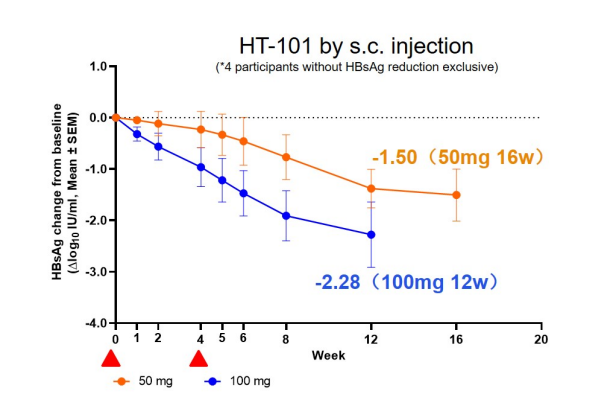
Based on preliminary pharmacodynamic data from the 50 mg and 100 mg cohorts: demographic and baseline characteristics were generally balanced across treatment groups (baseline HBsAg: 50 mg group: 2.85±0.37 log10 IU/ml; 100 mg group: 2.94±0.37 log10 IU/ml). The mean logarithmic reduction in HBsAg levels over time for the 50 mg and 100 mg groups is shown in the figure (excluding four participants with no reduction in HBsAg). Greater HT-101 dosage was associated with a greater decline in HBsAg. In the 100 mg HT-101 group, the mean reduction in HBsAg at week 12 was (2.28±0.64 log10 IU/ml); in the 50 mg group, the mean reduction in HBsAg at week 16 was (1.50±0.51 log10 IU/ml).
Suzhou Hepa Thera Biotech Co., LtdFounded in May 2021, Suzhou Hepa Thera Biotech Co., Ltd is a biotechnology company incubated by Fosun Pharma's New Drug Fund, focusing on the development of innovative drugs in the field of liver disease treatment. Hepa Thera leverages technologies such as RNA interference, antibodies, fusion proteins, and gene editing to address unmet needs in the treatment of hepatitis B, non-alcoholic fatty liver disease, liver fibrosis, cirrhosis, and autoimmune liver diseases. The company collaborates with universities, research institutions, and other biotechnology enterprises, developing products through co-development, contract research, licensing, and independent research. It is expected to become an influential innovative enterprise in China's liver disease treatment sector.
References:
1. Public Information on the Internet


Dian Dian "Share”、“Like" and "In Progress", give me a little recharge~"