Shanghai's First Domestic Brain-Computer Interface Successfully Implanted at Huashan Hospital, Enabling Paralyzed Patient to Get Out of Bed

Neuracle
Developer and Manufacturer of Brain-Computer Interface Systems and Related Equipment

Neuracle Medical Technology (Shanghai) Co., Ltd. has completed the third clinical trial implantation surgery in China, and the first in Shanghai, at Huashan Hospital Affiliated with Fudan University, for the brain-computer interface product NEO, which was co-developed with Professor Hong Bo's team from Tsinghua University's Department of Biomedical Engineering.
NEO's development and type inspection were completed in Shanghai. In August this year, it became the first brain-computer interface product in China to enter the special review process for innovative medical devices. This surgery marked the first human implantation procedure after the product entered the special review process. Currently, the patient who underwent the surgery is recovering well and was able to get out of bed and sit in a wheelchair on the third day after the operation.
In recent years, Shanghai has been actively promoting cutting-edge technological innovation in brain-computer interfaces, nurturing innovative enterprises such as Neuracle, BrainLink, and StepMed. These companies have developed products in invasive and semi-invasive fields respectively. As a leading enterprise in the brain-computer interface industry chain, Neuracle Technology (Shanghai) Co., Ltd. has advanced from non-invasive to semi-invasive technology at the technical level; at the product level, it has expanded from brain science research to clinical diagnosis, treatment, and rehabilitation. In the clinical trial phase of minimally invasive brain-computer interfaces, this company achieved a significant "from 0 to 1" breakthrough, obtained positive clinical outcomes, and passed the special review for innovative medical devices, proving that "minimally invasive implantation" is a safe and effective technical route.
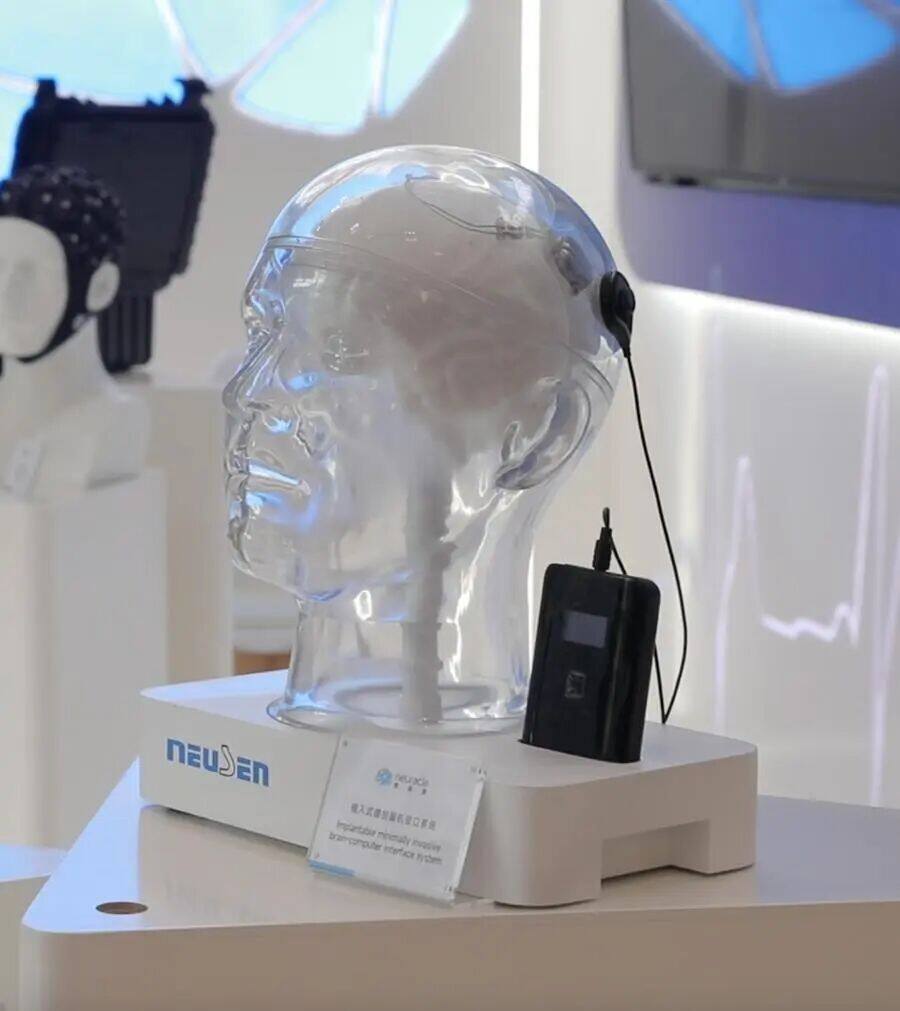
Demonstration Model of NEO Brain-Computer Interface Product Implanted in Human Body
The 38-year-old patient who recently underwent the NEO implant surgery has been paralyzed for four years. A car accident caused his cervical vertebrae to be misaligned, leaving him unable to grasp with his hands or stand. Through a neurosurgical procedure at Huashan Hospital, a coin-sized brain-computer interface (BCI) device was embedded on the exterior of his skull, successfully capturing neural signals from the sensory and motor regions of the patient's brain.
Reportedly, this is the first case in China to complete precise electrode implantation using "somatosensory evoked potential + online high-frequency signal analysis" technology. Neuracle and Huashan Hospital adopted the "online time-domain and spatial-domain brain function localization system," which enabled rapid and accurate localization of the hand's sensory and motor brain areas without waking the patient during surgery. The operation was completed in just 1 hour and 40 minutes, significantly reducing the time and risks associated with similar surgeries.
"The implanted brain-computer interface system adopts a semi-invasive design, with a very small size, only as large as a coin. It is implanted above the skull and beneath the scalp," said Wang Yujing, Product Director of Neuracle. "After the surgery, the medical staff will re-cover the patient’s scalp, and once the hair grows back, the device is almost undetectable."
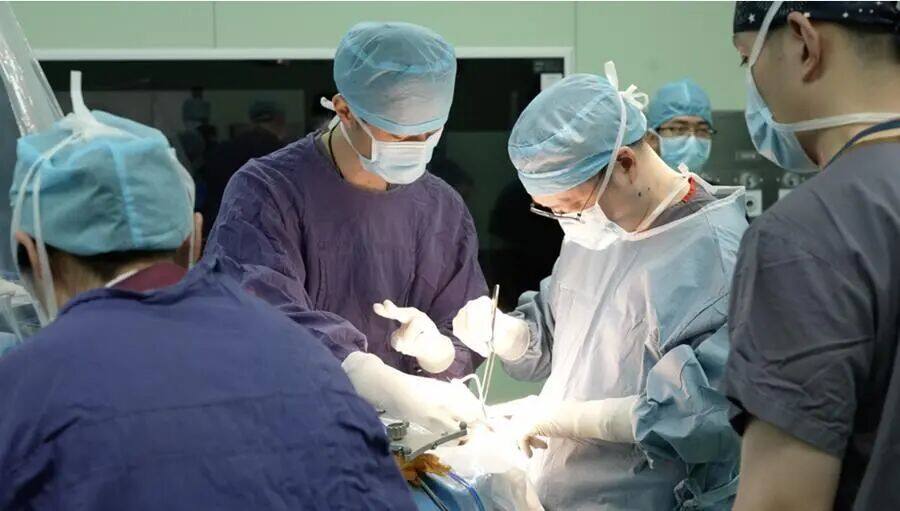
Huashan Hospital Team Conducts the First NEO Clinical Trial Implant Surgery in Shanghai.
This brain-computer interface system relies not only on chips implanted in the human body but also includes an external device. Patients can attach a small magnetic coil to the internal device through the scalp, similar to wirelessly charging a mobile phone. Its functions include power supply, signal transmission, and real-time algorithm updates. This set of external devices also includes a pneumatic glove, which patients can control using brain electrical signals to perform actions such as grasping.
Neuracle founder Xu Honglai told reporters that Shanghai has actively promoted the company’s cooperation with tertiary hospitals, enabling the company to accelerate the verification and optimization of the clinical application of brain-computer interface technology, and to drive the rapid transformation of research results into clinical efficacy. In addition, due to the lack of mature chip solutions for brain-computer interfaces in neural signal acquisition, wireless power supply, and communication links, Neuracle, under the guidance of government departments, plans to collaborate with semiconductor design teams from universities and enterprises in Shanghai. The focus will be on improving system performance from the bottom up and further strengthening the domestic production capability of key technologies in China.
"Our company has just completed the signing of Series D financing, and the clinical trials of brain-computer interface products will be fully launched," said Xu Honglai. Currently, Neuracle is developing higher-density and higher-throughput electrodes to cover a wider range of EEG regions. In the future, the products developed by the company will not only help patients complete basic actions such as drinking and eating but also have the potential to assist them in performing fine motor control tasks like writing and playing musical instruments.
A relevant official from the Shanghai Science and Technology Commission stated that Shanghai will continue to research cutting-edge technological innovation and future industry cultivation plans for brain-computer interfaces. Focusing on invasive and semi-invasive sectors, efforts will prioritize the productization of brain-computer interfaces, the establishment of a common technology R&D service platform, the promotion of clinical trials and application demonstrations, the improvement of product standards and testing systems, and the fostering of an industrial ecosystem. At the same time, support will be given to further enhance the technical level and application scale of non-invasive brain-computer interface products. By 2027, Shanghai aims to be the first in China to achieve clinical applications for locally developed brain-computer interface products, improving the quality of life for patients with paralysis, aphasia, and neurological diseases, while initially forming an innovative ecosystem for this future industry.
Revenue of 14.6 Billion, 341 Units Installed! da Vinci Q2 Wows Wall Street