

Sirrem Medical: Full-Stack Self-Developed Soft Rehabilitation Robots Delivering End-to-End, Multi-Scenario Solutions for Hand Function Impairment

Sirrem
Intelligent Rehabilitation Robot Technology R&D Provider
Soft robots are a new type of flexible robot. As an emerging branch of robotics technology, they can adapt to various unstructured environments and interact with humans more safely.
The uniqueness of soft robots lies in their adoption of innovative drive methods, replacing drive joints or devices built with complex motors, encoders, and sensors. With fully flexible materials, ingenious design, and structure, soft robots achieve functions that traditional robots can only accomplish by integrating numerous components and elements. This soft characteristic not only grants them excellent adaptability but also significantly enhances the comfort and safety of human-robot integration while reducing manufacturing costs to as low as one-tenth or even one-hundredth of traditional exoskeleton rehabilitation robots.
In daily life, the upper limbs of humans undertake more complex and diverse motor tasks than the lower limbs, such as grasping, pinching, and rotating, all of which rely on the flexibility of the hands and the fine manipulation of the fingers. In contrast, the functions of the lower limbs are relatively simple, mainly used for standing, walking, and running, but they are far less sophisticated and complex in motor precision compared to the upper limbs.
The area of the cerebral cortex motor function region occupied by the upper limb function is very large, and the regions for the upper limb and hand in the motor cortex are much larger than those for the lower limb. The upper limb is responsible for fine movements, so it has a relatively larger area in the motor cortex; the lower limb performs gross movements and thus occupies a smaller area in the motor cortex. Therefore, among stroke patients, the proportion of those with upper limb dysfunction is higher than that of patients with lower limb motor dysfunction. Moreover, rehabilitation treatment for the upper limb is more complex and delicate, and the recovery process is slower and more difficult. As a result, the rehabilitation of upper limb function has always been a key and challenging aspect of stroke rehabilitation.
"The hand has many joints, complex nerves, and a delicate structure. Traditional rigid exoskeleton mechanical structures have limited effectiveness in rehabilitation applications. Therefore, we have developed a soft rehabilitation robot with higher adaptability, compliance, better fit, and enhanced safety." Meng Mingqiang, founder of Ningbo Sirrem Medical Technology Co., Ltd. (hereinafter referred to as "Sirrem Medical"), told VCBeat.
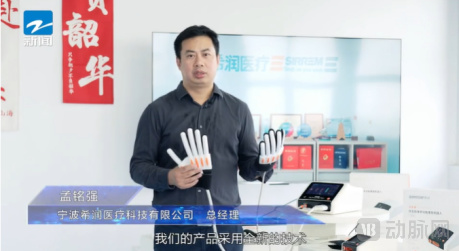
Sirrem General Manager Meng Mingqiang Interviewed by Zhejiang TV News Channel
Sirrem Medical was established in January 2019. Since its inception, it has consistently focused on the field of rehabilitation technology. Relying on the Rehabilitation Robotics Transformation Platform of Shanghai Jiao Tong University, the company is committed to the research and development of rehabilitation robot technology. It aims to create a series of soft rehabilitation robot products and aspires to become the leading Chinese enterprise with the most comprehensive product line and best efficacy in hand-function rehabilitation robots. The company's products have more than forty patents and have obtained medical device registrations from China's NMPA, the EU CE, and the US FDA.
Earlier this year, Sirrem completed a Pre-A round of financing worth tens of millions of yuan, jointly invested by Ningbo Fuchuang Venture Capital Fund and Ningbo Angel Fund. Subsequently, in September, the company obtained a Class II medical device registration certificate (Shanghai Medical Device Registration No. 20242190299) for hand function rehabilitation training equipment issued by the Shanghai Municipal Drug Administration.
At the beginning of this year, in the 12th China Innovation and Entrepreneurship Competition AIGC Healthcare Professional Competition, Sirrem won the Outstanding Enterprise Award with its "Hand Function Soft Rehabilitation Robot Project."
Independent and controllable structural design, production process materials, and software control,
Achieving Full-stack Self-developed Soft Rehabilitation Robot for Hand Function
Soft robots have various driving methods, including pneumatic, hydraulic elastic actuation, shape memory alloy actuation, tendon-driven actuation, pneumatic-electric combination, and more. After multiple attempts, Sirrem ultimately chose pneumatic (gas-driven) as the core driving method.
Meng Mingqiang, the founder, told VCBeat that Sirrem initially also experimented with drive solutions such as traction line drives, but these presented issues like rope slack and high maintenance costs. By comparison, pneumatic technology is not only mature and reliable, but it also truly achieves complete flexibility. Additionally, pneumatics are easy to modularize and can be combined freely — for example, one actuator can simultaneously drive multiple joints, greatly improving system flexibility and efficiency. Moreover, pneumatics use compressed air as a power source, producing no pollution, making it cleaner compared to hydraulic and other drive methods.
The core technology of soft robotics can be roughly divided into three parts: structural design, processing technology, and software algorithms. In the early stage of project establishment, Sirrem closely collaborated with universities and clinical institutions to deeply explore clinical needs. Through innovative structural design, they achieved a higher degree of finger conformity, enabling precise control of finger movements to complete desired actions. This design balances bending angle and bending force, with the fingertip bending force reaching over 7-8N and the finger bending range covering 0 to 270 degrees, effectively meeting the requirements for hand function rehabilitation.
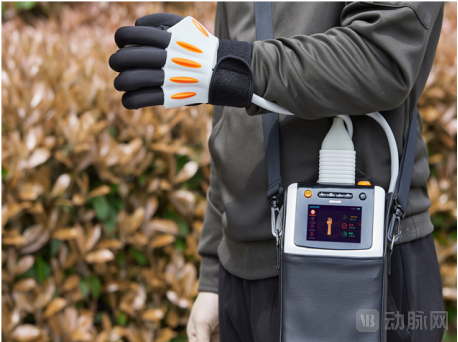
Sirrem's Hand Function Soft Rehabilitation Robot, image from the company's official website
In addition, Sirrem has also adopted a modular design. This design not only facilitates subsequent expansion to a full-body rehabilitation product line, achieving coordinated rehabilitation for the ankle, wrist, and other parts, but is also easy to disassemble and assemble. The quick-connect interface design it uses also makes operation more convenient.
As soft robotics has not been developed in China for a long time and the overall technology is still in an emerging stage, there are many challenges in materials and processing techniques. Sirrem has successfully overcome these difficulties with its capability of full-process independent manufacturing.
In terms of software, Sirrem has developed a feedback control algorithm for hand bones based on anatomy, using motion capture technology to achieve precise motion control and fine motor movement of the finger sleeves. This enables multi-mode rehabilitation training for patients' finger fine motor skills, including AI rehabilitation assessment, CPM passive rehabilitation, ART resistance rehabilitation, MT master-slave (mirror) rehabilitation, and BFT biofeedback rehabilitation.
Taking the mirror rehabilitation model as an example, Sirrem uses high-precision gyroscopes to accurately identify gestures on the affected side. Each finger is equipped with a high-precision nine-axis gyroscope to capture the movement, posture, and angle of the fingers, helping the affected limb perform precise mirror rehabilitation training for better recovery outcomes.
Given the varying lengths, thicknesses, and degrees of functional impairment in each patient's fingers, Sirrem Medical leverages the soft characteristics of soft robotics and its full-stack self-research capabilities to continuously iterate on the glove’s size and detailed design based on clinical application feedback. The company has now launched five gloves in different sizes, aiming to meet the needs of different patients and thereby assist them in achieving better rehabilitation outcomes.
Sirrem stands out in the field of soft rehabilitation robots in China with its full-chain independent and controllable capabilities ranging from structural design, production processes to software control.
"The golden period for rehabilitation usually lasts from half a year to a year, and just one or two weeks of treatment in the hospital is not enough. To achieve better rehabilitation outcomes, patients need to maintain regular rehabilitation training even after discharge," added Meng Mingqiang. Stroke patients typically receive rehabilitation treatment in the hospital during the acute phase, which is within 1-2 weeks after onset. As patients enter the later stages of recovery or the sequela stage, rehabilitation treatment is more often carried out in community or home settings.
To meet the needs of different rehabilitation cycles and scenarios, Sirrem has launched three major series: the flagship medical version, professional rehabilitation version, and portable rehabilitation version, covering more than ten models with prices ranging from a few thousand to hundreds of thousands of yuan. These can meet the full-scene rehabilitation needs of hospitals, communities, and families, helping patients seize the "golden period" of rehabilitation.
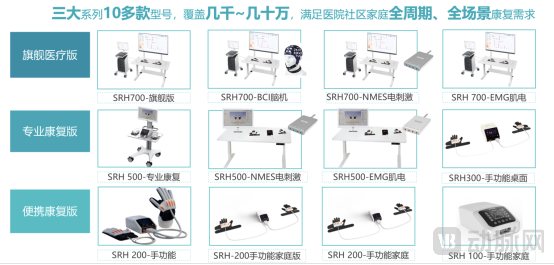
So, what are the differences among the three types of hand function soft rehabilitation robots designed for hospitals, communities, and homes?
Meng Mingqiang told VCBeat that the three products all integrate the latest rehabilitation theories, concepts, and functions, but each has its own focus. The hospital version emphasizes comprehensiveness and superior performance, incorporating professional functions such as EMG, electrical stimulation, and brain-computer interface. The community version focuses more on balancing functionality with ease of use, while the home version highlights portability, user-friendliness, and cost-effectiveness.
Currently, Sirrem's products have obtained medical device registration certificates from China's NMPA, the EU CE, and the US FDA. Relevant products have also been clinically used in over 20 hospitals in Shanghai, receiving unanimous praise from doctors and patients. According to previous disclosures, Sirrem conducted clinical trials in hospitals, where patients' hand function scores improved by an average of 30% over five weeks.
In terms of commercialization, Sirrem has reached cooperation with well-known domestic enterprises such as Sinopharm Group. Its products are exported to various regions, including Thailand, Singapore, South Korea, the Middle East, and Europe.
Next, the company will continue to advance deeply in soft robotics, making more explorations, optimizations, and improvements in terms of structure, technology, and materials. As related products are expected to be approved successively next year, Sirrem is poised to become a leading brand in hand-function soft rehabilitation robots in China.
Looking ahead, the hand-function soft rehabilitation robot is only the first step in Sirrem's long journey. Sirrem will continue to deepen its product layout, aiming to expand soft rehabilitation robot technology to the rehabilitation of multiple joints such as the wrist, ankle, knee, elbow, and even the entire body, to meet the diverse needs of patients with a more comprehensive product line.